
Steam Cleaning vs Encapsulation: Which Is Right for Your Business?
Steam cleaning versus encapsulation for Perth commercial carpets: what each one does at fibre level, real dry times, costs over a year, and how to choose.
Read ArticleHow Perth hotels, function centres, clubs and churches schedule carpet cleaning around a full events diary, in the gap between one event and the next.
In an office, the hard question about carpet cleaning is what method suits the fibre and the soil. In a hotel or function centre we still recommend the method at the inspection. The harder question is when the work fits, how long it takes and what has to be back in service by morning.
A venue does not have downtime. It has gaps: the four hours between a bump-out and a delivery, the Tuesday when the ballroom is dark, the fortnight in July when occupancy dips. Carpet care in this sector is the work of fitting a method into a gap that already exists, rather than asking the building to create one.
That changes what a good contractor looks like. Technical skill is the entry ticket. What a duty manager needs is somebody who reads a run sheet, knows what a bump-in is, and will not still be pulling hose across a lobby when a wedding party arrives to inspect. This article is about the logistics rather than the chemistry. The commercial side of it, how a venue floor gets scoped and priced, sits on our hotel and accommodation carpet cleaning page.
Venues are unusual in that one building contains half a dozen genuinely different carpet problems, each with its own soiling rate, acceptable downtime and method. Price the whole place as one line and the schedule that falls out of it is wrong in both directions at once: the quiet areas are attended to more often than they need, and the ones guests actually form a view about are attended to less.
So the first task is to stand in each carpeted space in turn and write down what it is genuinely dealing with:
Function-room carpet lives a strange life. It can sit untouched for four days and then take a hammering in a single evening. Three hundred people, a plated dinner, a bar service and a bump-out crew will do more to a floor between six and midnight than a corridor sees in a season.
The damage arrives in several forms at once. Red wine and beer go down and get walked in before anyone finds them. Dropped food is ground into the pile by dancing. Chair drag scars the fibre along the tip lines where the legs pivot. Staging, lecterns and audiovisual flight cases roll across on hard castors, crushing pile in straight lines that show whenever light falls low across the floor.
The dance floor edge is its own problem: a band of carpet that catches everything spilled at the edge of the crowd and takes the most enthusiastic foot traffic in the room. Bump-in and bump-out trolleys then run the same route from the loading door every event, so a lane deepens whether the room is used lightly or heavily. The consequence is that function-room carpet cannot be scheduled by the calendar. It has to be scheduled by what has been booked into it.
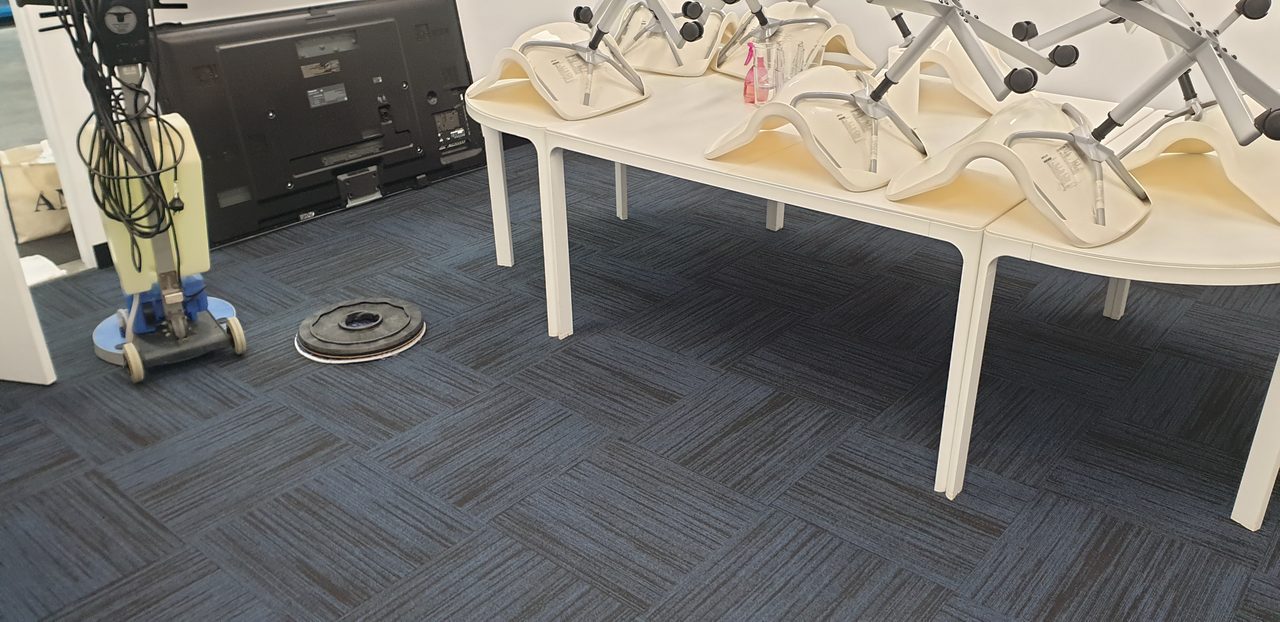
Ask a venue what they need from a carpet cleaner and the answer is rarely about appearance. It is whether the room can be re-set for a 7am delivery. Drying time stops being a technical footnote and becomes the primary planning variable.
Perth winter tightens that window. Cool, humid July nights slow evaporation considerably against a dry February evening, and a sealed function room with the air conditioning shut down overnight holds moisture far longer. If we work through winter we ask for the air handling to stay on, bring air movers, or choose a lower-moisture method. A room is never handed back with damp still sitting under the chair legs at set-up, and where the window on offer cannot deliver that, it gets said when the job is booked rather than at seven the next morning. What actually governs a drying time is worth understanding before you agree to a window.
The room's soil decides the method at our inspection. Your release time decides which night it fits.
Encapsulation is our low-moisture clean for venue carpet that is lightly soiled. Its detergent is worked into the pile, coats the soil near the tips and dries to brittle crystals that the vacuum lifts out, leaving nothing behind in the fibre. Very little water goes down, so the room is walkable an hour or two after we finish. How encapsulation works in detail is set out separately.
Where our inspection finds light soil, it suits corridors, lift lobbies, pre-function spaces and meeting rooms. A lightly used function room cleaned this way after a bump-out is ready for a morning re-set.
A polymer is worked into the pile with very little water.
The polymer wraps the soil it can reach in the fibre.
The crystals form as the carpet dries, which is quick because so little water went into it.
The brittle crystals release on later vacuuming and take the soil with them.
What encapsulation cannot do is remove what has soaked below the surface, because it only works on the soil the polymer can reach. A ballroom carrying three years of spilled drinks, or a lobby holding deep grit, needs truck-mounted hot water extraction to flush the fibre down to the backing and pull the residue out. A ballroom with heavy soil or a spread of different stains needs that deeper clean, every stain pre-treated before the rinse. The room's inspection settles which method it gets.
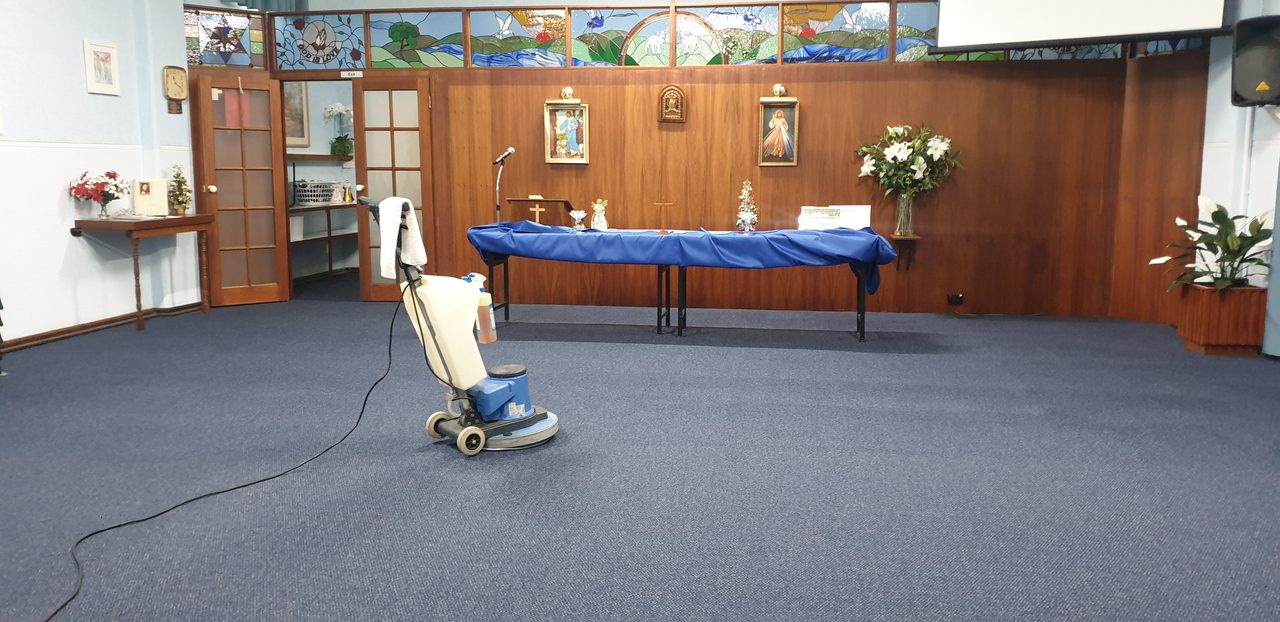
The failure mode in venues is not neglect, it is bunching. Someone books a big annual clean, the whole site is done in one week, and eleven months pass while the lobby quietly deteriorates and the rarely used board room stays immaculate.
A rolling schedule treats each zone on its own. Every zone in a venue should be cleaned by a professional at least yearly, in our advice. The lobby and lift lobbies usually need more, because grit and footfall concentrate there. You decide the dates. When we visit the site, free of charge, we suggest how often each zone needs us.
| Zone | How often | What drives it |
|---|---|---|
| Lobby and lift lobbies | More often than once a year, set by footfall | Grit, sand and moisture off the forecourt |
| Corridors | At least once a year, more often on busy floors | Steady soiling with a centre traffic lane |
| Function rooms | Against event volume, not dates | Episodic soil tied to the last event |
| Guest rooms | In blocks, a floor or wing at a time | Light soil; access is the constraint |
| Back of house | Set by how much soil it feeds forward | Feeds soil into every guest area |
Decoupled cycles stop the whole site being cleaned in one week and then left for eleven months.
Function rooms are then cleaned against event volume rather than dates. Guest rooms move through the building in blocks. Back of house is booked on its own timing, because it feeds soil into everywhere else.
The advantage is not only appearance. A rolling schedule spreads spend evenly across the financial year instead of creating one large invoice, which makes the maintenance line predictable when budgets are set. It also means no surprise inspection, corporate site visit or last-minute wedding walk-through ever catches a zone at its worst.
Guest-room carpet is a volume problem rather than a difficulty problem. The soil is light, the rooms are small, each one straightforward. The challenge is getting access to enough of them at once to justify the mobilisation, without taking sellable rooms out of inventory.
The method is to work in blocks. A floor or a wing at a time, coordinated with housekeeping so the block is already out of service for linen or minor maintenance, lets us set up once and work through efficiently. Scattered single rooms across five levels cost far more per room in set-up and hose runs than they should.
Perth gives you natural windows. Mid-week troughs, the quieter stretches between the summer visitor season and the winter conference calendar, and school-term periods all create blocks of low occupancy. Plan against the shoulder season deliberately: agree in advance that a wing is done whenever forecast occupancy falls below a threshold, and the work happens without a decision being made under pressure. Those rooms also get generous drying time, which matters in winter.
The most useful thing a venue can give a carpet cleaner is sight of the events diary a few weeks out. From a run sheet we can tell which rooms will need serious attention, where a bump-out will finish, and which nights are genuinely available.
On the night, the duty manager has the final say. Plans made a fortnight earlier collapse when a function runs late, a bump-out crew is short-handed or a room is resold. A contractor who checks in on arrival, confirms the room is genuinely released and adapts when it is not is worth more than one who starts at the agreed time regardless.
A few habits make the relationship work:
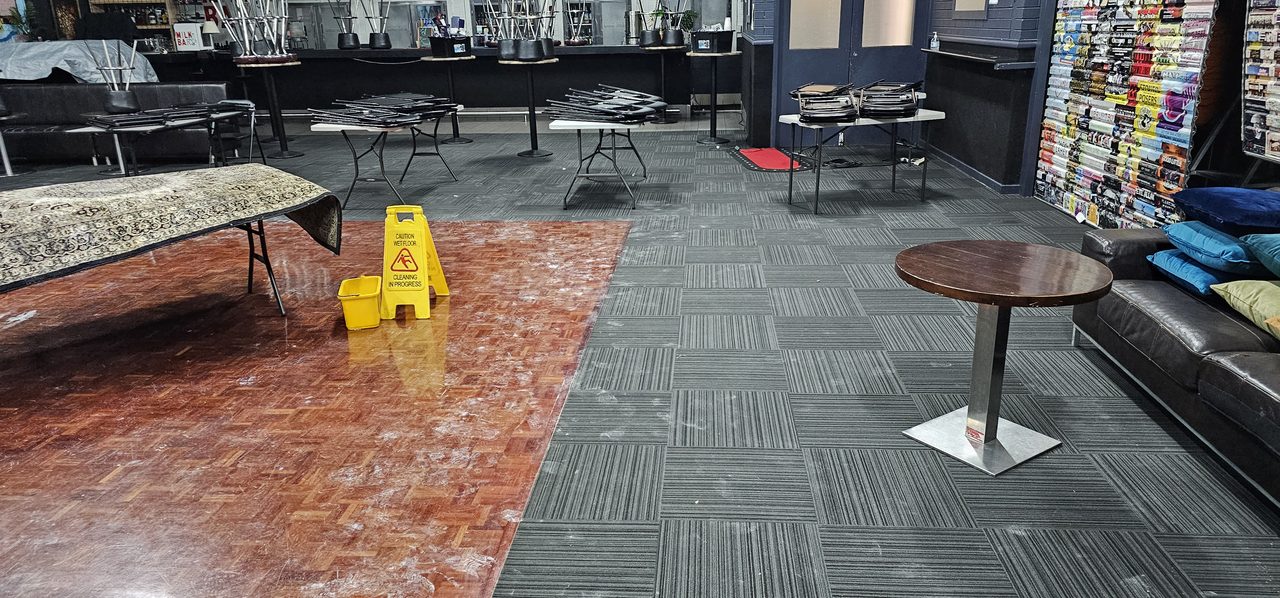
A hotel is never empty. Even at 2am there are guests asleep on the other side of a corridor wall, and a truck-mount at the loading dock with a vacuum head working outside a room door is not a quiet operation.
Hose runs need planning before the first length comes off the reel. That means where the truck can park, which rooms the hose reaches, how it crosses corridors without becoming a trip hazard and which doors need propping. Floors beyond its reach are cleaned with portable equipment brought up in the service lift. In a tower or a multi-level hotel that route decides how much of the building we reach in a night, and it is worth walking once in daylight rather than improvising at midnight.
Lift protection matters too. Portable machines riding the lift are padded so they never mark its walls or doors. Lift carpet is a small, high-value piece of floor that shows every mark. We use service lifts and back-of-house routes wherever the building allows. Where the carpet is lightly soiled, encapsulation is also quieter and needs no hose run at all.
The most common venue carpet problem is not a dirty floor. It is a single conspicuous mark in a room with a client inspection in three days: wine in the middle of a ballroom, coffee outside a boardroom, a grease trail where a bain-marie was wheeled through.
This is why we suggest a standing spot-response arrangement rather than a fresh enquiry each time. The venue keeps a list of what was found after each event, and we attend within the week to deal with it as a batch. It costs far less than emergency call-outs and stops small marks setting while somebody works out who approves the job.
The most common venue carpet problem is not a dirty floor, it is a single conspicuous mark in a room with a client inspection in three days.
Speed matters chemically as well as commercially. A mark treated in the same week is still sitting more or less where it landed. One left for a month is bonded, oxidised and has been walked through several hundred times. A same-week response means marks get handled in the easy phase, which quietly reduces how many areas eventually need aggressive treatment or replacement.
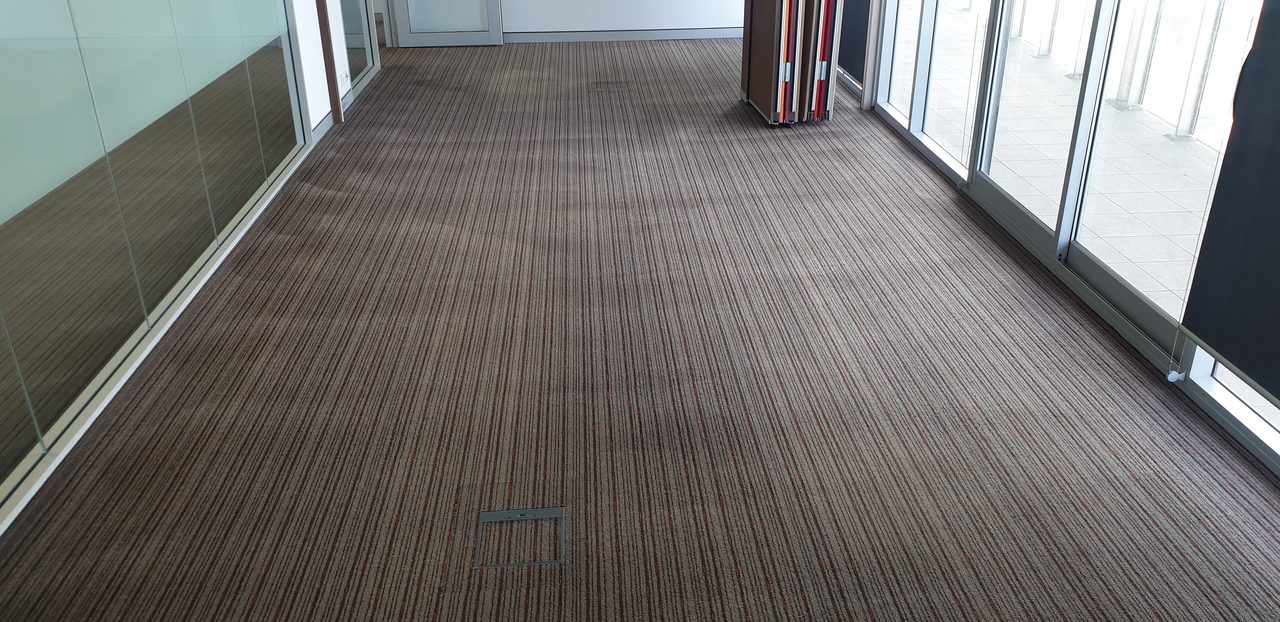
Function staff are always the first responders, and what they do in the first two minutes usually decides whether we can remove a spill later. The most useful thing a venue can do is train the floor team in a short, specific routine and stock the trolleys for it.
For red wine: blot, never rub, working from the outside of the spill inwards with a clean white cloth so the mark is not spread and the pile is not distorted. Cool water on the cloth, not poured onto the carpet. No hot water, which can set some pigments, and no coloured cloths, which transfer dye. Above all, no supermarket spot spray, because the residue is sticky, attracts soil and can leave a shadow harder to remove than the wine.
Two habits are worth building in. Mark the spot with a chair or a note so it can be found when the room is empty and the lighting is different, and record it so the morning report tells us where to go.
Other high-risk spills follow the same principle:
The first fifteen metres of a venue does more selling than any brochure. A guest arriving off the porte-cochere with luggage, or a couple walking in to inspect a room for a wedding, forms a judgement about the whole building from the entry carpet before anyone speaks. A dulled track between the entrance and the reception desk reads as a tired building, whatever the standard of the rooms upstairs.
That lane is not dirt in the ordinary sense. It is fine grit and sand walked into the base of the pile, where it abrades fibre and scatters light differently from the carpet around it. Vacuuming will not lift it, and it keeps darkening until it is flushed out. Perth accelerates this: coastal venues take sand year round, summer easterlies carry fine red dust, and buildings near construction pick up pale, abrasive limestone dust.
Sales-critical space often justifies more cleaning than its soil alone would. Many venues have the lobby cleaned more often than the corridors, not because it gets dirtier, but because it is under constant inspection by people who have not made up their minds yet.
Venue carpet work in Perth is after-hours work, and mostly weekend work. Functions run Friday and Saturday nights, so the carpet that most needs attention becomes available precisely when most trades have closed their diaries. Ask about weekend availability before you book anyone. We work seven days at the hours your bookings leave free, so a ballroom can be cleaned on a Sunday between two weddings.
Theatre and auditorium carpet is a related discipline we know from our work on the theatre carpets of a Fremantle cinema. Sloped floors, fixed seating, a narrow aisle carrying every foot in the room, and food and drink dropped in the dark produce soiling that is concentrated, sticky and hard to reach. The access constraint is the same as a function room: the work happens between the last session and the first.
Church and community venues run the same logic on a different diary. A church foyer takes heavy use over a few hours on a Sunday, plus weddings and funerals through the week. The whole congregation crosses a small area of carpet. The workable window is a weekday, booked around the events calendar just as a hotel ballroom is. We clean venues across the metro area, from Joondalup to Fremantle.
If you manage a venue and want this on a proper footing, the work is mostly done once and then maintained. Map the zones and decide how often each one needs a clean, based on what the area actually takes rather than what is convenient. Once a year is the least we advise for any zone in a venue. We suggest the rest at the free site visit. Then lay those cycles against the year and look for the collisions with your peak season, because that is where a schedule fails.
Next, identify the fixed opportunities: dark days, maintenance closures, low-occupancy stretches, the week after your busiest conference period. Book the heavier cleans into those windows well ahead, because those are the times a deep clean fits comfortably. Lightly soiled areas and spot work fit into the gaps as they appear, with the method recommended at our inspection.
Then put two agreements in place. One is the standing spot-response arrangement, so post-event marks are handled within the week without fresh approval each time. The other is a simple record of what was cleaned, when and by which method, which gives you evidence at budget time and shows which zones consume the most attention.
One caution about the plan itself. Every venue schedule we have watched fail did so the same way: it was built in a quiet month and then never read again. Occupancy patterns move, a new function manager sells the ballroom harder than the last one did, a refurbished wing stops being the cheap rooms. Put a date in the diary once a year to lay the cycles back over what the building actually did, because a schedule that no longer matches the trading year is worse than having none at all. It gives everybody the comfortable feeling that the floor is being looked after.
Steam cleaning versus encapsulation for Perth commercial carpets: what each one does at fibre level, real dry times, costs over a year, and how to choose.
Read ArticleHow to set commercial carpet cleaning frequency by zone, traffic and sector, and build a Perth maintenance schedule that protects the carpet.
Read ArticleA practical guide to office carpet stains for Perth facility managers, with first aid for every spill, the right fix for each stain and when to call us.
Read Article