
Encapsulation Carpet Cleaning: The Low-Moisture Method Perth Offices Rely On
How encapsulation polymers trap soil, why the vacuum finishes the job, what each machine does, and where low-moisture cleaning fits a Perth office.
Read ArticleWhat happens during hot water extraction: the four levers, pre-spray and dwell, wand technique, truck mount or portable, and what only a flush lifts.
Ask ten Perth building managers what a deep carpet clean is called and most will say steam cleaning. The name has been on vans, invoices and signage for half a century and it is not going anywhere, but it is worth being precise about what actually happens. The method is hot water extraction, and the thing doing the work is hot liquid water, not steam. Water leaves the machine at somewhere between sixty and ninety degrees, is driven into the pile through spray jets, and is pulled straight back out by a powerful vacuum, taking the dissolved and loosened soil with it.
The wisp of vapour you see rising from the wand on a cold morning is real, but it is a by-product, not the mechanism. Steam proper, water as a gas, carries almost no mass and cannot rinse anything. Cleaning needs liquid water, because liquid water does two jobs at once: it is the solvent that dissolves and suspends soil, and it is the carrier that transports that soil out of the building through a hose.
The distinction is more than pedantry. Once you see the method as a controlled flush, chemistry in, soil out, moisture managed at every step, everything else about it makes sense: why the preparation takes as long as the extraction, why the machine matters, and why drying time is a decision rather than an accident. This article walks through that flush from the moment the van parks to the moment the carpet is dry.
Cleaning technicians are trained to think of every clean as a budget spread across four levers: temperature, agitation, chemistry and time. The levers are interchangeable up to a point. Pull harder on one and you can ease off another, and the craft of the trade is choosing the mix that fits the fibre and the soil in front of you rather than applying one recipe to every floor.
| Lever | What it contributes | The cost of leaning on it too hard |
|---|---|---|
| Heat | Speeds every cleaning reaction and softens greasy soil | Can set protein stains and distress wool |
| Chemistry | Breaks the bond between soil and fibre | Residue, if over-applied or poorly rinsed |
| Agitation | Distributes product and reaches the base of the tuft | Pile distortion on delicate or loop constructions |
| Time (dwell) | Lets the chemistry finish before the rinse | The schedule is finite; dwell cannot stretch forever |
Ease off one lever and another must work harder. The mix is chosen per floor, not per brochure.
Heat is the lever hot water extraction owns. A rule of thumb the industry has used for decades is that every ten-degree rise in temperature roughly doubles the speed of a cleaning reaction, which is why water arriving at the fibre hot achieves in seconds what cold water manages slowly or not at all. Hot water softens greasy films, keeps lifted oils suspended instead of letting them settle back, and allows milder chemistry to do the same work, which matters on fibres that resent aggressive products.
The levers also trade against the building, not just the carpet. Wool wants lower temperatures and gentler chemistry, so agitation and dwell must make up the difference, which is why wool work is a discipline of its own. A tenancy that can only give you two hours after close limits time, so heat and agitation carry more of the load. Two cleans can look identical from the doorway and be entirely different decisions underneath.
The most important minutes of an extraction clean happen before the wand comes off the van. The first step is thorough dry vacuuming, because Perth carpet holds a remarkable amount of dry particulate, coastal sand from one direction and red dust off the easterly from the other, and dry soil should leave the building mechanically rather than being turned into a wet paste. Then comes the pre-spray: a cleaning solution applied evenly across the whole area, chosen for the fibre and the soil load, and left to work.
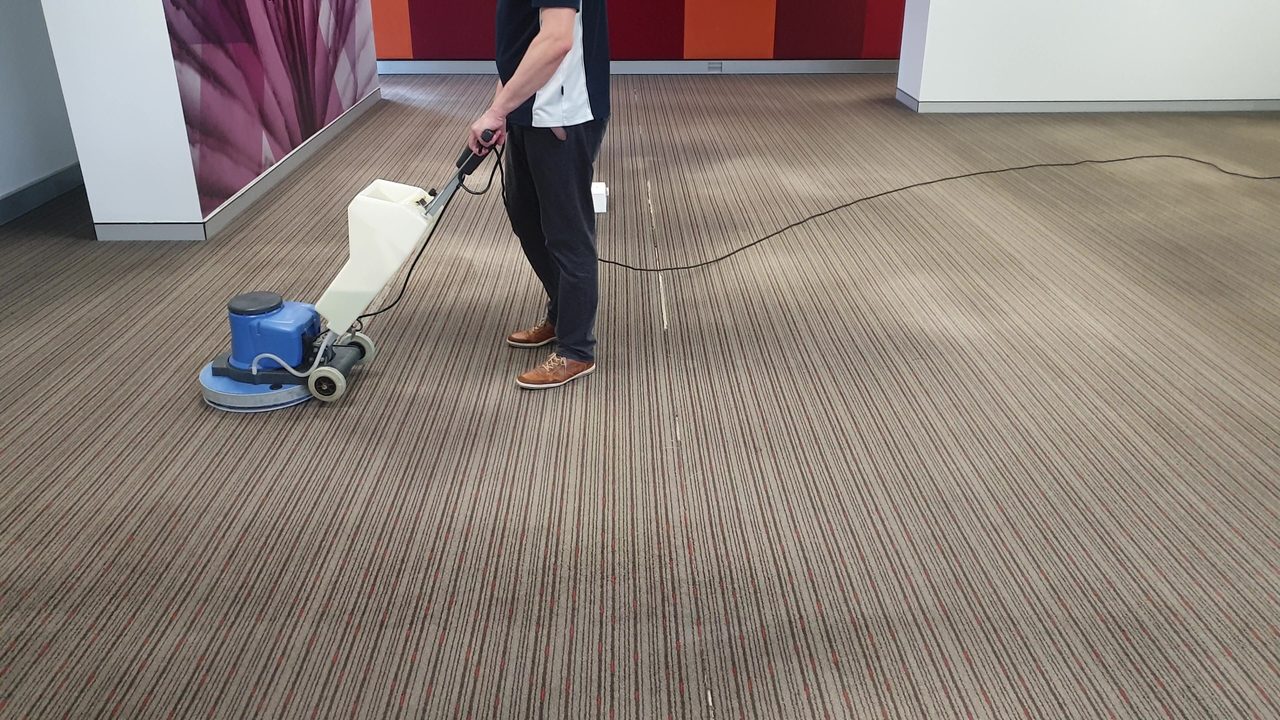
That waiting period is called dwell, and it is where the actual chemistry happens, typically ten to fifteen minutes. Surfactants wet the soil and creep beneath it, the solution swells and softens the greasy films that bind dirt to fibre, and the bond quietly breaks. We agitate the pre-spray in with a counter-rotating brush machine so it reaches the base of the tuft instead of sitting on the tips. A cleaner who skips dwell is asking the rinse to do the chemistry's job, and the rinse cannot.
Sand, grit and dust are lifted out mechanically while they are still dry and willing to leave.
A solution matched to the fibre and soil is applied evenly across the whole area.
Ten to fifteen minutes for the surfactants to break the bond between soil and fibre.
Counter-rotating brushes work the solution down to the base of the tuft.
Only now does the wand arrive, to flush out what the chemistry has already loosened.
The wand then rinses with hot water, usually carrying a mild acidic rinse agent that neutralises the alkaline pre-spray as it goes. The point of that pairing is what stays behind: almost nothing. The pile is left close to neutral, with no sticky detergent film for next week's foot traffic to press soil into, which is a large part of why a properly extracted carpet re-soils slowly.
It helps to be clear about the enemy. A vacuum cleaner, even a good one, removes loose dry particles and nothing else. What defeats it is grease: skin oils from hands and feet, cooking aerosols drifting from the kitchenette, tyre and bitumen residues walked in from the car park, spilt coffee with its milk fats. Together these form a thin bonded film through the traffic lanes that glues fresh dry soil to the fibre, and no amount of suction removes a glued particle.
The pre-spray's answer is emulsification. Surfactant molecules have one end that clings to water and one end that clings to oil, so they surround an oily deposit, break it into microscopic droplets and hold those droplets suspended in the wash water, the same mechanism that lets dish detergent lift fat from a roasting pan. Once emulsified, the greasy film stops being a coating and becomes cargo, and cargo is exactly what the extraction stage is built to carry away.
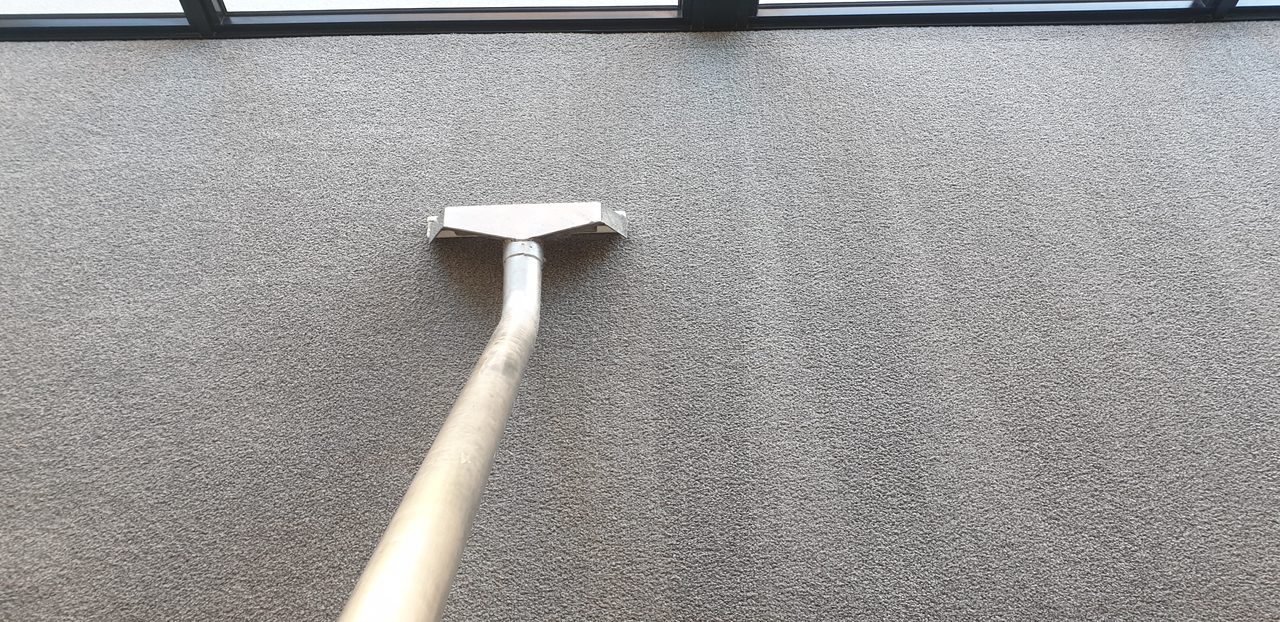
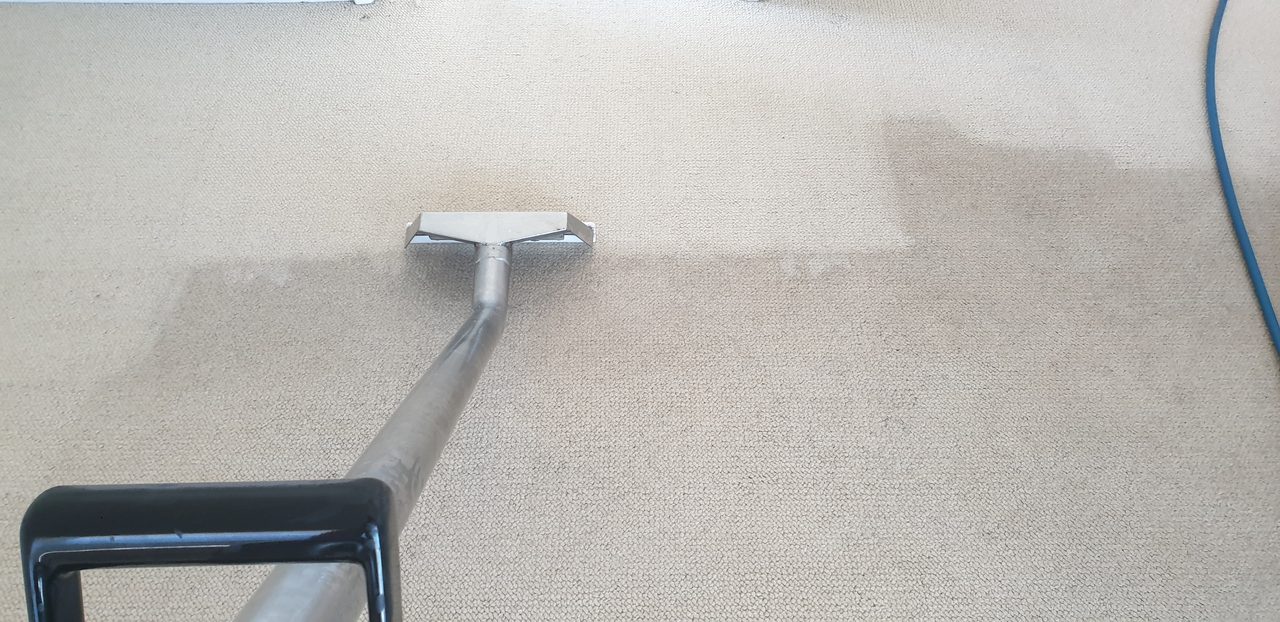
The wand itself is a simple instrument doing two jobs at once. Squeeze the trigger and spray jets inject hot solution deep into the pile; a few centimetres behind them, a vacuum slot pulls it back out. A wet stroke is that combination in a single slow pass, and slow is the operative word. The vacuum can only recover water it spends time over, so unhurried, overlapping strokes recover far more than fast ones covering the same ground.
Dry strokes follow: the trigger stays closed and the wand makes vacuum-only passes over the same ground, each one drawing more moisture from the pile. They are the least glamorous part of the job and the most commonly skipped, because from the doorway it looks as though nothing is happening. What they actually control is everything that comes afterwards: how many hours the carpet takes to dry, and whether marks wick back up the fibre as it does.
There is a rhythm to a floor done properly: working in lanes away from the exit, each stroke overlapping the last, wet passes then dry passes, the tone of the vacuum changing as the pile gives up its water. A full tenancy takes hours, not minutes. Extraction done at speed does not fail on the day; it fails that evening, as a floor that should have been dry stays damp into the night.
Two families of machine do this work, and the difference is worth understanding before you book. A truck-mounted unit keeps everything heavy in the van: a dedicated engine drives the vacuum blower, the pump and the heater, and only the hoses and the wand enter your building. Heat at the wand stays high all day, the vacuum has genuine lift even over long hose runs, and every litre of dirty water goes straight to a recovery tank in the van rather than being handled inside your premises.
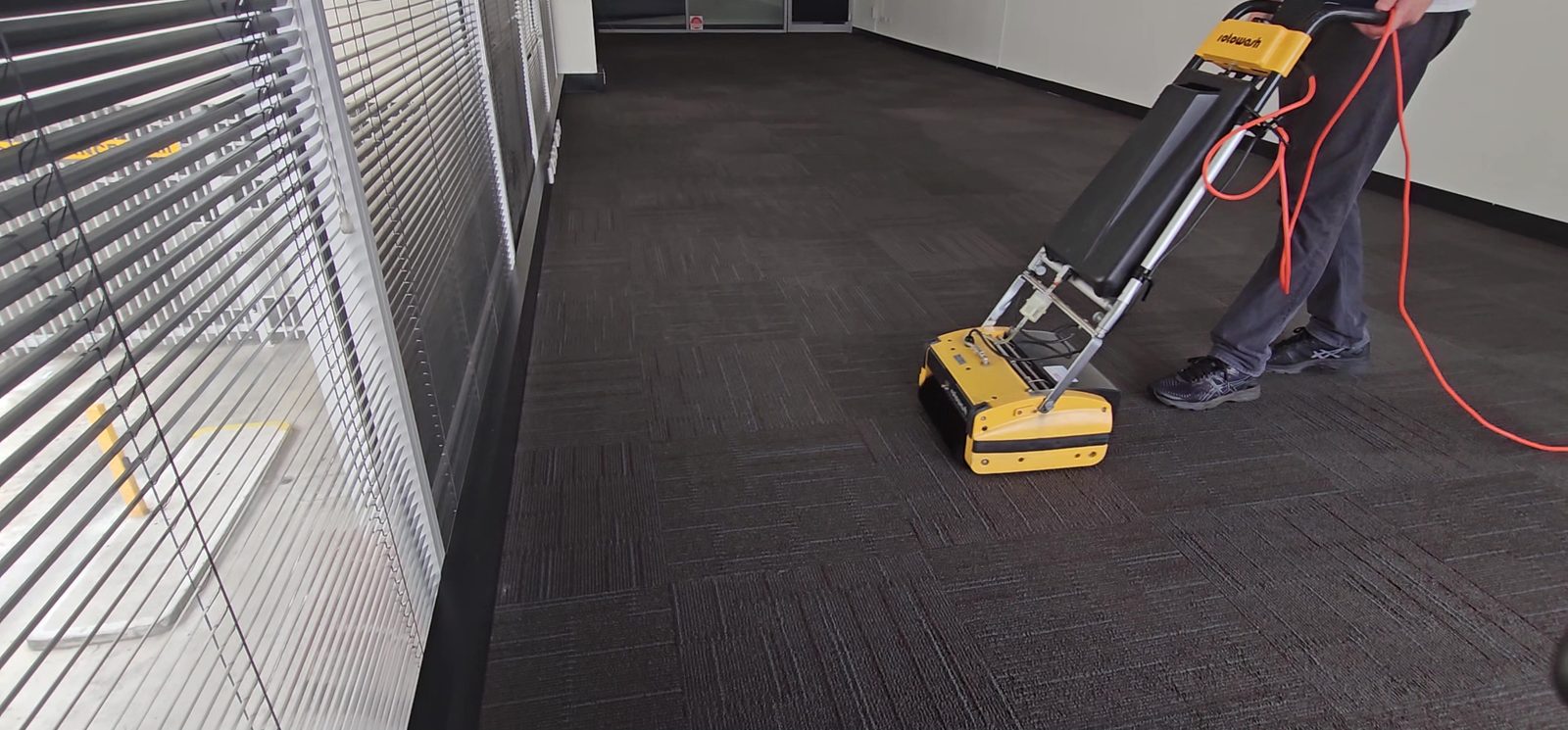
A portable is a wheeled machine that comes inside and plugs into a wall socket, and mains power is its ceiling. A standard circuit limits how much heating and vacuum a portable can generate, so it runs cooler and recovers less water per pass than a truck mount. What it buys back is reach: it rides a lift to any floor, needs no parking bay by the entrance, and works in buildings where a hose run is impossible. You can see the specific machines we run on our equipment page.
| Truck mount | Portable | |
|---|---|---|
| Heat at the wand | High and constant, engine-powered | Limited by the wall socket; drops under load |
| Vacuum lift | Strong, even over long hose runs | Modest; more dry strokes needed |
| Access | Hoses from the van; needs parking and a door path | Anywhere a lift and a power point will go |
| Waste water | Recovered to a tank in the van | Held on the machine, emptied on site |
Neither is better everywhere. The building decides.
The honest version of the comparison is that the building chooses the machine. A hose run loses heat and suction with every metre, so the truck mount works where the van can park within reach of the carpet. On level twenty a portable unit comes up in the lift and does the clean. For ground floors, warehouses and anywhere the van can park near a door, the truck mount is the stronger machine.
Encapsulation cleans the part of the carpet you can reach from above. This low-moisture clean is the method for lightly soiled carpet and puts very little liquid into the pile. Its polymer dries around the soil near the fibre tips so the vacuum can lift it out, which means it can only deal with what that polymer touches. Extraction, the deeper clean for heavier soil, rinses the full depth of the pile and removes material from the building in volume: litres of it, visibly, into a tank.
The recovery tank is the honest audit of what was living in the floor. The water comes out grey-brown even from carpet that looked respectable, because most of what extraction removes was never visible from above. It sits at the base of the tuft, below the reach of any brush, accumulating quietly from the day the carpet was laid.
The question every client asks is how long the carpet will be wet, and the honest answer is that drying time is decided, not discovered. Roughly half of it is settled before the operator leaves, by the volume that goes down and the volume the dry strokes bring back. A floor extracted with patience begins drying with far less moisture in it than a floor done at speed.
The other half is evaporation, and evaporation is weather, indoors or out. Moving air dries carpet far faster than still air, dry air drinks moisture faster than humid air, and a dense pile on an impermeable backing releases water more slowly than a low loop. A February afternoon with the sea breeze through the windows and a still, grey June morning are different planets for a wet floor. We have written separately about how carpet dries, because the subject deserves more than a paragraph.
As a working figure, a properly extracted commercial carpet with reasonable airflow is usually dry to the touch within a few hours, and comfortably ready for the next morning's traffic when cleaned in the evening, which is why after-hours booking is the default for office floors. What happens in the space during those hours moves the number more than most people expect.
Hot water extraction gives carpet with heavy soil and many different stains a thorough, deeper clean. It returns the pile to a genuinely clean baseline. Our advice is to have a floor professionally cleaned at least yearly, with busier floors cleaned more often. Lightly soiled carpet suits encapsulation instead, a choice we make at the inspection. Which method suits which floor is set out in a separate comparison.
In Perth the calendar has a shape. Late spring is the popular window for the restorative clean, after the wet months have finished tracking grit and limestone slurry indoors and while warm, dry air keeps drying times short. Hotels and venues thread it through the booking calendar instead, and office tenancies book the hours their floors stand empty. Traffic, not the calendar alone, sets how often a floor needs cleaning, so a busy ground-floor entrance usually needs more cleans than a quiet upper floor.
Encapsulation suits light soil. Extraction is the deeper clean that carries heavy soil out of the building.
The carpet shows when it needs the deeper clean. Traffic areas that soil again within days, a grey cast that no longer lifts and an odour that comes back on humid mornings all mean the soil has gone below the upper pile. We check for these at the inspection and recommend hot water extraction when we find them.
If you are arranging this for the first time, the practical picture is straightforward. Expect the preparation to take as long as the extraction, expect the operator to talk to you about furniture, power and access before a hose is unrolled, and expect drying advice specific to your building rather than a number recited from habit. The details of the service itself are on our carpet steam cleaning page.
A short conversation up front makes the visit better. Tell us the fibre if you know it, and the spills you know have happened, because the pre-spray is chosen for both. Tell us the access rules, the lift dimensions and the parking situation, because those decide truck mount or portable before anyone opens a van door. And tell us the real deadline, the hour people genuinely return, because the dry-stroke budget and the number of air movers are planned backwards from it.
One last piece of arithmetic that is easy to miss. The preparation and the drying decide most of what you get, and both of them are hours somebody has to be paid for. A quote that comes in cheap because it skips the pre-vacuum and leaves at the first sign of damp is not a cheaper version of this method; it is a different method wearing its name.
How encapsulation polymers trap soil, why the vacuum finishes the job, what each machine does, and where low-moisture cleaning fits a Perth office.
Read ArticleSteam cleaning versus encapsulation for Perth commercial carpets: what each one does at fibre level, real dry times, costs over a year, and how to choose.
Read ArticleWhy carpet drying takes as long as it does, the four levers that shorten it, where to stand air movers, and what changes between a Perth summer and winter.
Read Article