

Carpet Steam Cleaning
Our restorative clean for grey walkways, spill residue and stale odours, from the truck-mounted unit or a portable extractor on upper floors.
How we steam clean →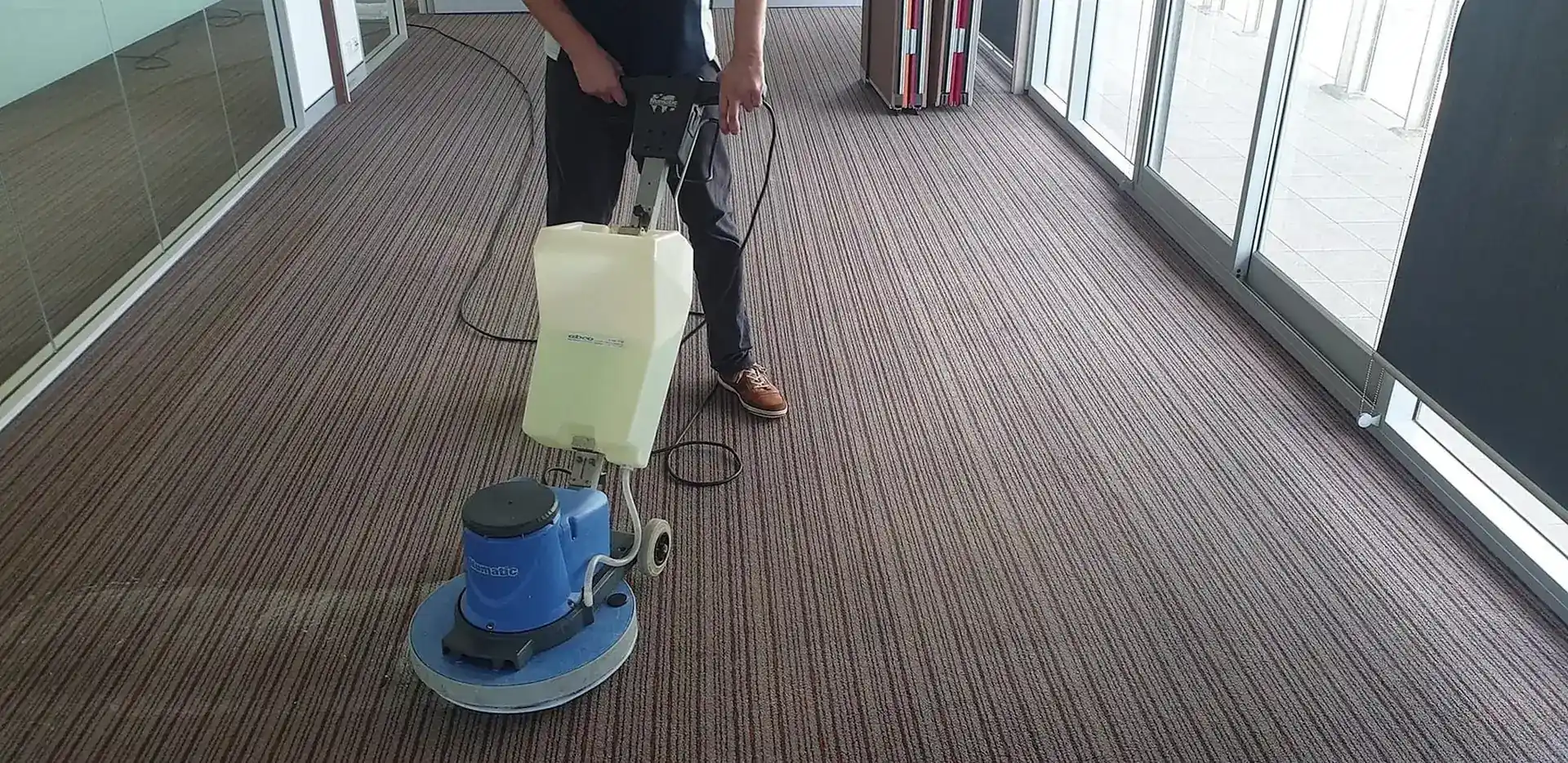
Office carpet cleaning across Perth, at the time you choose, 7 days a week. Once we've inspected your carpet, we recommend the method that suits it. Encapsulation is the low-moisture clean for lightly soiled office carpet, and hot water extraction gives the deeper clean where the carpet carries heavier soil and many different stains. Book one clean or regular visits, and your team returns to a floor that's clean, dry and ready for work.
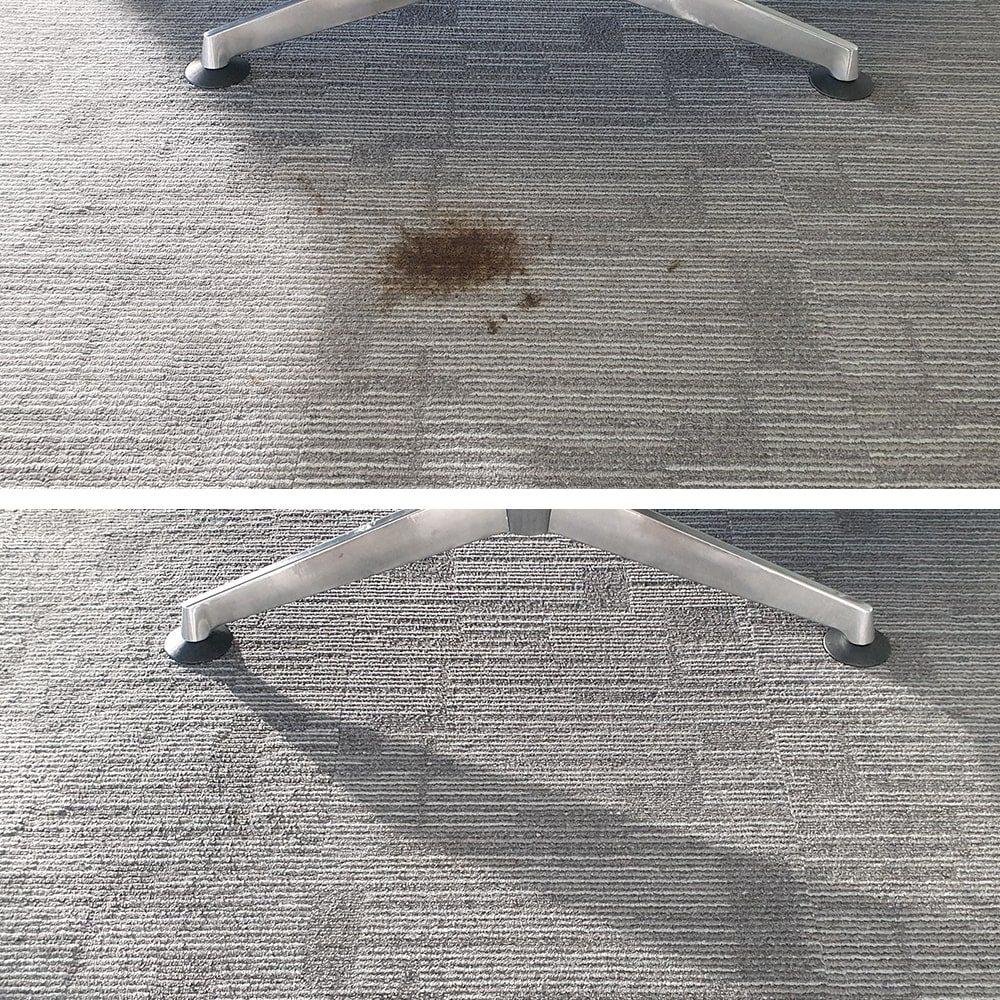
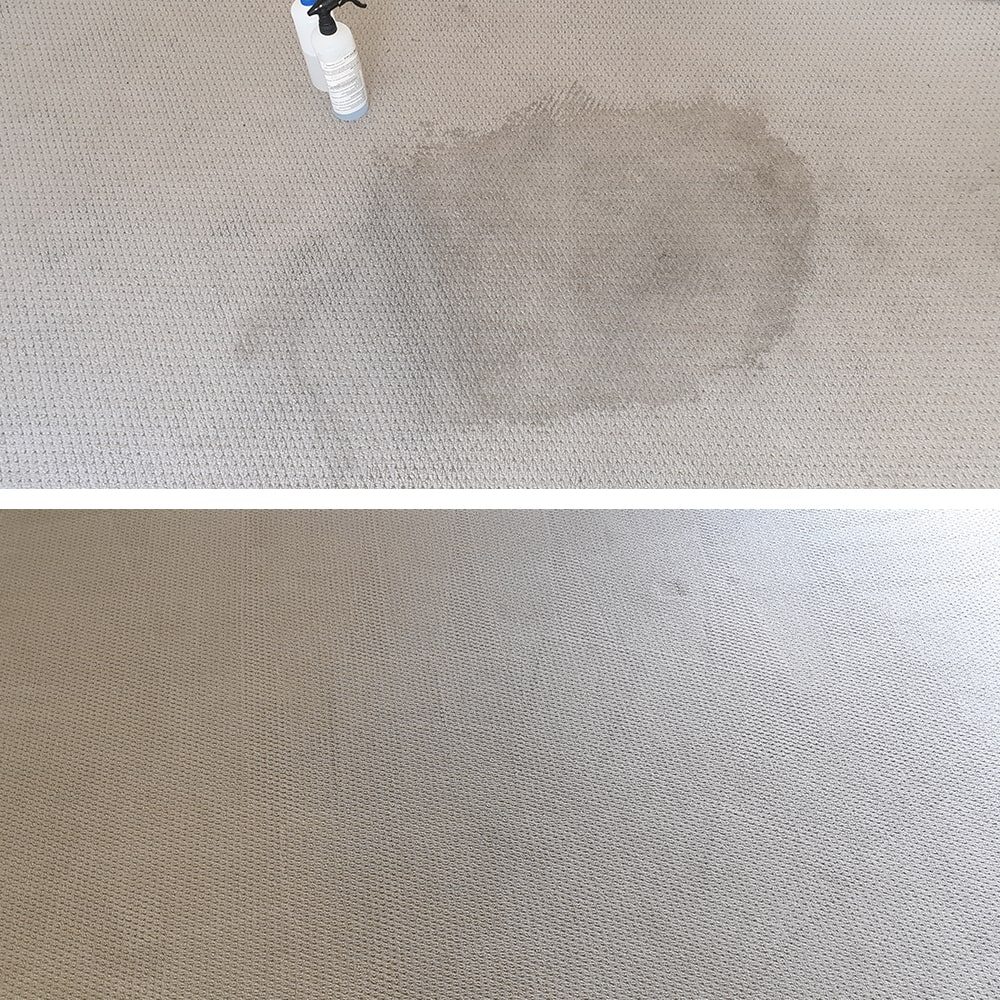
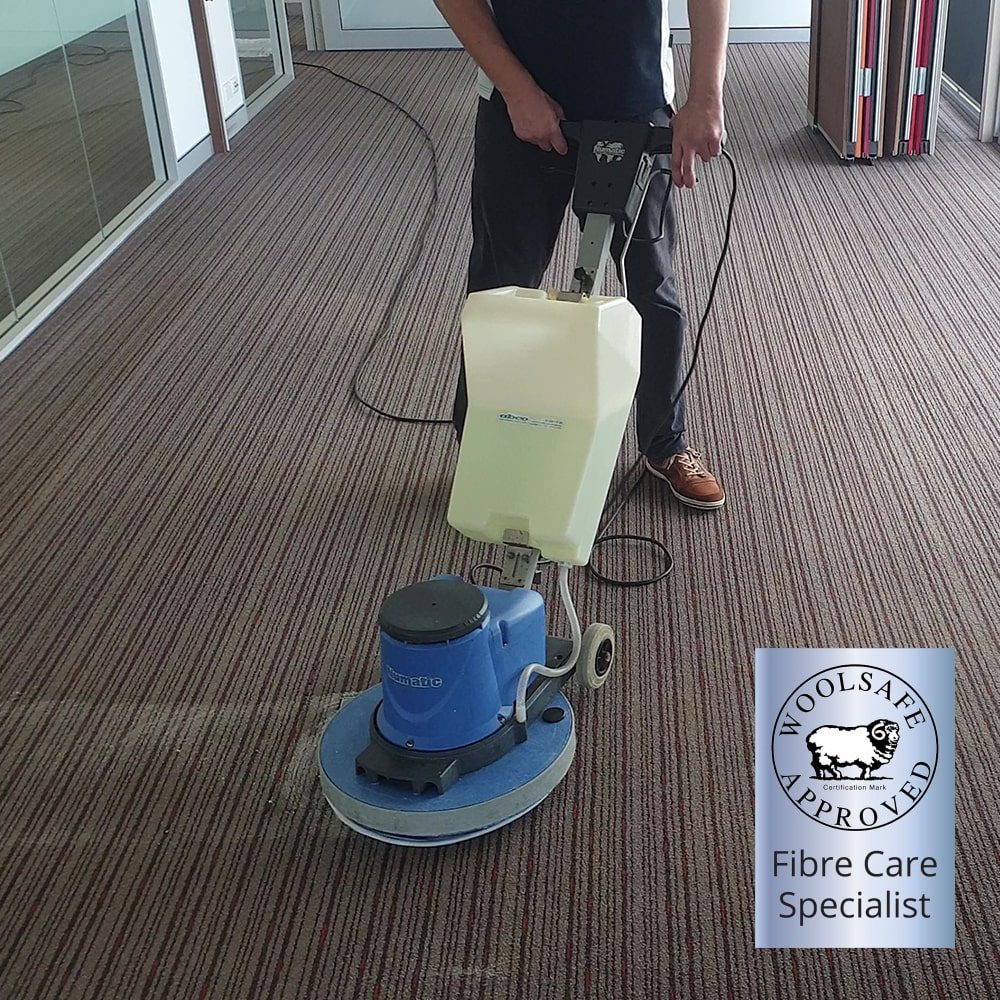
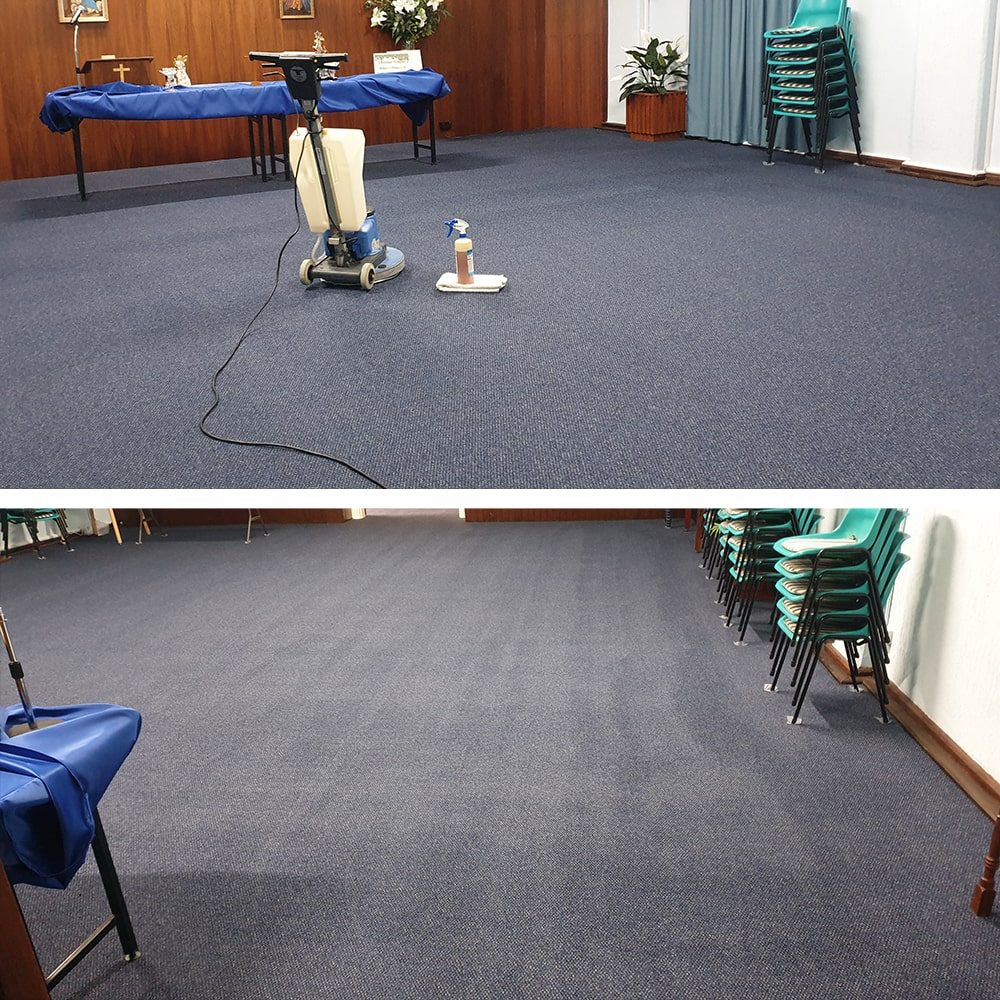
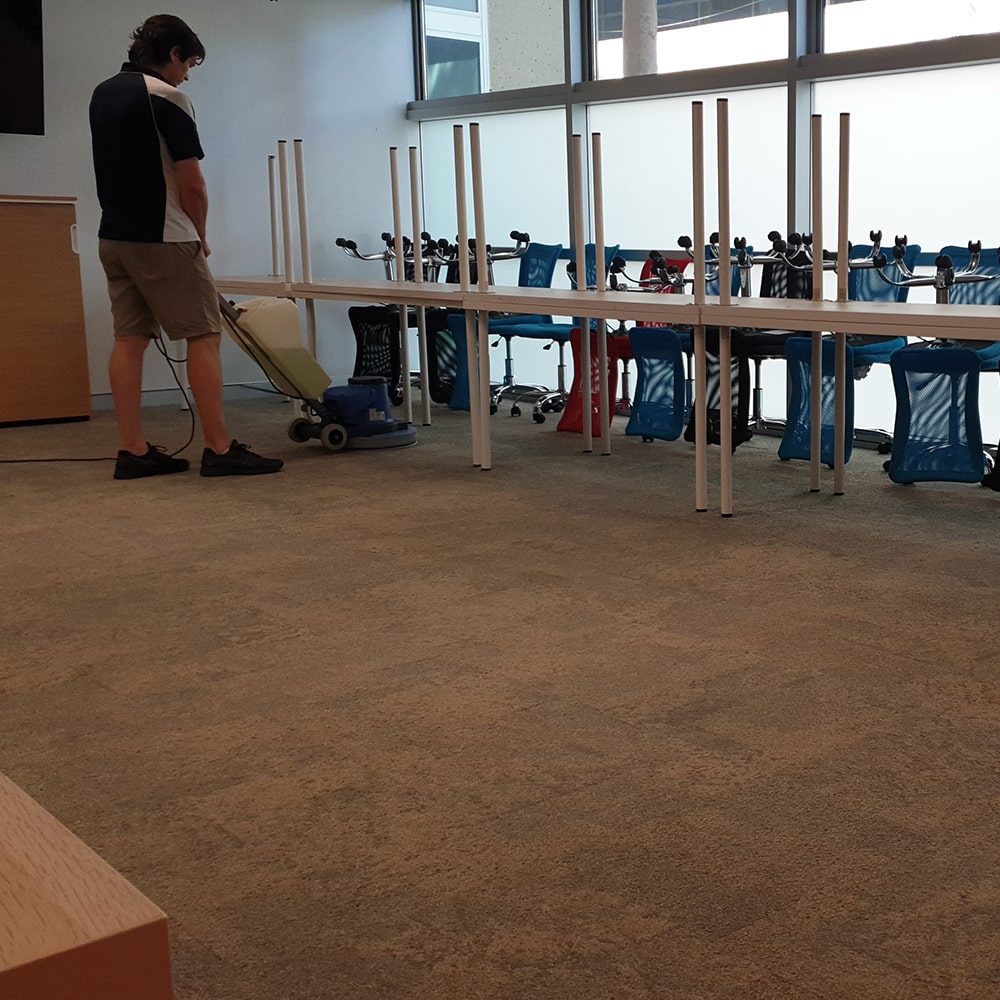
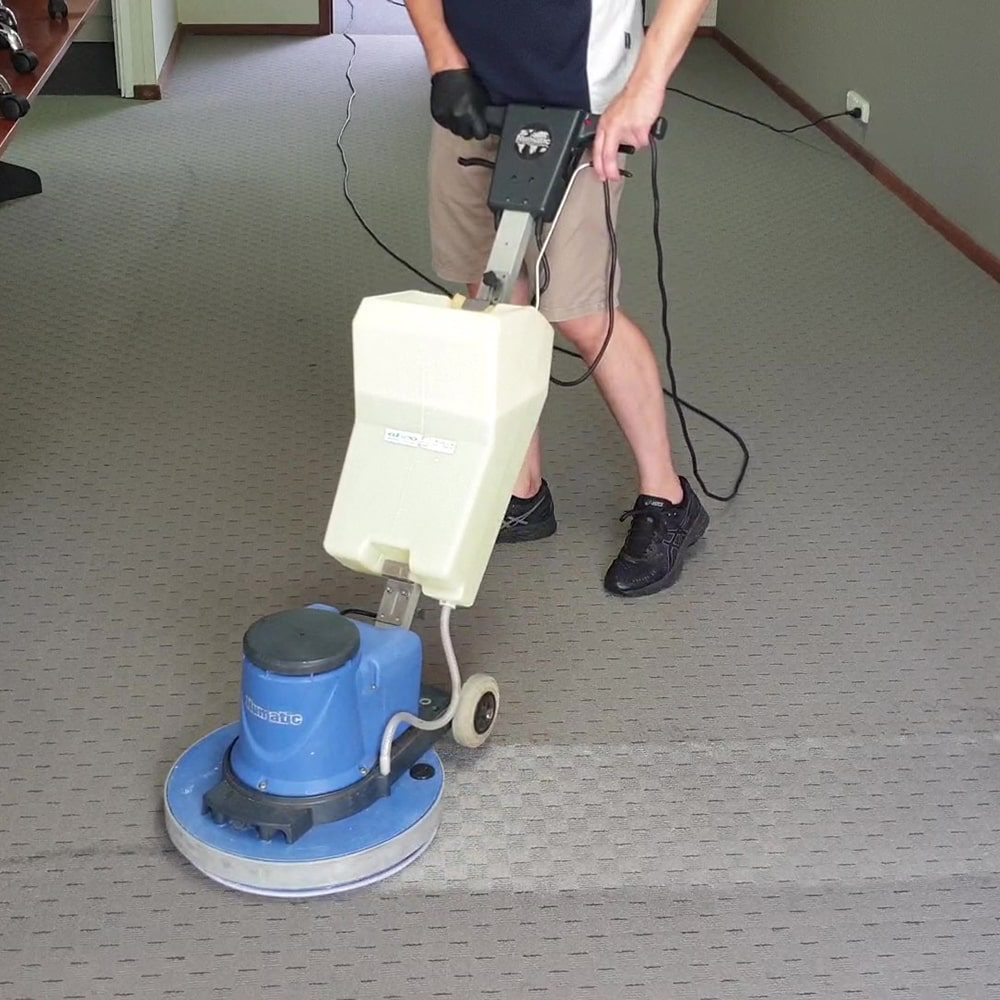
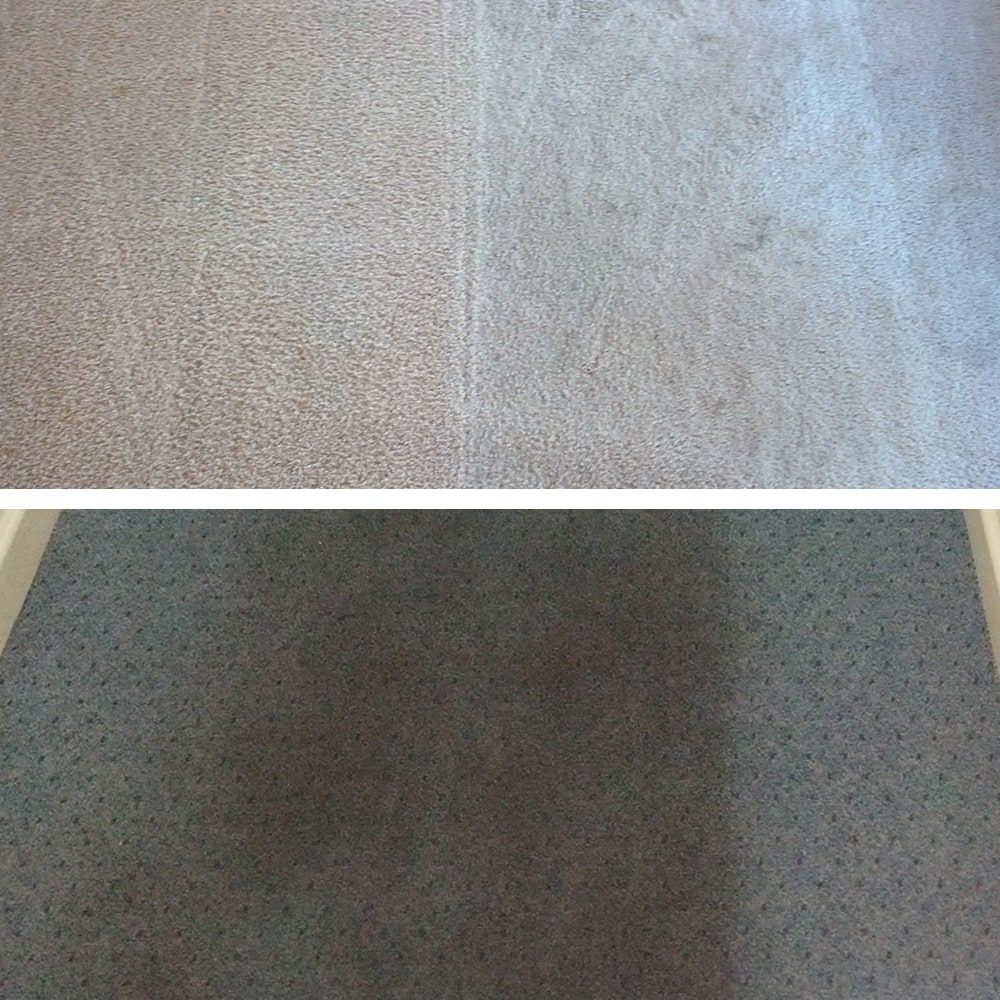
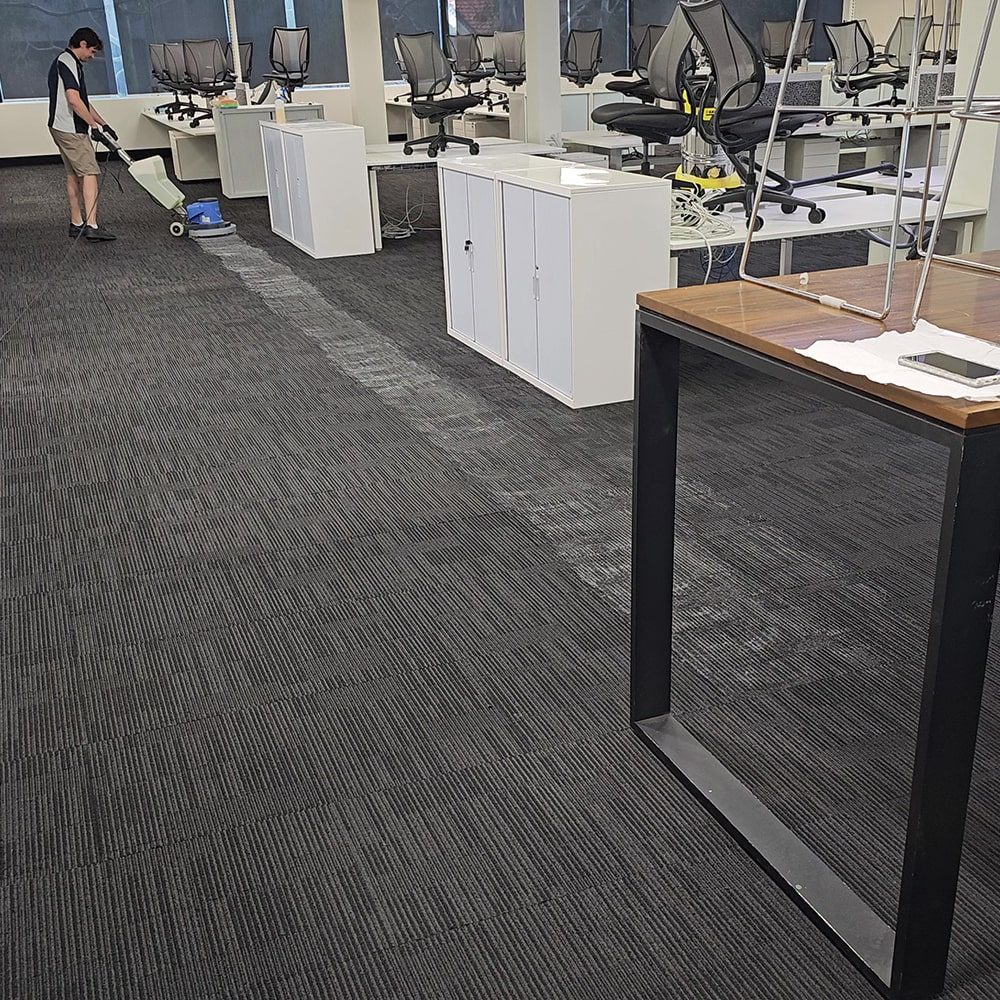
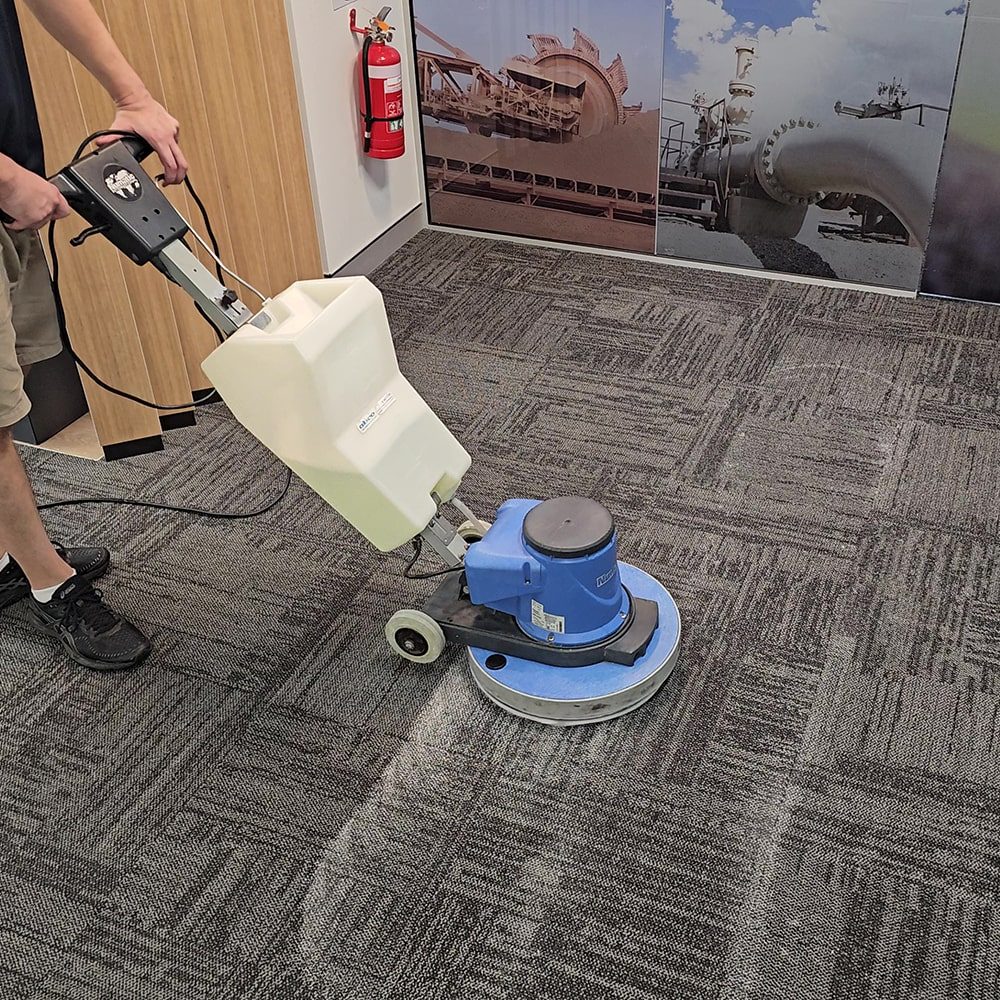
Your carpet is the largest surface in the building and the first one a visitor reads. Grey walkways from the lift to reception, darker lanes around the printer and marks under every chair say how the place is run, and the grit left in the pile wears the fibre out early. We bring the whole floor back to one colour and rinse out the stale smell with the soil, along with the dust and allergens the pile has filtered out of the office air. Your team works on a healthier floor, and the carpet gains years before it needs replacing.
Every commercial carpet cleaning job in Perth is backed by our guarantee: if anything isn't right after your clean, tell us within 14 days and we'll come back and set it right, at no extra charge. We also steam clean carpet in Perth homes. One call gets you a free estimate of the cost without a site visit.
Weekday, evening, overnight or weekend, 7 days a week: name the time and we book the clean for then. Steam-cleaned carpet dries in 4 to 8 hours and encapsulated carpet within an hour or two, so each area is booked for a time it can stay clear until it's dry.
No subcontractors. Every clean is done by our own police-cleared technicians, insured to $20M, as an IICRC Certified Firm cleaning to the IICRC S100 standard and AS/NZS 3733:2018, and your building's contractor paperwork goes in before our first visit.
We measure up on site, free, and note what you expect from the clean and any concerns you raise. Then you get one written price for the job, with the method and the drying plan. The date is set once you approve it, and if any part of the clean isn't right, let us know within 14 days and we'll return to fix it at no extra charge.
Stair treads and nosings are cleaned with a hand tool, entrance matting gets a heavier clean for the grit it traps, and rugs and runners are cleaned to suit their construction. Office chairs and tiled floors can join the same booking.
Start with the free site visit
You have a written price before anything is agreed. We recommend the method, and you decide when and how often we clean.
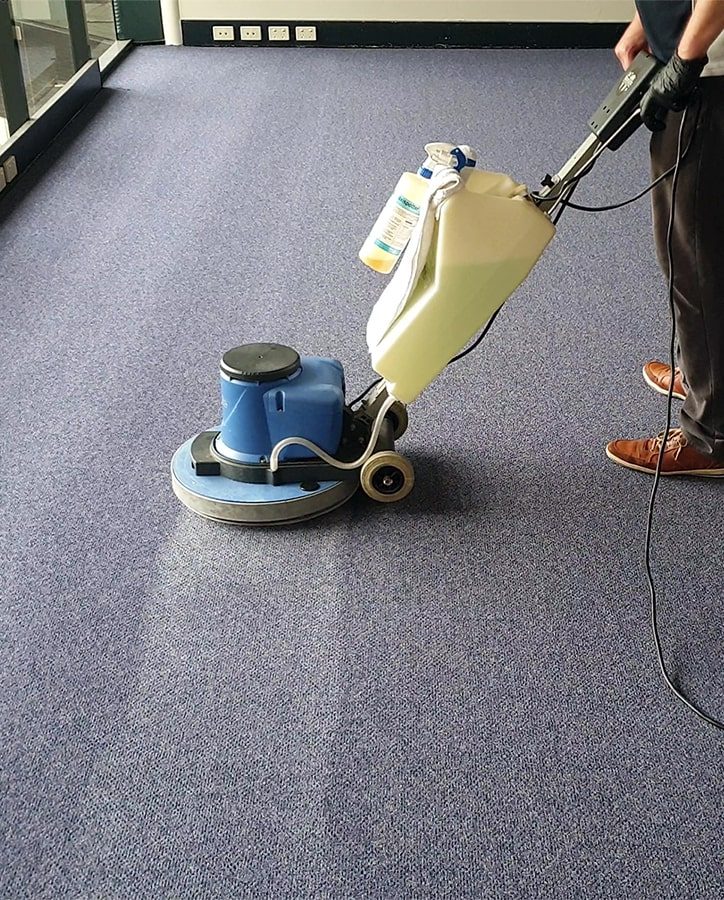
Every carpet clean works through four things: chemistry, heat, agitation and time. Our three methods set that balance differently, so each one suits a different floor and a different job.
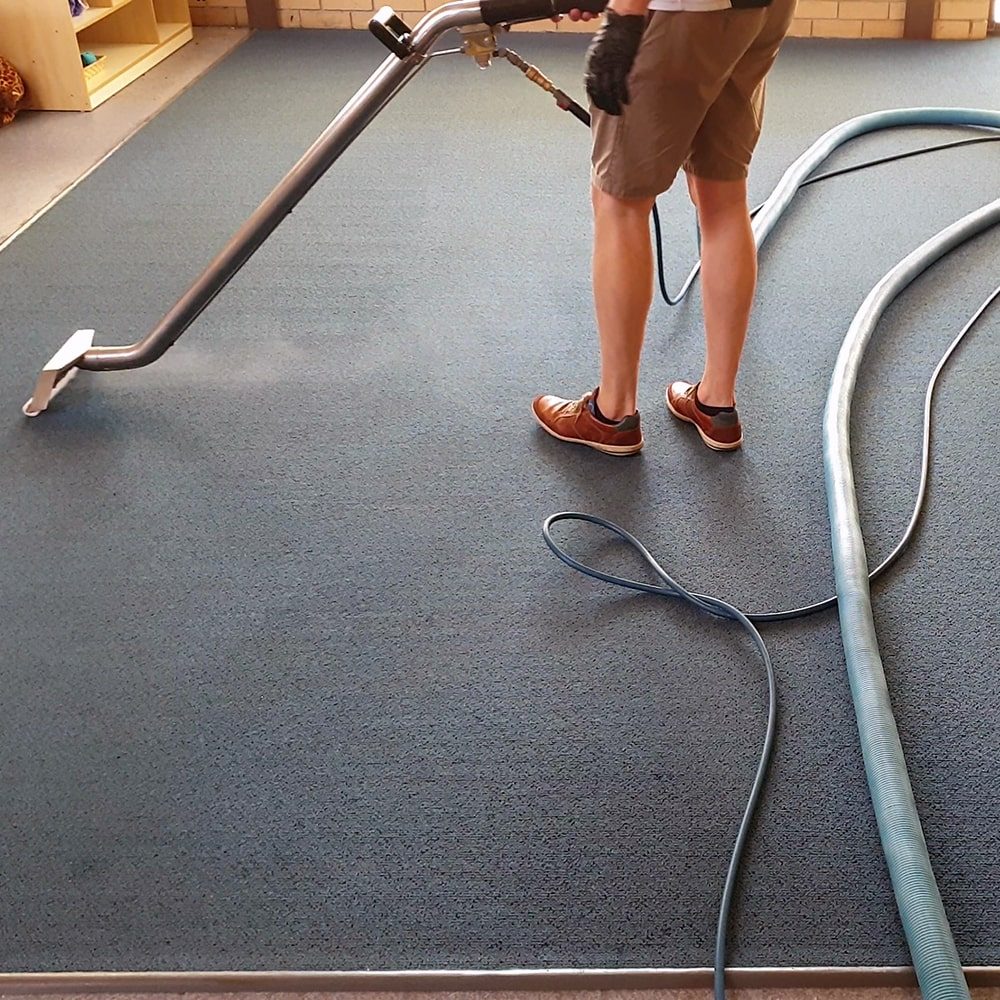
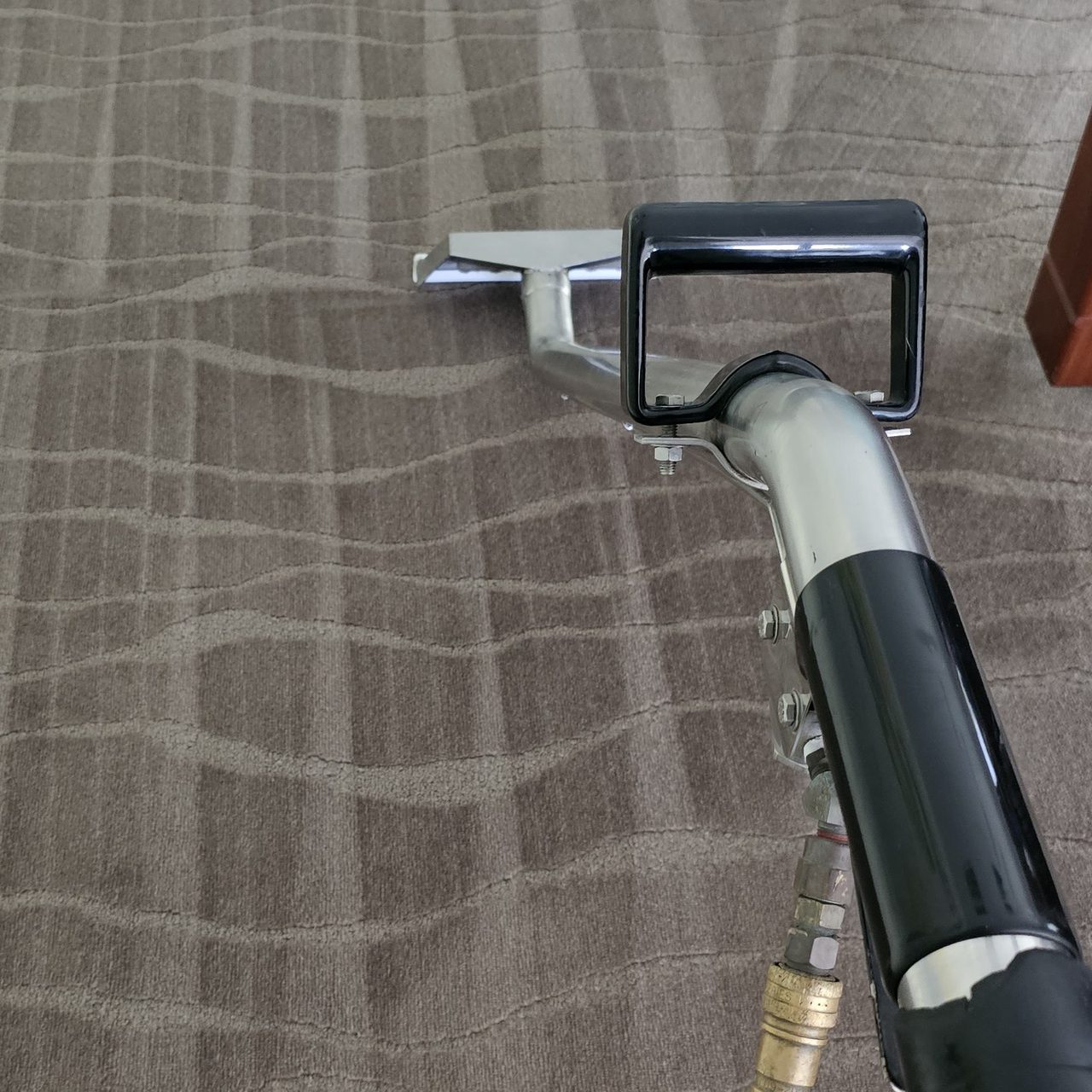
Our more thorough, deeper clean, for carpet with heavier soil and a wide range of stains. Like every clean we do, it starts with a thorough vacuum that lifts out the dry grit. A pre-spray matched to the fibre then breaks the bond between the oily soil and the pile, and after its dwell time heated water rinses through the carpet while strong suction pulls the soil, spill residue and old detergent back out. It cleans the pile right down to its base. Wherever the hoses reach, it runs from the truck-mounted unit in the van; on upper floors, we bring portable extractors up to you.
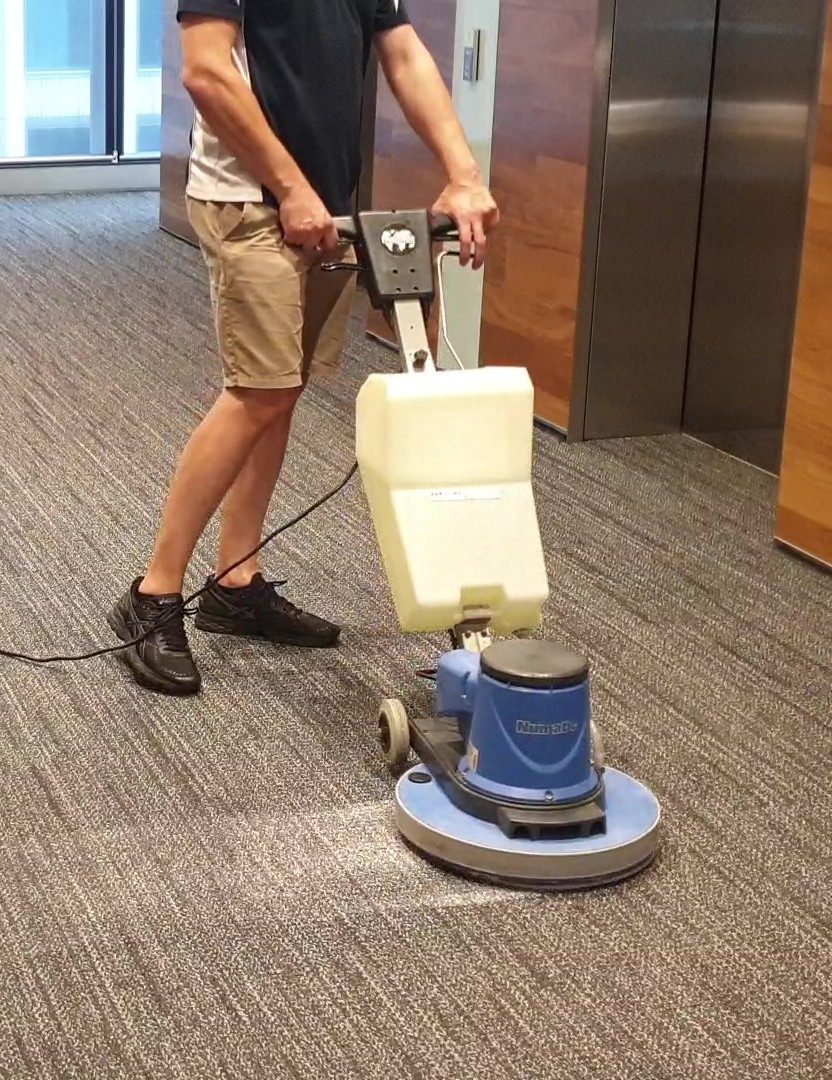
Our clean for lightly soiled office carpet, with very little moisture. A scrubbing machine works a polymer detergent into the upper pile, the polymer dries around the loosened soil as brittle crystals, and vacuuming lifts them out. Nothing is left behind in the pile, the water never reaches the tile adhesive, and your staff are back on the floor an hour or two later.
Our heavy restorative clean, for floors that hot water extraction alone won't bring back: years without a clean, dark traffic lanes, grease walked in from a kitchen or car park, or sand compacted into the pile. Machine agitation works the pre-spray through the pile and breaks the soil loose, then hot water extraction rinses it out. Where the fibre is soiled rather than worn, it brings back carpet that looked due for replacement.
Leave the choice to us
Every quote names the method we'd use on your floor and why. If you'd like the three compared first, the deciding factors below lay them out, and the site visit that settles it costs nothing.
We don't start from a favourite method. When we visit to quote, we look at the carpet's fibre, construction, pile height and texture, and at how your building runs, then recommend the method, or the mix of methods, that gives the best result in the time you have.
Colour runs right through solution-dyed nylon and polypropylene, so both tolerate stronger alkaline pre-sprays. Polypropylene is oleophilic: it attracts and holds oily soil, so its walkways grey faster and need a degreasing pre-spray before the rinse. With nylon dyed after manufacture, we avoid strong oxidising spotters, which can strip its colour.
Wool needs its own chemistry, because it's a protein fibre. Alkaline cleaning products cause alkali damage, leaving the fibre weak and harsh, and they can make acid dyes bleed; over-wetting a woven wool carpet on a jute backing can cause cellulosic browning. That's why wool gets a steam clean done with care: WoolSafe-approved products, lower heat, gentle agitation, thorough water recovery and a mildly acidic final rinse. Our owner holds the WoolSafe Approved Fibre Care Specialist credential.
Carpet tiles and glued-down broadloom are both stuck straight to the slab, so the moisture can only leave through the face of the carpet. On carpet tiles, too much water runs down the joins and can re-emulsify the adhesive underneath, and the tiles shift or lift. We control the water going in and recover it with strong extraction, or use low-moisture encapsulation, so the adhesive stays dry.
Lightly soiled carpet responds well to encapsulation. Heavier soil, a mix of stains, oily soil and shampoo left by earlier cleans need the rinse of hot water extraction, and sand compacted into the pile over years needs machine agitation first.
Steam-cleaned carpet needs its drying hours with nobody walking on it, so we book it for a time when the area can stay closed, whatever the day or hour. Where lightly soiled carpet can't be closed for long, encapsulation suits it, as the floor can be walked on again within an hour or two.
Some clients and building specifications ask for a particular method, and we work to it wherever it suits the carpet; where it doesn't, we'll explain why and what we'd recommend instead. Where you book us regularly, the method can change from one visit to the next.
Let us read the carpet before you book
Tell us the building and how long the floor can close. Zoran comes out, checks the fibre, the soil and the backing, and gives you a written price for the method that suits it.
Whichever method suits your carpet, the clean follows the same seven steps. The method itself is chosen at the inspection, and every step after it is set by your fibre, the soil it carries and the hours the floor can stay closed. Book the free site visit and you see the plan for your floor before anything is scheduled.
Every clean starts with a free site visit, and the visit starts with you. Walk us through the building and point out the stains that bother you, the walkways that have turned grey, any smell that lingers, marks that reappear after cleaning and the rooms you need back in use by a set time. Ask us anything as we go, from the method and the drying time to the products we use on your fibre and how we work around your staff. We take the time to answer each question there on the floor, so you know how your carpet will be cleaned before you book.
Next we read the carpet itself. We identify the fibre, whether nylon, polypropylene or wool, and the construction, from carpet tiles to glued-down broadloom and loop or cut pile. We read the soil in the traffic lanes and entrances, find the cause behind each stain you showed us and check access, hose reach and how long each area can stay closed.
Only then do we recommend the method. Lightly soiled carpet suits encapsulation. Heavier soil and a wider spread of stains call for hot water extraction, and floors with years of bonded soil get machine agitation before it. The method, the drying time and the price all go into your written quote.
Most of what a commercial carpet collects is dry particulate soil, the sand, grit and dust walked in on shoes. Perth's quartz sand is hard and sharp, and every footstep grinds it against the fibres. We vacuum it out before any pre-spray or solution goes down, with extra passes along the walkways, entrances and edges.
Taking the dry soil out first means the chemistry goes to work on the oily film that holds the rest of the soil to the fibres, instead of being spent on loose grit.
Traffic lanes and entrances hold far more soil than the rest of the floor, so they are pre-sprayed first. The pre-spray is chosen for the fibre and the soil it carries, with a degreasing pre-spray on oily walkways and a WoolSafe approved product on wool.
It is then left for its dwell time, the minutes the chemistry needs to break the bond between the oily soil and the fibre. Cutting that short leaves soil behind, so every lane gets its full dwell time.
Each mark is identified by its stain family and treated with the spotter that suits it. Coffee and tea are tannin stains, food and blood are protein stains that need an enzyme spotter, and grease and ink need a solvent. We carry water-based and solvent spotters on every job.
From experience we can tell you at the inspection what to expect. Most marks come out, some fade to a faint trace, and a few, such as bleach marks and permanent dye, stay. Pushing harder on a permanent mark only damages the fibre around it, so we stop there.
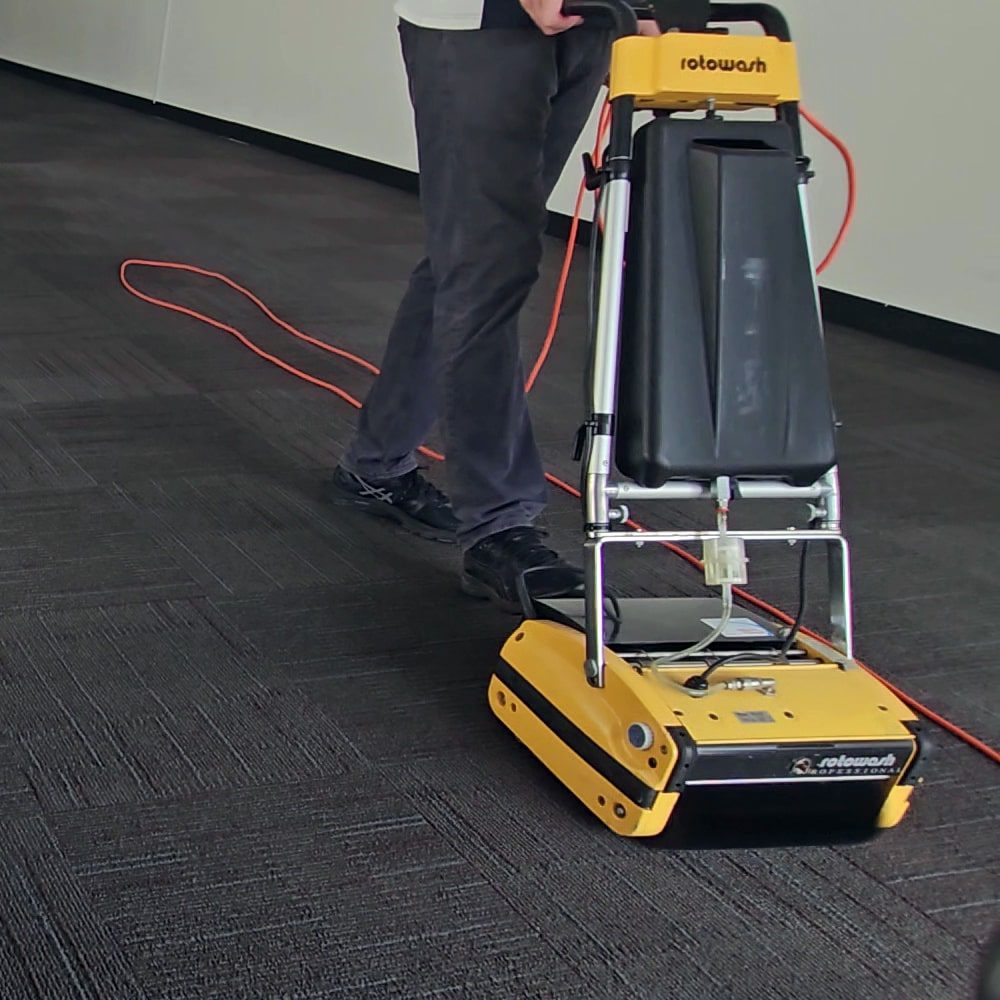
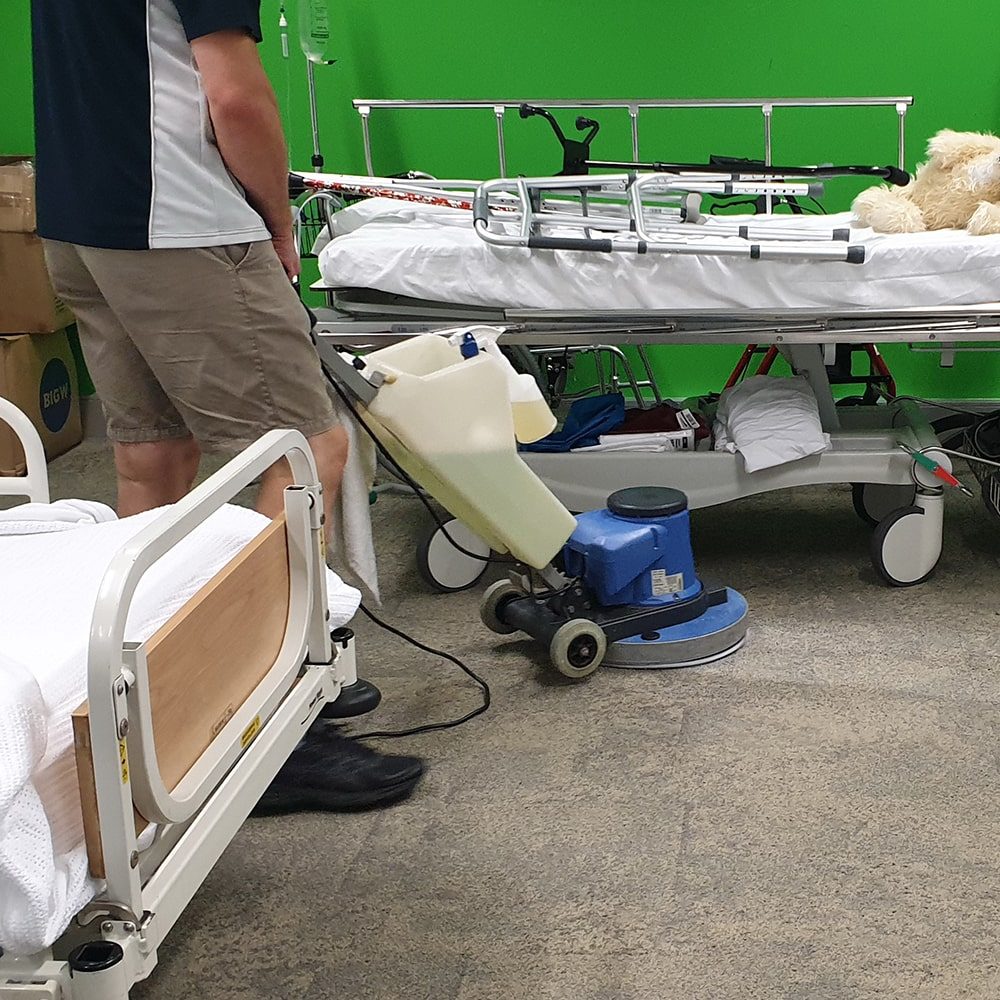
Where the soil is heavy or bonded to the fibres, a machine drives the pre-spray into the pile, down to the soil at the base of each tuft. We use Duplex, Numatic and Rotowash machines, and a Cimex on large open floors.
The machine and brush are chosen for the carpet's construction, and the pressure stays even across the floor. On an encapsulation clean, this machine pass is also where the cleaning solution is worked into the upper pile.
On a steam clean, heated water rinses through the pile and strong suction recovers it, carrying the dissolved soil and any old detergent back to the machine. It runs from the truck-mounted unit wherever the hoses reach, or from portable extractors on upper floors, and dry passes recover as much water as the carpet will give up. Wool is cleaned at lower heat, with a mildly acidic final rinse.
On lightly soiled carpet cleaned by encapsulation, a measured amount of the encapsulating detergent is worked through the upper pile. As it dries it holds the loosened soil, and vacuuming lifts both out, leaving nothing behind in the fibre.
We walk the whole floor under good light, checking the walkways and edges for any strip the machine missed, the carpet around desk legs and cables, and every mark treated in step 4.
Any area that wants a second pass is redone while the equipment is still on site, so your team never comes back to a missed patch.
Then we pack up and put the chairs and bins back where they were. Where you have given us the keys and the alarm code, we turn off the lights, lock every door and set the alarm on our way out. Your keys come back to you the following working day, so they are never with us longer than the job needs.
Encapsulation cleans lightly soiled carpet well when three things are right: the amount of solution, the brush or pad, and soil light enough for it. Every worry people raise about it comes from getting one of those wrong, and we get all three right on every visit.
Done properly, it leaves nothing behind. We put down a measured amount at the correct dilution, the solution dries fully, and vacuuming lifts the soil out with it, so the walkways stay clean instead of greying again within weeks.
It cleans the upper part of the pile, which is where the soil sits on lightly soiled carpet, and that is the carpet we use it on. Where the soil has worked deeper or the carpet carries a lot of different stains, the inspection shows it, and we recommend a steam clean instead.
The wrong brush or pad, or too much pressure, can fray loop pile, twist and flatten the tufts (pile distortion) or leave swirl marks. So the carpet's construction decides the machine and brush we use, the pressure stays even across the floor, and pile that can't take a scrubbing machine never gets one.
It can't, and we don't ask it to. Oily traffic lanes, kitchen doorways and floors that haven't been cleaned in years need a deeper clean, so we recommend agitation and steam cleaning for them.
Book it done the right way
Tell us what happened last time. We check the floor for residue and build-up, correct it with a rinse where it needs one, and quote the clean that will hold.
We look after about 450 square metres of carpet for an office in Perth. When we quoted, the carpet was in good condition, with stains here and there, and the office chose a Saturday clean, starting once the office's own cleaners had been through, with no weekend surcharge.
The office books us for every clean, and each visit covers the carpet throughout, including the foyer and the two meeting rooms beside it. The kitchen floor is part of the visit too, cleaned by hot water extraction while we're on site. Because the soil never gets the chance to build up, every clean is maintenance rather than a recovery.
Staff lift their paperwork, bins and chair mats from under their desks before they leave, so the carpet beneath every workstation is cleaned too.
Each visit starts with a thorough vacuum. Any grit still in the pile would turn to a paste under the cleaning solution, so taking it out first is what makes the result last.
Before the main clean, each mark gets the pre-spray that suits the stain and the fibre, and most come out with it.
A Saturday clean gives the carpet the rest of the weekend to dry, so it's dry well before staff return on Monday.
Start with one clean and judge it yourself
One visit shows you the standard. Tell us the floor area and the hours you can give us, and the written price for that first clean is with you before you commit to anything regular.
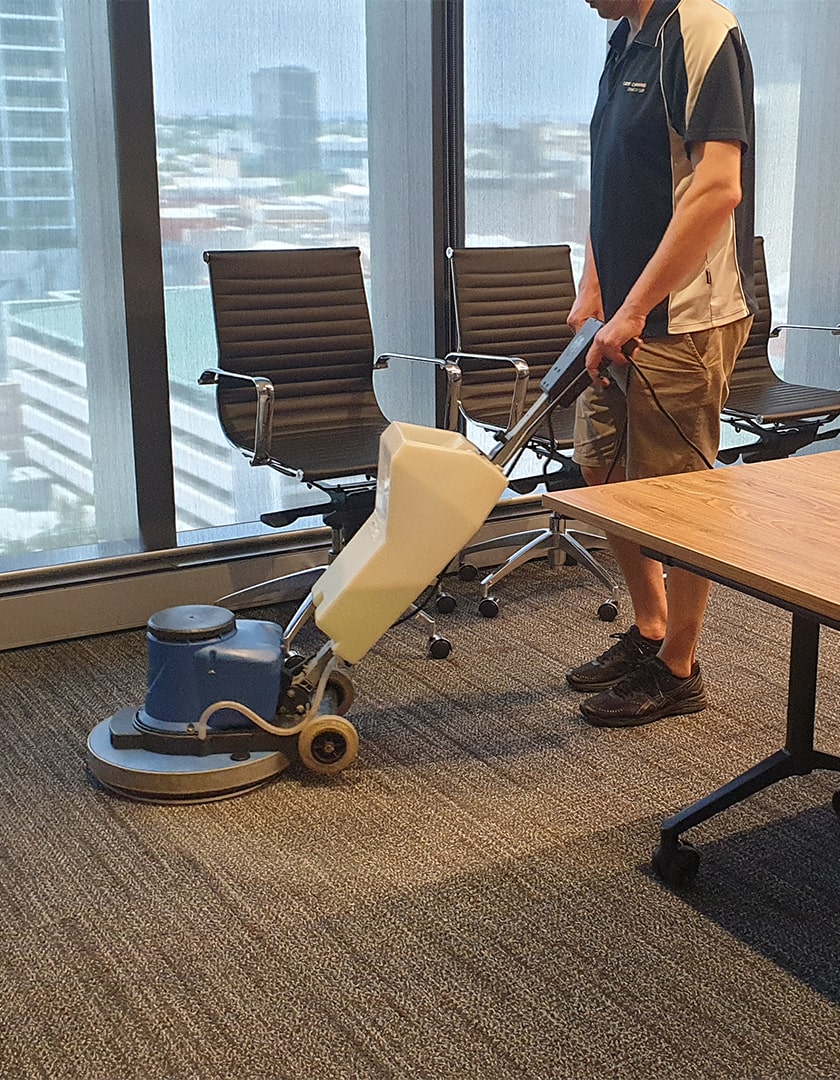
Many of our clients book us regularly, at the frequency that suits their premises and budget. Regular cleans take the soil out before it builds up, so the carpet stays presentable and no visit turns into a recovery job. Ask, and we'll recommend how often each area should be cleaned; the dates are yours to set.
We recommend cleaning every area at least once a year, and the busy ones more often: entrances, reception, main walkways and kitchen doorways. The right number of extra visits depends on how many people cross the floor, how much sand is tracked in, whether people eat and drink there, and the carpet's type and colour. Some sites have the interval set for them: certain government buildings, for example, need part of their carpet cleaned every quarter.
We can only recommend a method once we've inspected your carpet. Encapsulation is a low-moisture clean for lightly soiled office carpet. Its detergent surrounds the soil in the upper pile, where light soiling sits, and the vacuum lifts it out with nothing left behind in the fibre. Where the carpet carries heavier soil or many and varied stains, hot water extraction is the thorough, deeper clean. Each stain is pre-treated with the spotter that suits it, and the rinse and extraction reach the full depth of the pile.
Instead of one large bill for a catch-up clean, the cost arrives visit by visit. Because each visit starts from a cleaner floor, it also takes less work than a recovery clean would.
We contact you before each visit to confirm the day and time, so nobody in your office has to remember when the carpet is due.
Tell us your audits, client events, lease inspections and end-of-year dates, and we'll book the cleans so the carpet looks its best for them.
Ask us on the site visit
We look at the traffic and the soil on your floor and tell you what we'd recommend: once a year at the least, and more often where the walkways need it. You pick the timing, and the price for each visit is written down before the first one.
We clean when the office is empty, whether that's after hours, over the weekend or on a day the floor is clear. We arrive at the booked time with the access details sorted, and in most offices the only things we move are chairs and bins. When your staff return, the carpet is dry and everything is where they left it.
Everything we need to start is collected at the quote: keys or swipe cards, alarm codes, a parking spot, lift access and your building's rules. We start on time, and if the office is closed, no one has to come in to open up.
In most offices, chairs and bins are all we move: we clean around every workstation and its cables, and everything on the desks stays exactly where your staff left it. Where your premises need more shifted, we agree it at the quote.
A steam-cleaned floor usually dries in 4 to 8 hours, and an encapsulated one much sooner. Your quote includes the drying plan, and the clean is booked to fit it, with air movers for any room that has an early booking.
Hoses and machines go out to the van, and every chair and bin goes back in its place. If we're the last to leave, the building is left dark, locked and alarmed, and your people return to a finished floor.
Managed buildings set their own conditions for contractors, and we meet them before the first clean. Send us the requirements from your building manager, strata manager or head office, and we'll lodge each document with the person who needs it: the certificates of currency for our liability and workers compensation insurance, police clearances, our Safe Work Method Statement and any site induction, with the safety data sheets kept in the van. On the day, we sign in and start work without anyone in your office having to chase a form.
We're insured for $20M public and products liability, with goods in our care covered to $250,000, and we hold workers compensation insurance for our team, so a technician hurt on your floor is covered by our insurer. Both certificates of currency go to whoever in your building asks for them.
Everyone on our team holds a National Police Clearance, which managed buildings expect before giving a contractor after-hours access. Where a school, childcare centre or other site requires a Working with Children Check, we can provide one.
Our written statement of how the work is done safely, covering hose runs, power leads, wet floors and the machines we use.
The safety data sheets for everything we use stay in the van, so you or your building manager can read any of them while we're on site.
Site inductions are completed before the first clean, and we follow your building's rules on access, lifts, loading docks and signing in.
Every clean is done by our own team, never a subcontractor, and as an IICRC Certified Firm we hold every job to the S100 standard.
Ask, and it's sent before the first clean
Tell us what your building manager or head office asks for and we send each document ahead of the booking: both insurance certificates, the police clearances and the Safe Work Method Statement, so the approval is done before the van arrives.
Reception, the main walkways and the carpet beside the kitchen soil faster than the carpet under the desks. They get the pre-treatment their soil calls for on every visit, and we'll tell you which areas are worth cleaning more often. On the free site visit we walk each of them with you and price them on one quote.
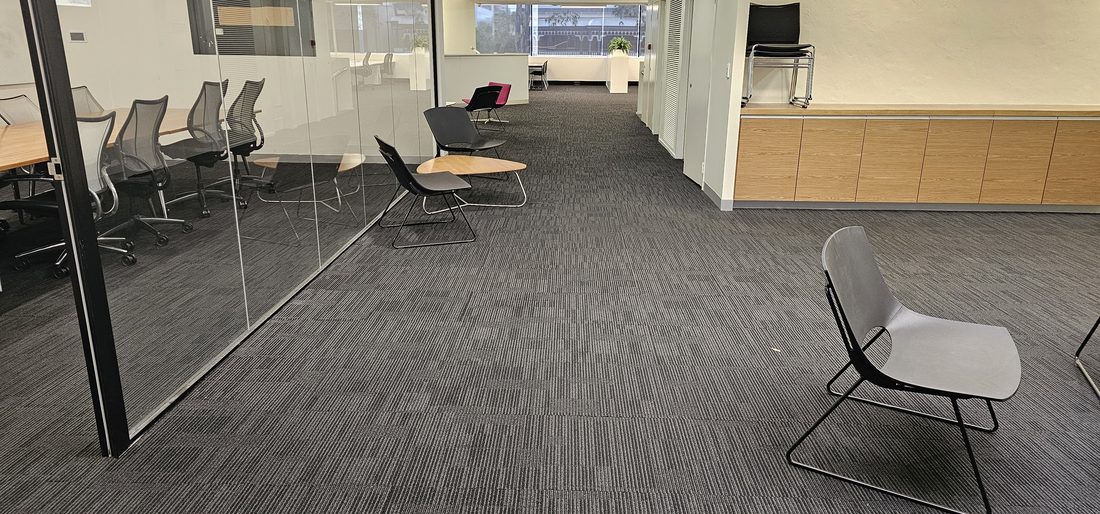
Chair castors crush the pile and grind grit into it around every desk, and the main walkways carry the whole floor's traffic. We leave desks in place and clean around their legs and the cables beneath them.
Most open-plan floors are carpet tiles. Lightly soiled tiles suit encapsulation, which keeps the water away from the adhesive, walkways carrying heavier soil get a steam clean, and we tell you at the inspection which one each part of the floor needs. The walkways are pre-treated first, and we recommend cleaning them more often than the carpet under the desks.
Tell us how many desks are on the floor and the price covers the walkways and the castor marks in one figure.
Street grit and car-park sand reach your reception carpet before any other part of the office, and every visitor crosses it. It's a small area, so cleaning it on a shorter cycle adds little to each visit.
We pre-treat the walk-off area and the path to the front desk, and clean the entrance matting too, so it keeps catching grit before it reaches the carpet. We tell you at the inspection which method your reception carpet needs, and most of our clients have it cleaned more often than any other area.
Ask us to look at reception first on the visit; how fast it soils usually sets how often the rest of the office needs us.
Around a meeting table, the carpet wears where chairs are pushed back and pulled in, and that's also where drinks get spilt. The chairs come out first; we clean under the table and around its legs, then put every chair back where it stood.
A boardroom laid in wool gets WoolSafe-approved products and a mildly acidic final rinse. Meeting rooms are easy to book in during a quiet week, and they need a clean at least once a year, more when the room is used every day.
Book the boardroom with the rest of the floor, or on its own before an important meeting. Either way it's priced on the visit.
Carpet beside a staff kitchen collects coffee, soft drink and food, plus oily soil walked out from the kitchen floor, so these patches darken first while the desk areas around them still look clean.
We pre-treat the spills with spotters matched to each stain, and a degreasing pre-spray goes down before the rinse, because oily soil only comes out with hot water extraction.
Point us to the kitchen carpet when we quote and it gets its own pre-treatment inside the same price.
Common-area carpet wears sooner than anything inside the tenancies, because everyone in the building uses the lift lobbies, corridors and stairwells. Stairs are cleaned one tread at a time, and we book the work with the building manager around lift bookings, the loading dock and access hours, so no tenant is held up.
Lobbies and lifts usually need cleaning more often than the upper corridors, and we recommend the method for each area once we've inspected its carpet.
Building managers can send us the common areas alone; we quote them separately from the tenancies and clean them outside the busiest hours.
A make-good clause can require the carpet to be handed back professionally cleaned. A clean before handover costs far less than paying for new carpet under that clause, and our invoice stays in your records to show the work was done.
Your lease may name a method, such as a professional steam clean, and that's the one we use. The whole tenancy is done in one visit, stairs and entrance matting included, timed for your handover date. A floor that has gone years without a clean gets machine agitation before the steam clean, so the soil bonded into the traffic lanes is loosened before it is rinsed out.
Send us the make-good clause and the handover date, and we book the clean so the carpet is dry before the inspection.
Every review here is a real Google review, quoted word for word, with the reviewer's name and star rating as they appear on Google. If you'd like your office looked after the same way, ask for your free quote below, or see the work in our gallery.
★★★★★
We have used Zoran on numerous occasions to clean our office carpets. His prices are reasonable and he takes pride in what he does. I highly recommend Commercial Carpet Cleaning Perth if you require a good job.
★★★★★
Thank you for the outstanding work. Our carpets and office chairs look fantastic. A reasonably priced service compared to what the previous carpet cleaner charged us.
★★★★★
The whole experience was great, from the initial communication, the planning and the carrying out of the job. There were no issues at all. It was well priced and Zoran did a really good job. I will definitely call him again next time :)
★★★★★
Zoran made our carpets look amazing. He kept us very informed throughout the whole process and was very helpful with other cleaning tips or tricks. Definitely recommend.
Plumbers and electricians in Western Australia must be licensed by the state before they can work on your building's pipes or wiring. Carpet cleaning is not a licensed trade. No licence, registration or qualification is needed, so anyone with a machine can offer to clean your carpet. The difference shows once the job is done, in how the carpet looks, how quickly it dries and how long it lasts. Training to the industry standard is voluntary, which makes it the clearest way to tell who knows the trade. We're an IICRC Certified Firm, and we're glad to show you what that means on your floor.
The IICRC is the international certification body for the cleaning and restoration trade. It writes the S100 standard for professional carpet cleaning and certifies the technicians and firms that train to it. The training covers fibre identification, carpet construction, cleaning chemistry, drying and stain removal, so the product, the heat and the amount of water are chosen for the carpet in front of us. Search Perth on the IICRC Global Locator and you'll find us listed.
Too much water and too little extraction leave moisture at the base of the pile. As the carpet dries, that moisture rises to the tips and carries dissolved soil and old spill residue with it, so marks reappear once the carpet is dry. The trade calls this wicking, and slow drying leaves a musty odour as well. We measure the water we put down and pull it back out with strong extraction and dry passes, so your carpet dries within the hours planned in your quote.
A carpet clean is priced on the time spent on your floor and the skill behind it, so a very low quote buys a faster clean. Most of that time goes into steps you never see. The dry soil is vacuumed out first, the pre-spray is given its time to work, and the extraction passes are made slowly enough to pull the soil out. A rushed clean cuts those steps, the soil left deep in the pile shows in the walkways again soon after, and you pay again for the clean the floor needed in the first place. Our written price covers every step your carpet needs, and no step is rushed to reach a lower figure.
Before you book anyone, ask whether the company is an IICRC Certified Firm and which standard it cleans to. Ask which method it would use on your carpet and why. A trained cleaner answers from the fibre and the soil, and only after seeing the carpet. Ask for the price in writing after an inspection, and ask what happens if something isn't right afterwards. Put every one of these to us on the free site visit. Here's our answer to the last one. If anything isn't right after your clean, tell us within 14 days and we'll come back and set it right, at no extra charge.
Book an IICRC Certified Firm
Ask for a free site visit. We inspect your carpet, answer every question you bring, and give you one written price for the clean it needs.
Every price we give is in writing, and it's for the job in front of us. We visit, measure the carpet, check the fibre and see how worn and soiled it is, then send you one figure that covers the lot, so nothing is added on the day.
You pay for the carpet we actually clean, measured on site with a laser measure. Every partition wall, corridor and flight of stairs adds edges to work, so a divided floor costs more per square metre than an open-plan one.
Wool takes longer than solution-dyed nylon or polypropylene, because it needs WoolSafe-approved products, lower heat and more careful drying, and carpet tiles need close control of moisture at the joins. The first clean of a neglected floor takes the most work; with regular cleans, each visit takes less.
An encapsulation visit is quicker than hot water extraction, and a heavily soiled floor that needs agitation before the steam clean takes the longest. We price the clean we recommend for your floor.
We judge on site how much spot treatment the coffee, ink and grease marks need, and how much pre-treatment the busiest walkways need, and include both in the one written price.
The more furniture on the floor and the higher the floor is in the building, the longer the job takes. At the inspection we check van parking, hose reach and any lift booking, and that decides whether the truck-mounted unit or a portable machine does the work.
We work whenever your job needs doing, 7 days a week, and agree the working window at the quote. The area is always empty while we clean, and a floor we can work through in one uninterrupted visit costs less than one cleaned in several short windows.
Whichever clean we use, the minimum charge is $385, GST inclusive. It covers getting to your building, setting up and the first area of carpet we clean, so a small job costs the minimum, and on a larger floor it's part of the total, never an extra on top. The site visit and the quote cost nothing, and the price you approve holds unless the job changes. Ask for yours below and it's emailed to you after the visit. For a house or an apartment there is no site visit to arrange. Call 0460 815 038 and you have a cost estimate, free, while you are on the line.
Most of the soil in office carpet is walked in dry, so what your cleaners do between our visits decides how long the floor keeps its colour.
Grit left in a walkway cuts the fibres under every footstep, so the entrances and main routes need a vacuum every day, with slow passes rather than quick ones.
Walk-off matting traps grit and moisture before they reach the carpet, but only while it's clean. Vacuum it daily, have it washed when it's loaded, and make the run long enough that shoes take several steps on it before they meet the carpet.
Castors roll over the same patch of carpet all day and crush the pile under each desk. A chair mat takes that wear instead, and it's far cheaper than replacing worn tiles under the workstations.
Blot it, don't spray it
Blot it straight away with white paper towel or a white cloth, and keep people off it. A shop-bought spotter or a scrubbing brush can set the stain or spread it, so leave the treatment to us. Call for free phone advice: we'll tell you whether the mark needs a visit, and if it does, we'll book you in as soon as possible.
Office chairs, fabric screens, rugs and kitchen tiles are often booked with the carpet, so one booking covers the lot. Tell us what else needs doing when you ask for the quote, and each item is priced on the same visit.
Our restorative clean for grey walkways, spill residue and stale odours, from the truck-mounted unit or a portable extractor on upper floors.
How we steam clean →Toner, coffee, grease and dye marks treated on their own, with the spotter each stain family needs.
How we remove stains →Wool broadloom in boardrooms and executive offices, cleaned with products that WoolSafe has approved for the fibre.
How we clean wool carpet →Upholstery is priced by the piece, and reception lounges, task chairs and fabric screens are all cleaned in your building.
How we clean upholstery →We take the grease film off office kitchen and washroom tiles and flush the soil out of the grout.
How we clean tile & grout →Rugs and runners cleaned to suit their fibre and construction, in the same visit as the carpet.
How we clean rugs →Moisture meters guide the drying after we extract the water from flooded office carpet.
How we handle water damage →Ask us directly
If your question isn't answered here, call us. You'll get a straight answer about your carpet and your premises, with no obligation.
A small area costs $385, GST inclusive, which is our minimum charge. On a larger floor, that minimum is part of the price, and the total is set by your floor and your timing: how much carpet we're cleaning, its type and condition, access to the building, and when you'd like the work done, whether that's a weekday, a weeknight or a weekend.
There's no charge for the quote: after measuring the floor on site, we send you a written price, with no obligation to go ahead. Nothing is booked until you've approved it, and the approved figure holds unless you change the scope, for example by adding another floor. How the minimum charge and the quote work is explained on our pricing guide.
Call us as soon as you know when you need the clean, and we'll work to that date. We arrange the site visit with you, and once you've approved the price, we book the clean for the day and time that suit your office.
Where the carpet has to be ready by a set date, such as a lease handover, an audit or a client event, mention it when you call and we'll schedule the clean to meet it.
For water damage, don't wait for a booking: call Zoran straight away on 0460 815 038 and we'll treat it as urgent.
After a steam clean, commercial carpet usually needs 4 to 8 hours to dry. Encapsulation puts very little moisture into the pile, so lightly soiled carpet cleaned that way is dry within an hour or two.
On a steam-cleaned floor, the fibre decides most of the drying time. Nylon and other synthetics carry the water mostly on the surface and give it up quickly; wool is hygroscopic, taking water into the fibre itself and releasing it slowly. The amount of soil we had to rinse out and the air while it dries account for the rest, since evaporation slows in cold, humid air.
Drying is something we assess at the inspection, and the plan goes into your quote. We book the clean for when the area can be left empty, so the carpet dries with nobody walking on it, and where an area is needed back sooner, our air movers shorten the drying. Airflow and air conditioning both speed drying, as our guide to how commercial carpet dries explains.
Most do, and we tell you at the quote which ones won't: with the right treatment, the majority of marks come out, others lighten to a faint trace, and a small number stay for good.
Coffee, tea, soft drink, food, water marks and everyday grime usually respond well, especially when nobody has tried a shop-bought spot cleaner on them first. Strong food dyes are harder: the red colouring in cordial and some sports drinks is itself an acid dye, and nylon carpet takes up acid dyes at its dye sites, so that colour can leave a permanent tint. On commercial floors we also see bleach marks, burns, sun fade and worn pile. No clean removes those, because the fibre itself has been changed or lost, and we'll name the ones on your floor when we look at it.
We carry water-based and solvent spotters, so paint, ink and grease marks get the chemistry they need too. Each stain is pre-treated before the main clean with the spotter that suits what caused it, and you'll see the result once the clean is done. Where a mark needs more than a standard clean, our carpet stain removal service takes it on.
They do, mainly in how much moisture goes in, and we clean more carpet tiles than any other commercial floor, so our methods are set up for them.
Most tiles are laid on a releasable adhesive, and too much water running down the joins can re-emulsify it, so the tiles creep or lift. Where the tiles are lightly soiled, low-moisture encapsulation suits them. Where they need a deeper clean, we steam clean with measured moisture and strong extraction, so the water comes back out of the pile instead of soaking the backing. The tiles stay in place, and the joins get extra attention because soil collects along the tile edges.
If you're choosing a new floor, compare the two in our guide to carpet tiles vs broadloom.
Yes. Every document is current, and we send them to your building manager or head office before our first visit:
Tell us what your building asks contractors for when you enquire, and we'll complete any site induction before the first clean. The work is always carried out by our own staff, with no subcontractors, and the details are on our about us page.
Every clean we do follows the IICRC S100 standard for professional carpet cleaning and AS/NZS 3733:2018, the Australian and New Zealand standard for carpet cleaning maintenance. As an IICRC Certified Firm, we hold our own work to both on every floor, whatever the size of the job.
Here is what that means on your floor.
If your building's contract or specification names a cleaning standard, send it with your enquiry and we'll show you how our clean meets it.
Yes. A safety data sheet travels in our van with every product we use, on every job, and you or your building manager are welcome to check any of them during the job. Each sheet sets out:
Because the sheets travel with the products, the right sheet is always on site when the product is. If your WHS team has a question about anything we'll be using, just ask and we'll talk you through it.
Yes, wherever a site requires one. Schools, childcare centres and other places where children are present can ask contractors to hold a Working with Children Check, and ours is available on request.
Tell us when you ask for a quote, along with anything else on the site's contractor checklist, and it will be with your site manager before the first clean.
We recommend cleaning any commercial carpet professionally at least once a year, with more cleans added where the premises or the floor need them. Several things decide how many more:
Where a contract or a government rule fixes the frequency, such as part of the carpet every quarter in some government buildings, we book the dates to meet it.
Busy areas can be cleaned more often than quiet ones, so you pay for extra cleans only where the floor needs them. When we come to measure, ask us and we'll recommend a frequency for each area; how often you book is always your decision. Our guide covers how often commercial carpet should be cleaned in more depth.
Nothing: the desks and everything on them stay exactly as they are, and your staff find it all where they left it. We clean around each workstation and the cables and power boards beneath it, and move chairs and bins aside before returning each one to its place.
The carpet itself is what needs clearing. Before cleaning day:
To see how the visit runs from arrival to lock-up, read what happens on cleaning day.
Straight after, ideally once the trades have finished and before the furniture goes in. A fit-out leaves plaster dust, fine grit and footprints across new carpet, and the finest dust works down into the pile, where a vacuum doesn't fully reach it. Left there, it is ground against the fibres by every pair of shoes and wears the carpet faster.
Cleaning before the furniture arrives is also the quickest job, which keeps the cost down. If your team has already moved in, book the clean soon and we'll work around the new furniture. New carpet needs its own care in the first months after handover, which is the subject of our guide to carpet care after a fit-out.
Only once it's physically damaged, so try a clean first. From a distance, bonded soil and worn pile look alike, and a close look tells them apart. Where it's soil, our agitation and steam clean (a scrubbing pass, then hot water extraction) usually brings the floor back for a fraction of the cost of new carpet, and keeping a carpet in service for longer also keeps it out of landfill.
Once you see damage like this, new carpet is the better spend:
When we walk your floor, we'll give you a straight answer on whether a clean will give you the result you're after. If it won't, we'll say so rather than sell you one. Before you decide, read our guide on whether to repair, restore or replace commercial carpet.
The difference is in the floor, the hours and the paperwork. Commercial carpet cleaning has to allow for:
Business premises are our work, so our machines, methods and procedures are set up for commercial floors and the buildings around them. Comparing contractors is easier with our guide to what to ask a commercial carpet cleaner before you hire one.
Yes, at whatever interval you choose. Booked regularly, each clean starts from a cleaner floor, so the visits stay light and the carpet keeps an even colour.
You pick the dates around your trading hours and quiet periods, we recommend the method for each visit, and a reminder from us comes before every clean. You pay visit by visit, with no lump sum for a catch-up clean. For a month-by-month view of carpet care, see our twelve-month carpet maintenance calendar.
Neither is better for every office, because the two suit different carpets, and we can only recommend one once we've inspected yours. Encapsulation suits lightly soiled carpet. A machine brushes a polymer-based solution through the upper pile, the solution dries with the soil locked inside it, and vacuuming lifts it out, leaving nothing behind. It uses very little water, and the carpet dries in an hour or two.
Carpet steam cleaning, or hot water extraction, is the more thorough clean for carpet with heavier soil and a wide mix of stains. It flushes the oily, bonded soil from the base of the pile and pulls it back into the machine. It's also our choice for wool and wool-blend carpet, and heavily soiled floors are scrubbed first and then steam cleaned.
Our recommendation comes from the fibre, how heavily and how deeply the carpet is soiled, the stains on it, and how soon each area has to be back in use. The two are compared side by side in our steam cleaning vs encapsulation guide.
We cover suburbs across the Perth metro area, seven days a week. That runs from Joondalup in the north to Fremantle in the south, and from the coast out to the hills. Whether you have one tenancy in the CBD or sites spread across the suburbs, you get the same team, the same equipment and the same standard at each one.
You can find your suburb on our service areas map, and our carpet cleaning Perth page explains how we work across the city.
Every industry sets its own conditions. A childcare room has to be dry, with every product safe for children, before they arrive; a hotel can spare a floor only between check-out and check-in; a government building has its own contractor rules. We've written a page for each industry we work in, with the hours, standards and paperwork that apply.
If your industry isn't named here, tell us about the building; every commercial floor is quoted the same way, on a free visit.
Tell us about your premises and what you'd like cleaned, and we'll arrange a time to come and measure up. The quote is free, the price is in writing, and there's no obligation either way. If the job is urgent, or it's water damage, skip the form and call Zoran on 0460 815 038.
Even, clean carpet across the whole office, done at the time you choose and dry before your team is back. Send the form, or call Zoran on 0460 815 038. We'll take it from there.