
Encapsulation Carpet Cleaning: The Low-Moisture Method Perth Offices Rely On
How encapsulation polymers trap soil, why the vacuum finishes the job, what each machine does, and where low-moisture cleaning fits a Perth office.
Read ArticleSteam cleaning versus encapsulation for Perth commercial carpets: what each one does at fibre level, real dry times, costs over a year, and how to choose.
If you manage a Perth office, school or retail space, you have probably been offered both steam cleaning and encapsulation and wondered why the same carpet needs two different approaches. The short answer is that they solve different problems. Steam cleaning is the trade's hot water extraction. It is the thorough clean for heavily soiled carpet with many different stains, rinsing the full depth of the pile. Encapsulation is a low-moisture clean for carpet that is only lightly soiled.
Neither method is universally better. Neither has replaced the other. The right choice depends on how much soil is in the carpet, what stains it holds and what the carpet is made of. Our inspection settles which method fits.
| Steam cleaning | Encapsulation | |
|---|---|---|
| What it does | Flushes bonded soil out of the pile | Locks light soil into dry crystals |
| Where the soil ends up | In a recovery tank, out of the building | In the carpet until it is vacuumed up |
| Water used | High, with strong vacuum recovery | Very little |
| Back in use | Usually 4 to 8 hours | Within an hour or two |
| When it runs | After hours or at the weekend | In a short window when the area is clear |
| Suits | Heavy soil and many different stains | Lightly soiled carpet |
Neither replaces the other. The inspection shows which one your floor needs.
This article goes past the brochure version: what each method does to a fibre, what it needs on site, what dry times really look like in a Perth winter, where each one fails, and what they cost over a year rather than per visit.
A carpet fibre is not a flat surface. Under magnification it is a twisted, textured filament coated in oily film that soil sticks to. Commercial soil is mostly two things: dry particulate, which is sand, grit, limestone dust and skin cells sitting loose in the pile, and bonded soil, which is oily residue from shoes, food and airborne kitchen grease that has glued fine particles to the fibre itself.
Vacuuming removes most of the dry particulate if it is done often enough. It does almost nothing to the bonded layer, and that layer is what dulls a corridor, because oily film scatters light differently to clean fibre.
Hot water extraction attacks that layer by softening it with heat and detergent, flushing it out of the pile with water and pulling the water back out. Encapsulation attacks the same layer differently: the polymer surrounds the oily soil, breaks its grip on the fibre and dries into a brittle crystal around it, so the whole package can be vacuumed away as dry crystals. One method carries the soil out in liquid; the other converts it to a dry crumb and hands removal to your vacuum.
Truck-mounted hot water extraction is a serious piece of plant. The heat, vacuum and pump all live in the van, and hoses run from the vehicle into the building. The practical constraints are usually about access rather than carpet: where the van can park, how far the hose has to travel, and whether that run goes up a stairwell or through a lift lobby.
Keeping the machine in the van is precisely why the results are better. Heat stays high all the way to the wand, and the vacuum is far stronger than a portable unit can produce, so more of the water going in comes straight back out. The soil comes with it, into a recovery tank, and leaves the building rather than being redistributed across the floor.
What it needs from the building is modest but real, and worth knowing before booking.
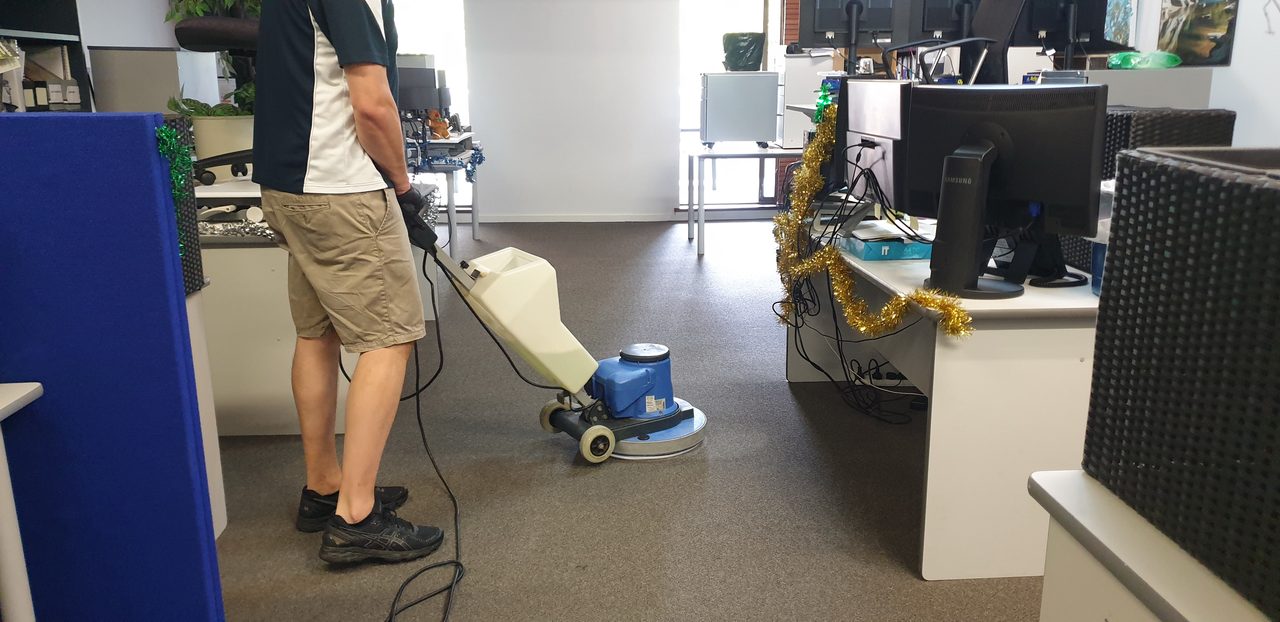
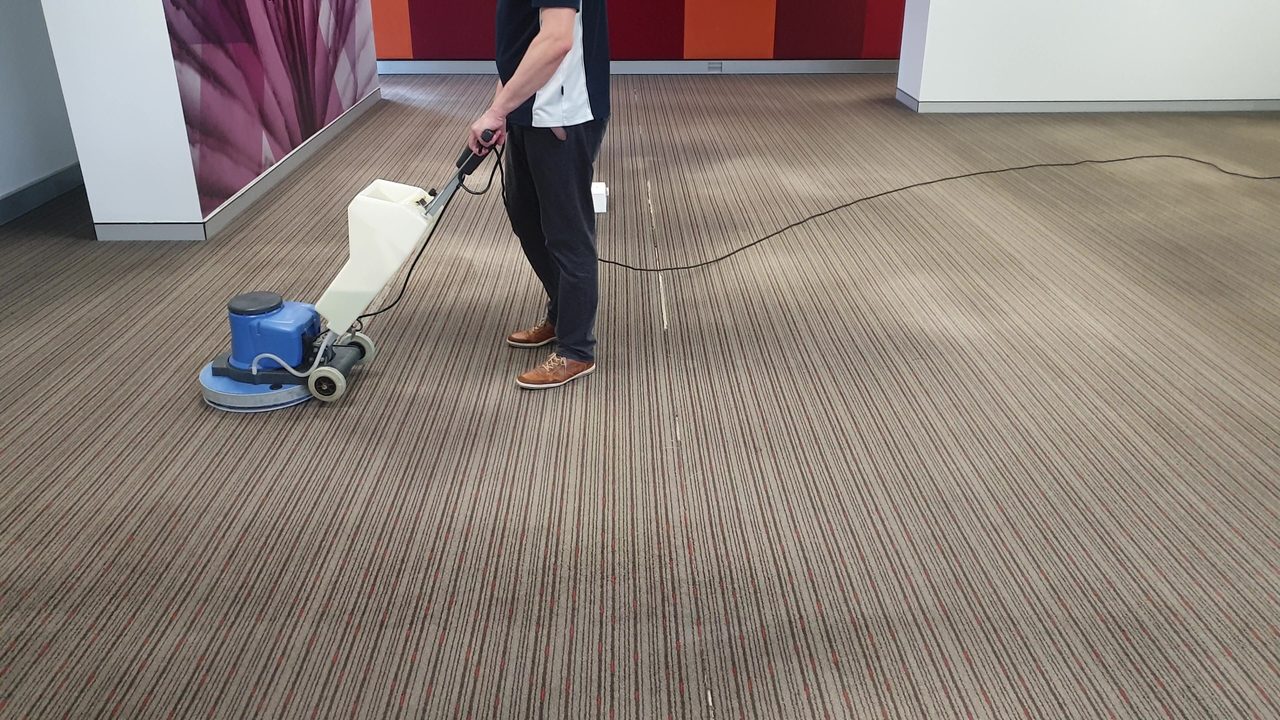
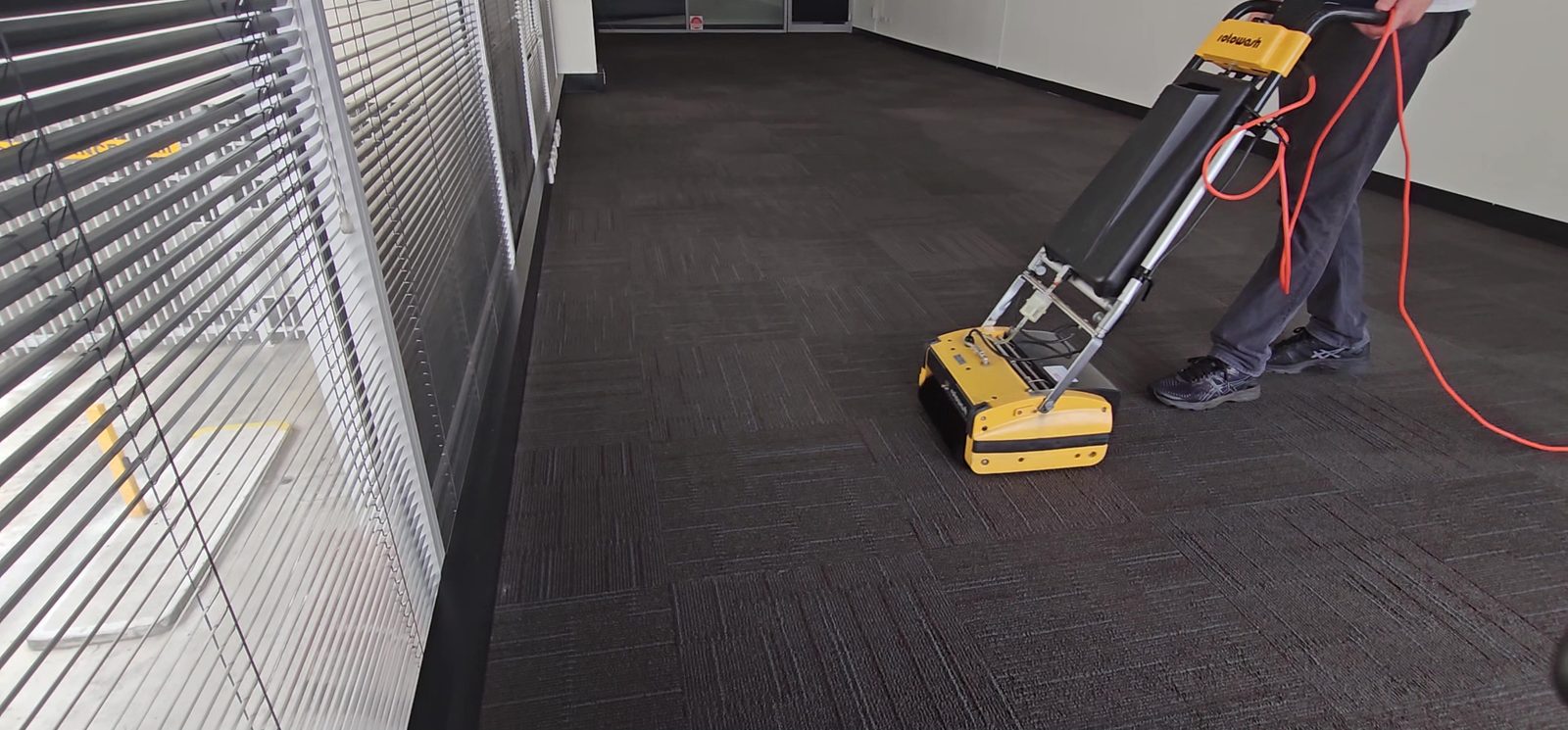
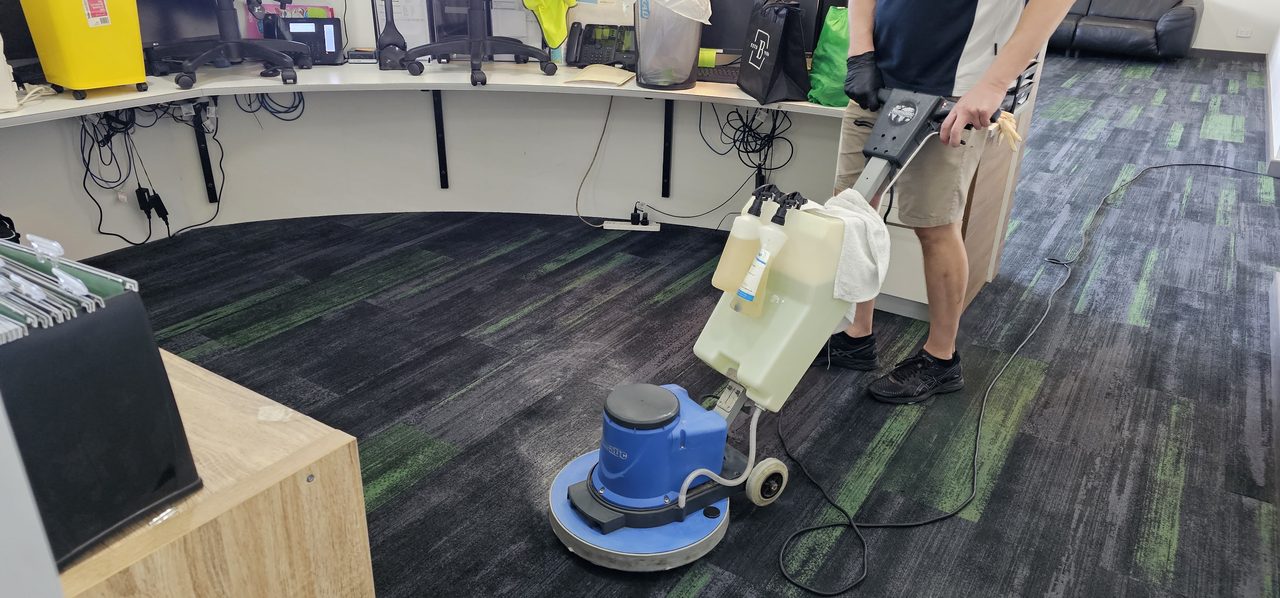
Encapsulation is the opposite in almost every logistical respect. The whole job arrives in a compact machine, a bucket of solution and a sprayer. There is no hose run, no van tethered to the building and no recovery tank to empty. A cylindrical brush machine such as a Rotowash works the solution through the pile with mechanical agitation rather than water volume.
That agitation does most of the work. The brushes drive the polymer down the fibre shaft and lift the crushed pile upright at the same time, which is much of the reason an encapsulated traffic lane looks refreshed rather than merely cleaner. With so little water used there is no soaking and no wet backing. People can walk on the floor again in an hour or two.
A compact machine, a bucket of solution and a sprayer, with no hose run and no recovery tank.
A scrubbing machine drives the polymer down the fibre shaft and lifts crushed pile as it goes.
It breaks the oily soil's grip on the fibre and dries into a brittle crystal around it.
The crystals leave with routine vacuuming over the following days.
The soil leaves over the following days rather than during the clean. It is held in dry crystals that your vacuum collects. Once they are vacuumed up, nothing stays in the fibre. That is why your cleaning contractor's thorough vacuuming in the days after is part of the clean.
Dry time is where the two methods differ most for an occupied floor. A well-executed truck-mounted clean on a synthetic commercial loop, in a ventilated space on a warm dry day, is usually dry in a few hours. The same job on dense cut pile in a sealed office in July takes considerably longer, and with no air movement it can still be damp the next morning.
Encapsulation on the same floor dries far faster. The pile is barely damp when the machine passes. The floor is walkable and dry within an hour or two, because so little liquid goes down.
What matters is not the number but the shape of the disruption around it.
Perth summers make this easy. A floor cleaned in February with the air conditioning running dries quickly, because the incoming air is hot and dry and carries moisture away almost as fast as you put it down. Winter is a different exercise. From June to August the air outside is often close to saturated, the building is shut against the rain, and evaporation slows right down.
The season does not decide the method. Lightly soiled carpet suits encapsulation in any month. Carpet with heavier soil needs steam cleaning in winter as much as in summer.
When your carpet needs steam cleaning in winter, we manage the drying deliberately: book earlier in the evening rather than at midnight, keep the air conditioning running overnight instead of switching it off for the weekend, and put air movers on the slowest areas. A Friday night clean on a floor nobody enters until Monday is usually the easiest win in winter.
Encapsulation has a ceiling. It is very good at removing light soil that sits in the upper pile. It is not designed to reach soil ground into the base of the yarn over years, and it will not rescue a neglected carpet.
Encapsulation suits light soil; extraction deals with heavy soil. On a heavily soiled floor, encapsulation gives a modest improvement and then plateaus, because it works the same shallow layer while the deep soil stays put.
These are the signs we look for at the inspection that a floor needs extraction rather than encapsulation.
Extraction has failure modes too, less discussed because it is the method with the better reputation. The most common is over-wetting. Too much water going in, or not enough coming out, pushes moisture into the backing and underlay where nothing can extract it. That is how you get carpet that dries slowly, shrinks at the seams, wicks stains back to the surface a day later, or develops an odour it did not have before.
The second failure is residue. Detergent left in the pile is sticky, and sticky carpet re-soils faster than it did before. A floor that looks superb on Monday and grey again by Friday has usually been cleaned with too much product and rinsed with too little.
| Failure | What you see | Where it comes from |
|---|---|---|
| Over-wetting | Slow drying, seam shrinkage, wicking, new odour | Too much water in, not enough back out |
| Residue | Superb on Monday, grey again by Friday | Too much product, too little rinse |
| Using it on light soil | Cost and disruption for little gain | Deep cleaning a floor that encapsulation suits |
None of these are arguments against extraction. They are arguments about how it is run.
The third is using it on a floor that does not need it. A corridor with only light soil gains nothing from deep extraction that encapsulation would not give it. The extra water and drying time are a cost with no return. The inspection shows which method the soil calls for.
How a carpet is built decides how much water it can safely absorb, and it is the part of the decision most buildings never consider. Modern commercial broadloom with a synthetic backing tolerates extraction well. A jute or hessian backing does not: it absorbs water, swells and shrinks as it dries, and can pull a carpet off its grippers or open a seam. Wool face yarn holds far more water than nylon and dries correspondingly slower, which is one reason wool is treated as its own discipline rather than as carpet that happens to be expensive.
Carpet tiles are dimensionally stable and generally fine with extraction, but the join lines let moisture down onto the adhesive, and heavy over-wetting can lift edges or leave grid-shaped wicking marks. Cushion-backed and dense cut-pile carpets hold more moisture per square metre than a low-level loop and should be planned as slower-drying floors from the outset.
A short list of construction facts is worth having before a method is chosen.
Per visit, encapsulation is the cheaper service and steam cleaning the dearer one. Price is not what decides between them. A cheaper clean that cannot reach the soil in your carpet costs more in the end, because the soil stays and keeps cutting the fibre.
Encapsulation used on heavily soiled carpet leaves the deep soil in place, so the results taper off. Steam cleaning used on lightly soiled carpet costs more than the soil calls for. Matching the method to the soil at the inspection is what keeps the cost right.
Regular cleaning removes soil before it bonds, so the carpet spends less of its life with abrasive grit grinding through it. Our advice is a professional clean no less than once a year, with busier areas cleaned more often where they need it. Carpet fails because sand cuts fibre, not because it gets dirty.
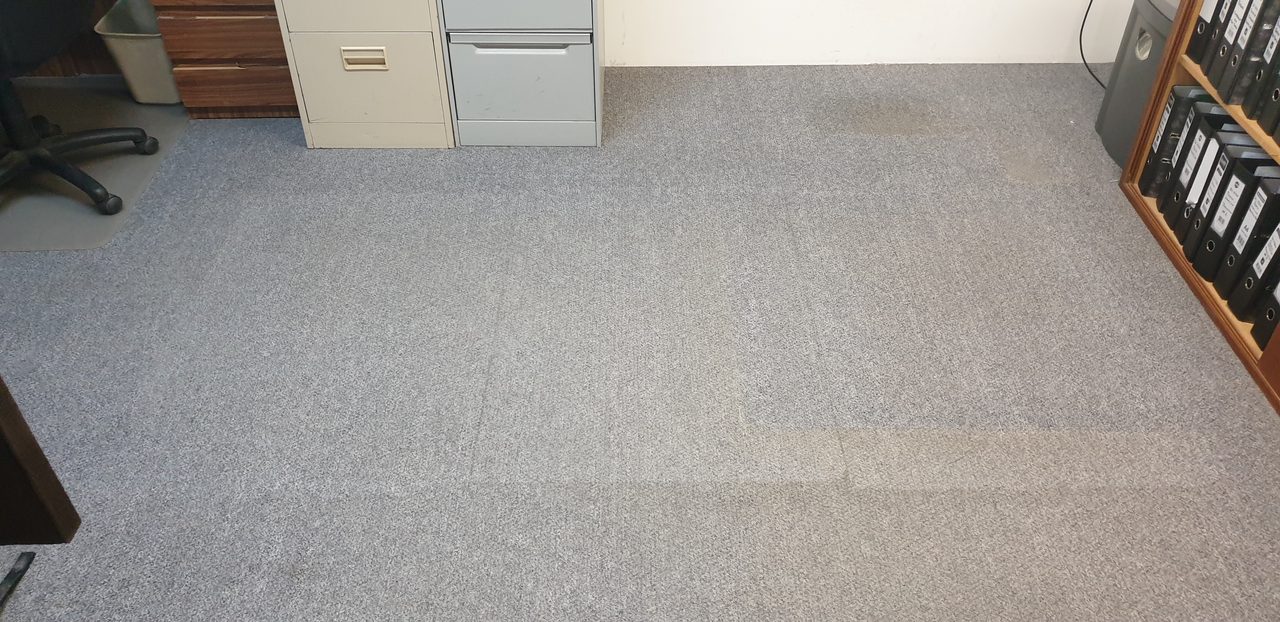
Take a mid-size West Perth office floor: reception, a main circulation spine, a couple of meeting rooms and open-plan workstations, with heavy wear in a narrow band and almost none under the desks. The inspection often finds different soil levels in different areas, so one floor can need both methods.
At the inspection, the entry area and main walkway show the heaviest soil and the most stains, so we recommend steam cleaning there. The meeting rooms and open-plan areas are lightly soiled, so encapsulation suits them. Our advice is a clean of the whole floor every year, with the entry and walkway done more often if their traffic calls for it. The client chooses how often to book. Autumn is a good time for the whole-floor clean, once the summer's coastal sand and easterly dust have been walked through.
The details vary by building. A venue with food and drink on the carpet has a much higher extraction requirement, and a cinema like the one we cleaned in Fremantle is different again because spills concentrate in aisles and foyers rather than spreading evenly. The principle stays constant: match the method to the soil in each area, clean the whole floor every year and give the busiest areas more cleans where they need them.
Building type is a useful shortcut, because it captures traffic, soil type, hygiene expectations and downtime tolerance in one word. Underneath it the same three questions always decide the answer. How much soil is going in, what stains it carries and what the carpet is made of. We answer those at the inspection and recommend the method from them.
The starting points below are a guide rather than a rule, and any of them shifts once someone has looked at the actual floor.
The most reliable way to decide is still to have someone look at the actual carpet. Soil level, fibre, backing, traffic pattern, access and operating hours all feed into the recommendation, and ten minutes on the floor settles questions an email exchange cannot.
One practical note on buying either of them. The price gap between the two methods is usually smaller than the gap between two quotes for the same method, because what actually costs money is hours on site: the pre-vacuum, the dwell, the dry strokes, and the time spent making sure a floor is genuinely ready to hand back. Ask what the hours are before you compare the numbers, and the comparison stops being guesswork.
If you are unsure which method your space needs, that is the kind of question worth asking before you book rather than after. An inspection of your carpet shows clearly whether it needs one method, the other or both in different areas.
Match the method to your soil load, the stains in the carpet and its fibre and backing. The carpet then holds its appearance for longer at a lower annual cost. We make that match at the inspection. When and how often you book is up to you.
Carpet fails because sand cuts fibre, not because it gets dirty.
The question worth asking is not which method is better. Our inspection tells you which one your carpet needs now.
How encapsulation polymers trap soil, why the vacuum finishes the job, what each machine does, and where low-moisture cleaning fits a Perth office.
Read ArticleHow Perth's dry summers and wet winters set the timing of vacuuming, encapsulation and deep cleaning, plus budgeting, records and working around tenants.
Read ArticleHow to set commercial carpet cleaning frequency by zone, traffic and sector, and build a Perth maintenance schedule that protects the carpet.
Read Article