
Entrance Matting: The Cheapest Carpet Care Your Building Will Buy
Most Perth buildings run their entrance matting too short and pay for it in worn traffic lanes. How the three-zone system works and how to audit yours.
Read ArticleCoastal sand wears the fibre, red scarp dust stains it and limestone dust dulls it. How each Perth soil reaches your commercial carpet and what stops it.
Ask what is in a commercial carpet and the generic answer is dirt. In Perth the honest answer depends on the street address. Vacuum the entry of a Fremantle tenancy and you collect pale, sharp quartz sand. Do the same in Midland and the sample comes up red-brown. Do it in a tower off St Georges Terrace and you find a fine grey powder with a faint pink cast that arrived on the wind rather than on a shoe. Three buildings, three soils, three different kinds of damage.
The reason is under the footpath. Perth sits on the Swan Coastal Plain, a series of sand bands running roughly parallel to the coast until they stop at the Darling Scarp. West of the freeway the ground is dune sand. Toward the hills it turns to red-brown gravels and loams rich in iron oxide. In between, and under a large share of the construction sites in the metro, is limestone. The soil map of the coastal plain is, for our purposes, a carpet maintenance map.
This matters because the three soils do not damage carpet the same way. Quartz cuts fibre. Iron oxide dyes it. Limestone and cement dust powder it and dull it. A cleaning schedule built for an average city soil load misses the real cause in most Perth suburbs. It spends effort on damage the building never receives and too little on the soil arriving every day.
West of the Mitchell and Kwinana freeways, the dominant soil is the pale quartz sand the suburbs are literally built on. It lies loose on every verge, footpath and beach car park from Fremantle up to Joondalup, and through summer the afternoon sea breeze keeps it moving. Any doorway on a western elevation collects a fresh delivery most days, and every shoe that crosses a sandy car park carries a sample inside in the tread.
Quartz is a genuinely hard mineral — about seven on the Mohs scale, which puts it above a steel blade and above window glass. The grains are angular, with fracture edges rather than rounded faces. Under a footstep those edges are pressed against carpet fibre at the full weight of the walker and dragged a few millimetres sideways. Repeated a few thousand times a day in the same traffic lane, that is not soiling. It is machining.
The grains do their worst after they disappear. Fresh sand sits at the surface where a vacuum can lift it, but within days it works down the pile and lodges near the backing, where routine vacuuming cannot reach and every subsequent compression grinds it against the base of the tufts. The dulling that results is permanent: scratched filaments scatter light instead of reflecting it, so the traffic area looks dull even when it is clean. How quickly a floor reaches that point depends partly on whether it is wool, nylon or olefin, because the fibres differ sharply in how they take abrasion.
Drive east and the ground changes colour. The Darling Scarp and its foothills are laterite country — ironstone gravel and red-brown loam rich in iron oxides, the same family of compounds that colours the Pilbara. Midland, Forrestfield, Kalamunda and the industrial land along the base of the scarp sit on it, and anywhere in the metro where earthworks strip the surface exposes something similar, because the red fraction travels with fill, truck tyres and wind.
The trouble with iron oxide is not only that it is hard enough to abrade. Its finest fraction behaves as a pigment, because chemically that is what it is — red and yellow ochre are iron oxides, and the colouring oxides mixed into concrete and pavers are the same compounds sold in bags. Particles this small do not sit on a fibre the way sand does. They lodge in its surface texture, and on absorbent fibres they effectively dye it.
The complaint arrives the same way every time. A beige or grey carpet near the entry of an eastern-suburbs building takes on a pink-beige cast, the cast survives a professional clean, and the cleaner gets the blame. It is worth being precise about what has actually happened, because the usual diagnosis — residue, poor workmanship, cheap chemistry — is usually wrong.
Extraction removes the loose loading, the red dust that is merely sitting in the pile, and the cast lightens accordingly. What remains is the fraction that has bonded to the fibre over months or years of traffic. Wool takes the tint readily, which is one reason it is a brave choice near an unprotected eastern entry. Conventionally dyed nylon takes it more slowly. Solution-dyed nylon, where the colour runs through the filament rather than sitting on its surface, resists it best, though nothing is immune forever.
Specialist iron treatments will shift a discrete rust mark, but a broad cast built up across an entry area is a different problem, and promising to remove it entirely would be dishonest. The realistic goal is to lift what is removable, then cut off the supply. Every month the dust is intercepted before it reaches the carpet is a month the staining does not deepen.
The third signature is white-grey. Much of coastal Perth sits on Tamala limestone, the city builds with it and on it, and cutting, grinding or driving over it produces a plume of fine calcium carbonate that travels several streets. Add cement dust from concrete cutting and rendering, and any building near an active site — a description that covers a remarkable share of the metro in any given year — receives a steady fallout of pale mineral powder.
Limestone is softer than quartz, but what it lacks in hardness it makes up in volume and fineness. It fills the pile, greys the colour and gives the carpet a chalky, slightly gritty feel under your hand. Cement fines bring a further problem: they are alkaline, and industry experience has long been that alkaline dust left sitting in wool carpet is unkind to the fibre and leaves a film that attracts the next round of soil. Osborne Park is the standing example — an industrial and showroom precinct where vehicles grind limestone road base all day and the carpets show it. The common sources are worth naming, because each one has an end date you can plan around.
A facility manager on the twenty-first floor of a CBD tower could be forgiven for thinking suburb soil is a ground-floor problem. The building has no verge, no beach and no earthworks, and its main entry is a well-matted lobby. Yet the carpet along the eastern glazing still develops a faint warm-grey film, and the vacuum sample still shows red under a bright light. The delivery mechanism is the easterly.
On summer mornings a hot, dry wind runs off the scarp and the interior, carrying the finest fraction of exactly the red material described above. Particles that fine do not need a door. They ride ventilation intakes, loading docks, lift shafts and clothing, and they settle wherever air slows down — which indoors means carpet, the largest area of still, textured surface on the floor plate. A week of strong easterlies leaves a visible red-brown film on an outside window ledge; a fraction of the same fallout is arriving inside.
Within a few hundred metres of the ocean or the river mouth there is a fourth ingredient, and it is not a grit at all. Breaking waves throw microscopic droplets of seawater into the air, the water evaporates, and what remains aloft is salt crystal — sea-salt aerosol. Fremantle, the beachfront suburbs and the marina precincts live in it, as anyone who parks a car near the coast already knows from what happens to the paintwork.
Salt is hygroscopic: it draws moisture out of the air. Salt crystals lodged in carpet do the same, so on humid days the fibre around them never quite dries. Slightly damp fibre is sticky fibre — fine dust that would brush off a dry pile clings to a damp one — which is why coastal carpet often resoils noticeably faster after cleaning than the same carpet a few suburbs inland. The salt itself is invisible; you only ever see its work.
Salt does not cut and it does not stain. It simply keeps the fibre damp enough for everything else to stick.
The practical consequence is method selection. Salts are water-soluble, so a hot water extraction finished with a thorough rinse dissolves and removes them along with the soil they have been holding. Coastal carpet with only light soil still suits encapsulation. Where salt has built up in the pile, the rinse of a steam clean is what dissolves it out. We tell you which your carpet needs when we inspect it.
Every one of these soils changes character with the season, because the thing that moves them changes. From roughly November to April, Perth's soils dry to powder and wind does the carrying — the sea breeze from the west in the afternoon, the easterly off the scarp in the morning. Everything arrives dry, fine and abrasive, and February, at the hot and dusty end of that run, is when the load peaks.
The June rain does not stop the traffic in soil; it changes the vehicle. Water turns the same quartz, iron oxide and limestone into a slurry that rides in on wet soles, and a wet sole deposits far more per step than a dry one, and deeper in the pile. The slurry then dries in place, binding the mineral load into the base of the tufts, where it waits for foot traffic to resume the grinding.
The two seasons therefore do different damage. Summer is when abrasion accrues, because the soil is dry, sharp and mobile in the pile. Winter is when sheer loading accrues, because each footstep imports more material and plants it deeper. We recommend matching your cleaning to that rhythm. Through summer, put the effort into matting and vacuuming. After winter, a professional clean takes out the wet season's load before it sets in the pile. The detail for each month belongs in a maintenance calendar; the principle is simply that the same building fights two different wars a year.
A commercial carpet is a record of everything that has crossed it, and it is surprisingly legible once you know the signatures. Colour, texture and location together identify the soil more reliably than anything short of a laboratory, and identifying the soil tells you which defence is underweight.
The reading takes five minutes with good light and clean hands. Rub the pile in a traffic lane and again at an entry, look at what comes up, and compare the colour of the lane with the colour under a desk or along a skirting line where nobody walks.
| What you see | Likely soil | Where it shows | Will cleaning fix it? |
|---|---|---|---|
| Dull traffic areas that stay dull after a proper clean | Quartz sand abrasion | Traffic lanes, worst near western and car park entries | No — scratched fibre is permanent, though cleaning removes the grit doing further damage |
| Pink-tan cast strongest at the entry | Iron-oxide dust | Eastern-suburbs entries, any building near earthworks | Partly — loose loading lifts, bonded pigment stays |
| Chalky pallor and a gritty feel | Limestone or cement dust | Construction-adjacent sites, industrial precincts | Mostly — it extracts well, but returns while the source is active |
| Dark, greasy lanes that darken rather than dull | Tracked car park oils | Any entry off bitumen, all year round | Yes — this is a cleaning problem with a cleaning solution |
Read the carpet before writing the spec. The signature tells you whether you are buying back appearance or protecting fibre.
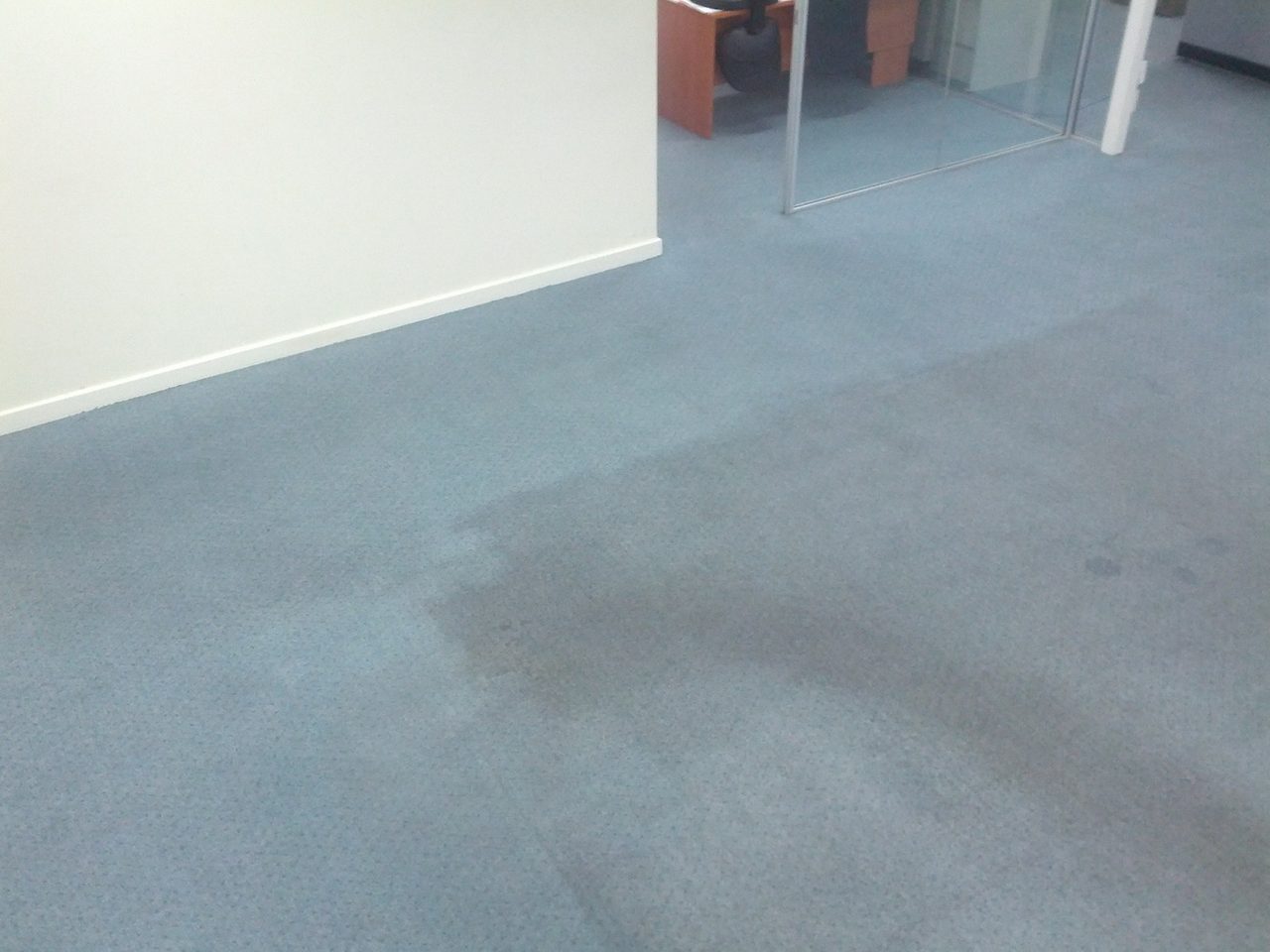
That comparison with protected areas matters because it separates soiling from wear. If the lane is darker than the skirting line, there is material in it that extraction will recover. If the lane is lighter and duller than its surroundings even after a clean, the difference is scratched fibre, and the next dollar should go into interception rather than into more frequent cleaning of a surface that has already permanently changed.
The defences are the same three layers in every suburb; only the weighting changes. The first layer is interception at the door — the mat well defence, covered in detail elsewhere. The short version for present purposes is that the sandier or dustier the postcode, the longer the matted run needs to be and the more often the mats themselves must be serviced, because a mat loaded with quartz stops being a trap and becomes a grinding plate.
The second layer is routine removal of dry soil before it migrates down the pile, which is the business of our vacuuming guide. Two suburb-specific notes belong here. In sandy coastal suburbs, entries justify daily vacuuming through summer even where the rest of the floor does not. And the finer the local soil, the more machine filtration matters — red scarp dust is fine enough to pass a cheap filter and blow straight back into the office air behind the machine.
The third layer is professional cleaning, with a steam clean wherever our inspection finds soil the first two cannot reach: the deep-lodged grit near the backing, the salt load near the coast, the alkaline film near construction, and the loose fraction of the red staining in the east. How often you clean should follow your building's soil, not a citywide average.
None of this is an argument for more cleaning everywhere. It is an argument for the right cleaning in the right place — which is usually cheaper, because effort stops being spent against damage a building never receives. A Scarborough tenancy and a Midland showroom can hold identical carpet, identical traffic and identical budgets and still need different cleaning, because the ground under them is different.
It is also why a quote given without seeing the site is worth roughly what it costs. Two things decide the right cleaning and neither can be read off a floor plan: what comes up out of the pile when a vacuum is emptied onto a white sheet, and which way the doors face. The suburbs we service run from the beach dunes to the base of the scarp, and the soil changes across that distance more than most building managers would credit. If there is one thing worth carrying away from all this, make it the white-sheet test. It costs nothing, it takes two minutes, and it will tell you more about your own building than any brochure will.
Most Perth buildings run their entrance matting too short and pay for it in worn traffic lanes. How the three-zone system works and how to audit yours.
Read ArticleWool, nylon, olefin and polyester each need a different pH, temperature and agitation. How we identify your fibre on site, and why guessing ruins carpet.
Read ArticleHow Perth's dry summers and wet winters set the timing of vacuuming, encapsulation and deep cleaning, plus budgeting, records and working around tenants.
Read Article