Home Gallery Blog FAQs
Contact 0460 815 038
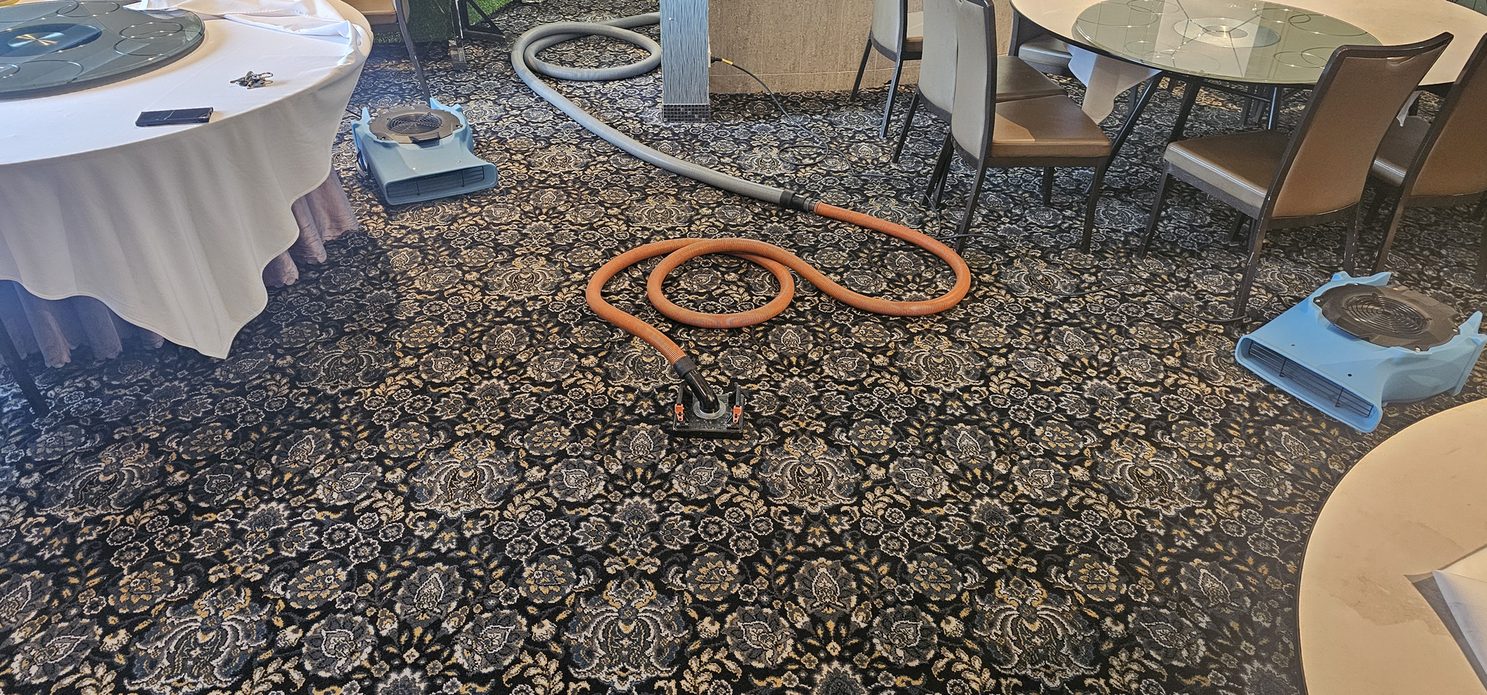
Water damage restoration in Perth, flood extraction and air movers drying the carpet of a function room between its dining tables.

Water Damage Restoration in Perth

As an IICRC Certified Firm, we restore water-damaged commercial carpet to the IICRC S500 standard, whether the water came from a burst pipe, a roof leak or an overflowing basin. Our flood extraction tools pull the water out of the carpet and off the slab beneath it, then air movers and dehumidifiers run until our moisture meters read the floor dry. A hot water extraction clean finishes the job and puts the floor back into use. Extraction in the first hours saves the most carpet, so call us the moment you discover the water.

15+ yearsCleaning commercial carpet
IICRC certifiedCleaned to the industry standard
WoolSafe approvedSpecialist care for wool carpet
$20M insuredPublic & products liability
Free on-site quotesWritten price, no obligation
From $385GST inclusive
7 days a weekWhenever you need us
Perth metroJoondalup to Fremantle
IICRC qualified in water damage restoration

Water damage restoration for carpet and floors

Water on a commercial floor is a problem measured in hours. A burst pipe, a leaking roof or a basin left running sends water under closed doors, along the skirtings and across the slab beneath the carpet tiles, well past the patch you can see. We get the water out, dry the carpet and the slab beneath it, and clean the floor so your people can use it again instead of replacing it. A flooded room at home is handled the same way. Call straight away and we estimate the cost over the phone before we set out.

More of the floor saved

Water caught in the first day or two is usually a drying job. Carpet left wet for longer starts to delaminate, with its backing layers coming apart, and within one to three days mould can start to grow, which makes replacement likely.

Dried to the readings

Our moisture meters show where the water went, and we keep drying until the floor is dry all the way through, not just dry to the touch.

Cleaned, not just dried

Once the floor is dry, the affected carpet gets a full hot water extraction clean and a deodorising treatment, so it looks and smells like the rest of your floor.

Open 7 days

We take water damage calls 7 days a week, evenings and weekends included, and extraction starts on the first visit.

Water on the floor now?

Call the moment you find it

We talk you through what to do before we arrive, any day of the week, and the carpet is assessed on the first visit, so you know whether it can be saved before you pay to dry it.

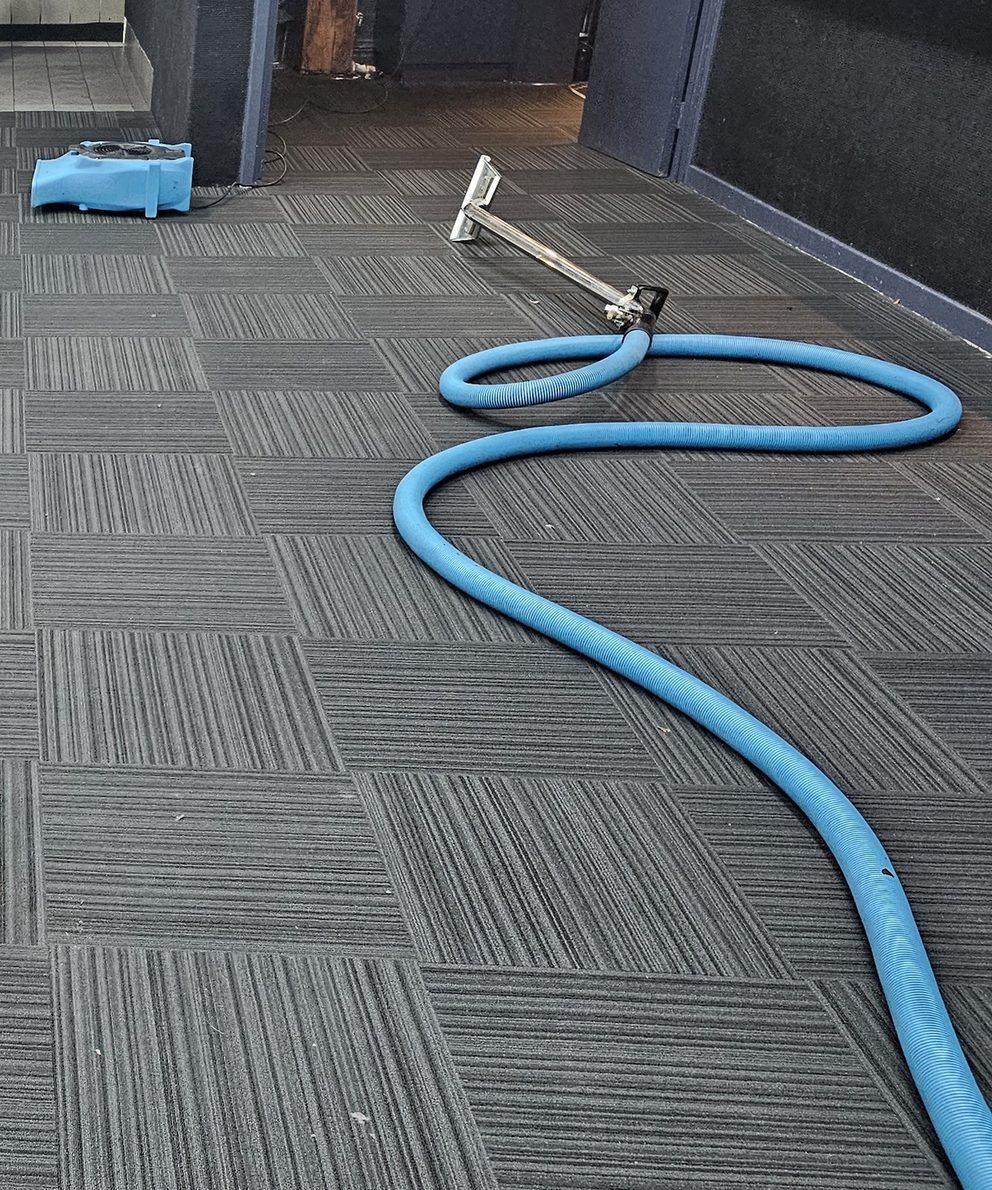
Flood extraction on the carpet tiles of a Perth office, pulling the water from the joins and the slab beneath.
Truck-mounted extraction set up at a Perth function venue, the hose and wand laid on the carpet tiles and an air mover already running.
Before we arrive

Five safe steps while we're on our way

Take only the steps you can do safely. Each one limits the damage. If water is still coming in, call your plumber and us at the same time.

Turn off the water

If you can reach the valve or the stopcock, turn it off. If it's a roof leak or a storm, move what you can away from where the water is coming in.

Keep away from power

Keep people away from power points, power boards and cables near the wet floor. Only switch off at the board if getting to it keeps you out of the water.

Lift what can't get wet

Raise boxes, paperwork and electronics onto desks or shelving. Cardboard soaks up water fast, and paper doesn't recover.

Don't use a household vacuum

It isn't built for water and can give an electric shock. A mop only spreads the water further. Leave the extraction to us.

Take photos

Before anything is moved, get photos of the water and where it came from. Your insurer will ask for them.

Urgent help

We answer 7 days a week, evenings too

Where the water is, what caused it and roughly how long it's been sitting are all we need to give you a realistic arrival time.

Floors and walls

How each floor and wall dries

Most commercial carpet has no underlay. It's carpet tiles or broadloom glued straight to the slab, so the water that gets through the carpet runs under the tiles or sits between the carpet and the concrete. We work out the approach for each floor at the first inspection.

Carpet tiles

Water runs under the tiles and across the slab, and their PVC or bitumen backing slows the drying of the concrete beneath. We dry them where they lie, extracting the water out of the joins and the backing in repeated passes with our flood extraction tools before air movers and dehumidifiers dry the tiles and the slab until both read dry.

Glued-down broadloom

Water soaks the carpet and sits on the slab beneath it. Repeated passes with our flood extraction tools recover as much water as possible, then air movers and dehumidifiers dry it in place. A long soak can soften the adhesive and let the carpet lift, and we check for that as it dries.

Broadloom on underlay

This carpet is stretched over underlay on gripper strips, which is uncommon in commercial buildings but found in some hotels and boardrooms. Underlay soaked with clean water and caught early can be dried in place. Long-soaked or contaminated underlay has to come out.

Rugs and entrance mats

We get them off the wet floor straight away, so their dyes can't bleed into the wet carpet (dye transfer) and the floor under them can dry.

Timber and parquet

Timber beside wet carpet takes up water from below and cups, with the edges of each board rising above the centre. We extract the surface water fast, dry the room, and point out any boards that need a flooring contractor.

Concrete and car parks

Standing water in a basement car park or lift lobby keeps running towards the carpeted areas beyond it. We clear it with the truck-mounted unit before it gets there.

Walls and skirtings

Plasterboard and timber skirtings draw water upwards, and a wet wall keeps the carpet beside it damp. Where the water has wicked only a short way up, the equipment drying the room dries the bottom of the wall too, and the meter confirms it. A wall soaked higher, or wet inside its cavity, is structural drying work, and we'll put you onto a specialist.

Not sure what's under the carpet?

We find the water with the meter

Tell us the floor and we map the wet area on arrival without lifting a tile, and the scope says what dries in place.

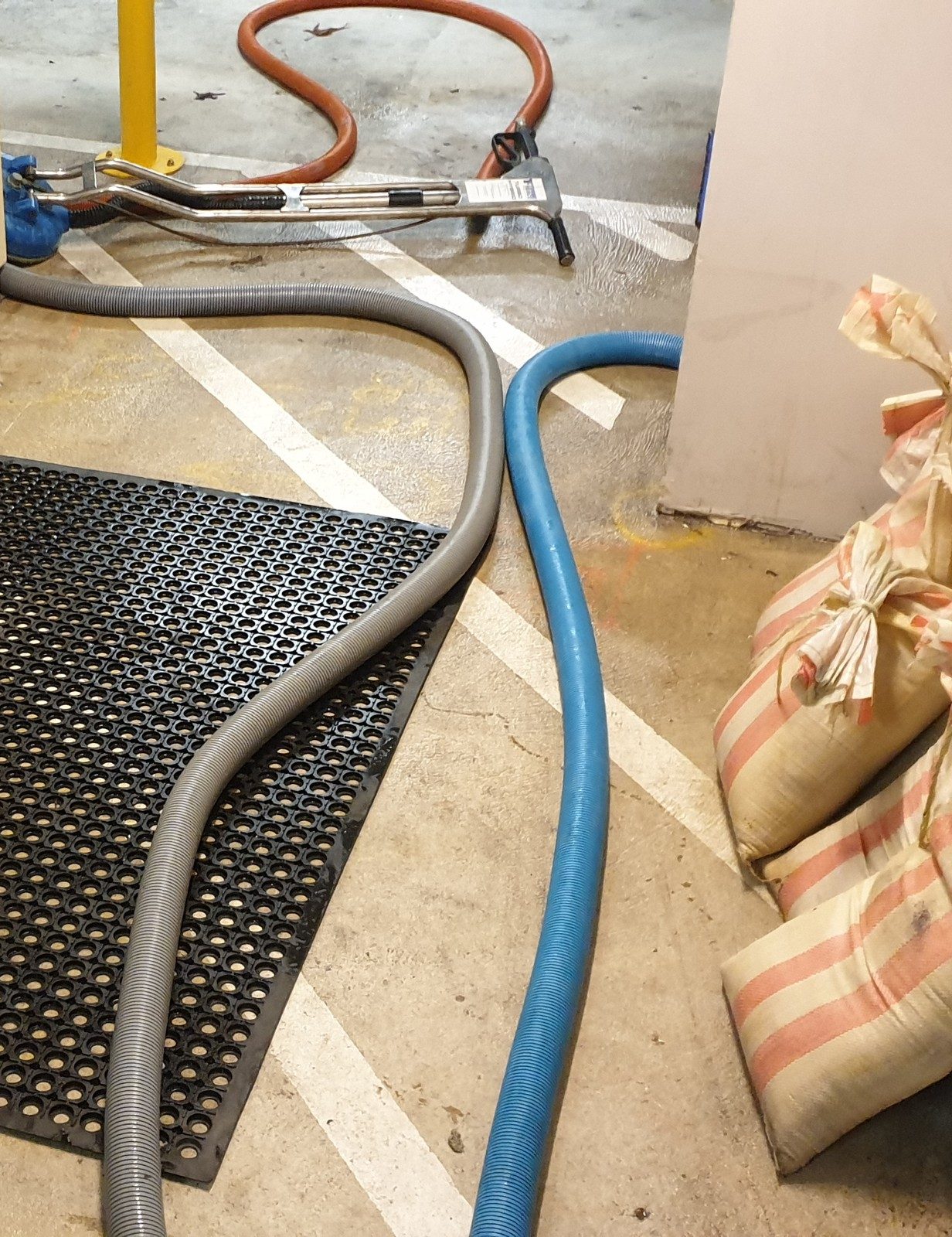
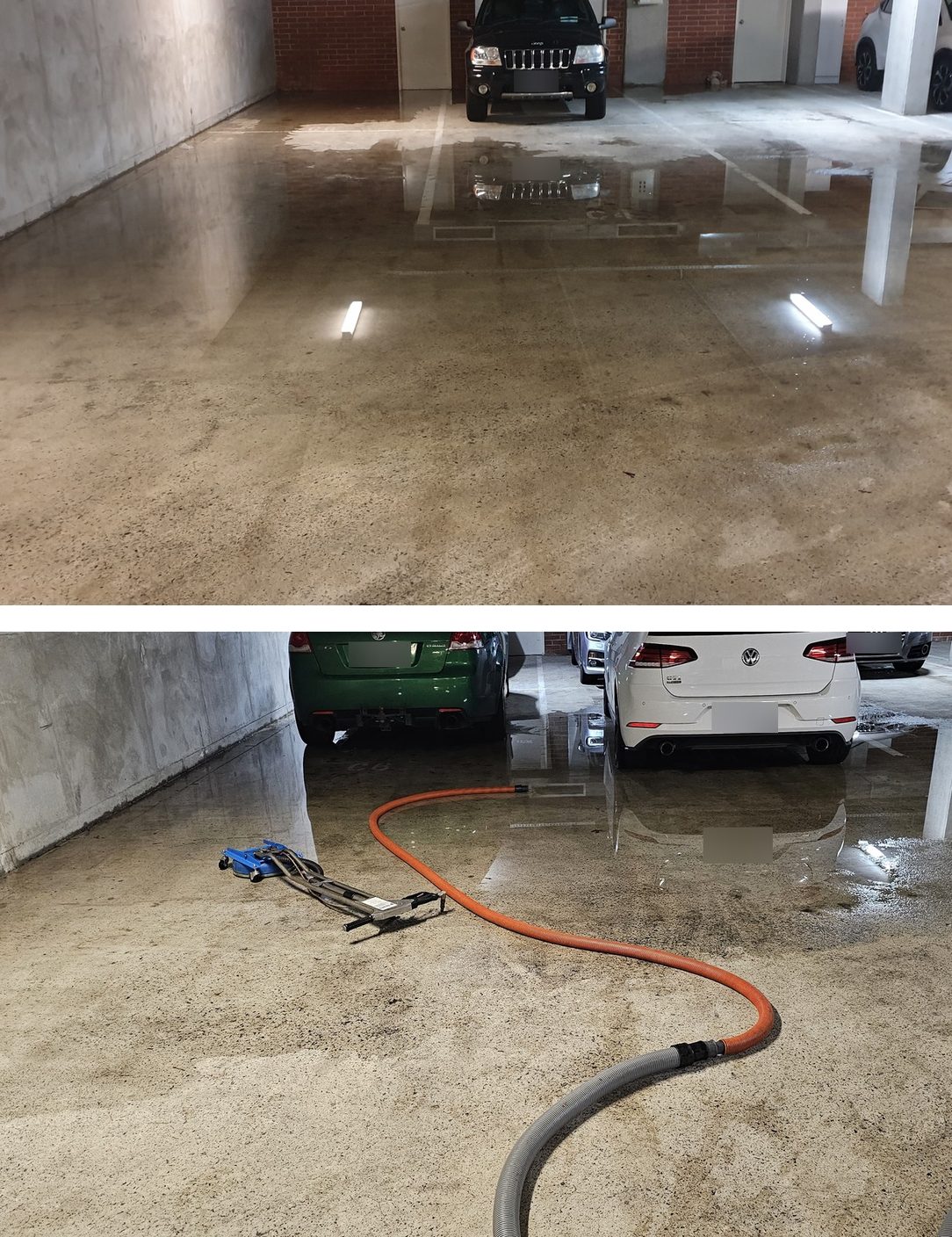
Our truck-mounted hoses run into a flooded basement lift lobby in Perth, clearing the water before it reaches the carpet beyond.
Standing water across a basement car park in Perth, and the sand a flood carried in left on the slab while we extract it.
IICRC water categories

What clean, grey and black water each mean

Under the IICRC's water damage standard, S500, water falls into three categories. We establish which one you have before the drying starts, because the category tells us what can be kept and what has to go.

Category 1: clean water

It comes from a burst supply pipe, a tap or a hot water unit. Caught early, the carpet and the floor beneath can usually be dried and cleaned.

Category 2: grey water

It comes from a dishwasher, a washing machine or an overflow with no sewage in it, and carries significant contamination, so we clean the carpet and apply an antimicrobial as well as drying it.

Category 3: black water

This is sewage, a drain backing up, or storm water that has crossed the ground outside, and it is grossly contaminated: carpet soaked with it can't be safely kept, and the standard says it should be removed. You'll know that from our first visit.

Water gets worse with time

Clean water left sitting for a day or two picks up contaminants from the carpet, the slab and the building, and is then treated as Category 2. Call early and a Category 1 leak stays a Category 1 job.

Hard surfaces underneath

Once contaminated carpet is out, we clean the slab and other hard surfaces and apply an antimicrobial before the room is used again.

Not sure how dirty the water was?

Tell us where it came from

The source decides the category and what can be saved. Say on the call whether it was a tap, a drain or a flood, and we bring the right treatment.

Class 1 to Class 4

Sizing the drying job by its water class

Alongside the category, the IICRC S500 standard gives every job a class from 1 to 4. The class measures how much water the carpet, the floor and the walls have taken up, and so how much has to be evaporated to dry them: the evaporation load. It sets the size of the drying set-up and how long it runs.

Class 1 and Class 2 jobs are the work we take on: carpet and floors, smaller areas, and walls that are barely wet. When a job goes beyond that, we tell you at the first call or visit and point you to the right specialist, so no time is lost.

Class 1: the least water

Only part of a room is affected, with the carpet and floor lightly wet and very little soaked into anything else. A short drying set-up after fast extraction brings it back.

Class 2: a room or more of wet carpet

Carpet and the floor beneath are wet across a whole room or more, and water has wicked a short way up the walls. Extraction, air movers and dehumidifiers dry the carpet, the floor and the bottom of the walls together, and the moisture meter confirms each one.

Class 3: soaked from above

The most water, often from a burst pipe or a roof leak overhead: walls soaked well up, ceilings and insulation wet as well as the floor. Drying a building in that state is structural drying, a job for a structural drying specialist.

Class 4: water held in dense materials

Water is bound deep in concrete, hardwood, stone or plaster, which give it up slowly. These materials need specialist drying methods and far longer drying times, and that is structural drying work too.

More than a wet patch?

We size it on the first visit

Tell us how much floor is wet and how long it's been that way. The class sets the machines we bring; a Class 3 or 4 job is handed to a structural drying company, and we say so on the call.

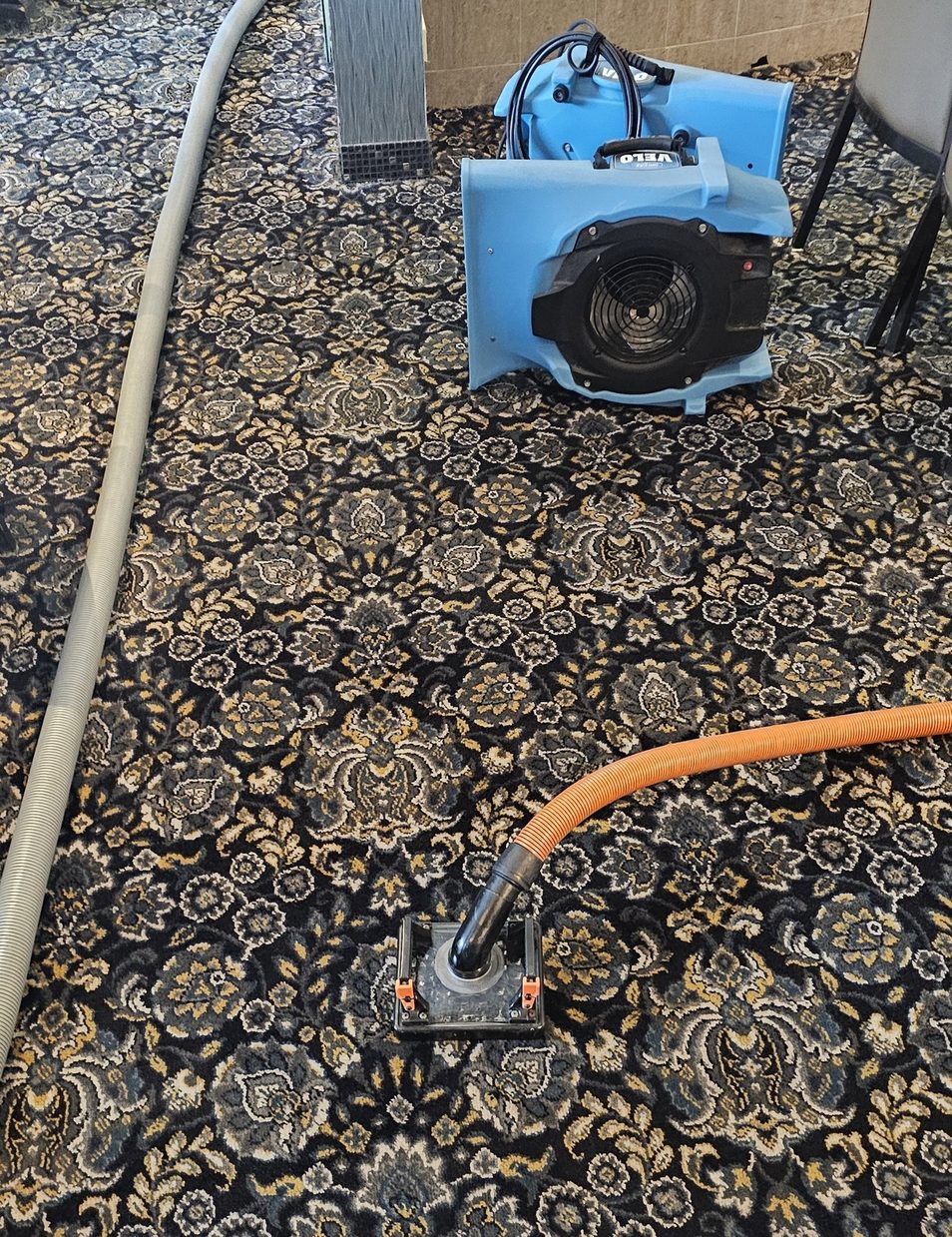
Drying a Perth function room's carpet, an air mover set beside the flood extraction tool on the patterned floor.
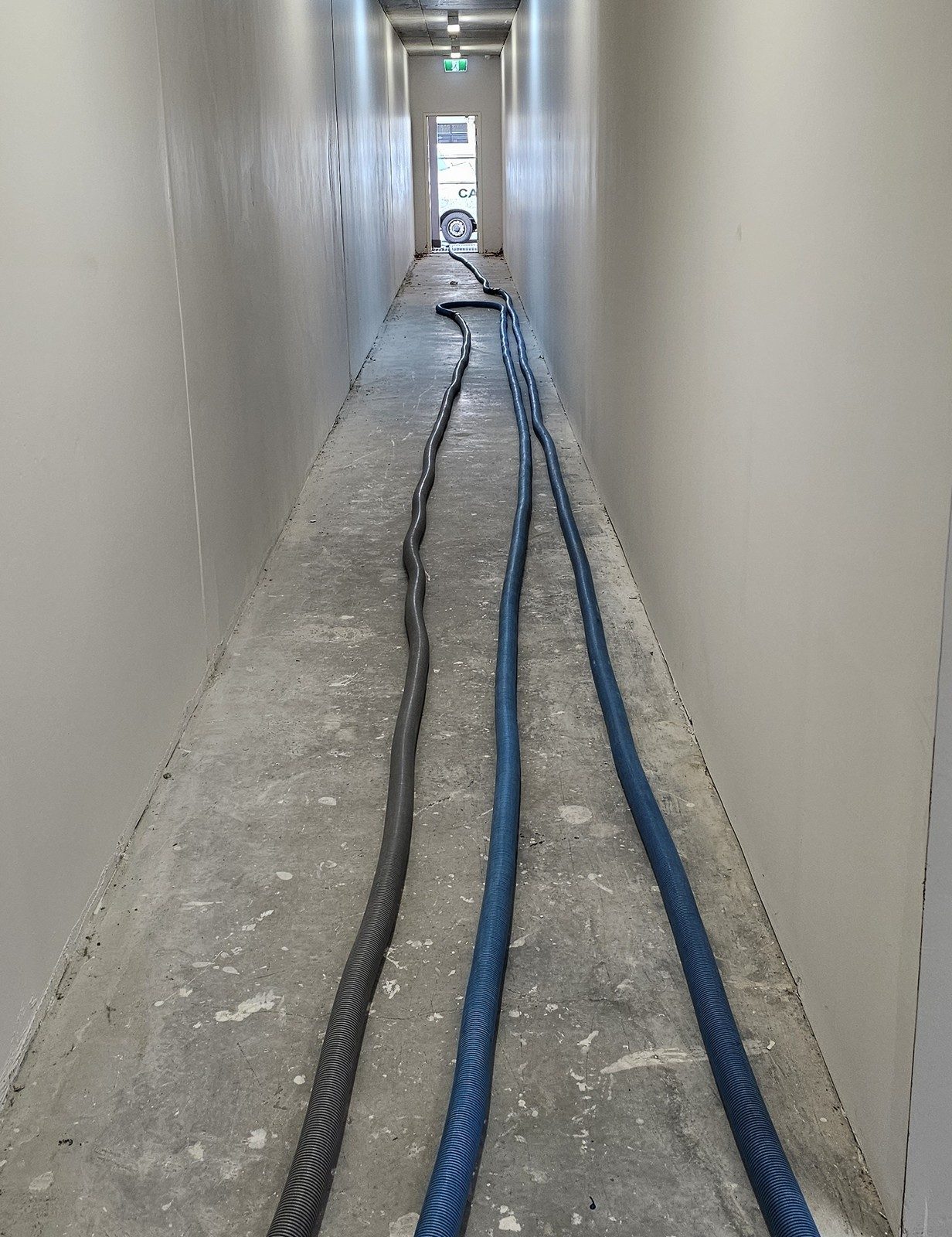
Our truck-mounted extraction hoses laid down a service corridor in Perth, on their way to a flooded basement car park.
For your insurer

Measured and documented for your insurer

We scope the job with moisture meters, not by the size of the wet patch. The readings show where the water went, and the price you agree to covers that area. If later readings change the scope, you approve the change on the day.

Readings as the floor dries

We take moisture readings at each visit and record them, so you have a record of how the floor dried. An assessor may look at the claim weeks after the water marks have gone, and the readings show what was there.

A written scope

What was wet, what we did and what it cost, in one document you can pass to your insurer or assessor.

Photos on arrival and at handover

We photograph the wet areas when we arrive and again when we hand the floor back.

Cover and clearances

Our documents are ready for your building manager on request: certificates of currency for our $20M liability cover and our workers compensation, National Police Clearances, and our Safe Work Method Statement.

The claim stays with you

You and your broker lodge the claim, and we give you the evidence to support it.

Claiming on insurance?

The record comes with the job

Ask on the first call and the moisture readings, the photos and the written scope are kept for your insurer from arrival to handover.

Call, extract, dry, sign off

How we run a water damage job

The first step happens on the phone, before we arrive. After that, the category of the water and the type of floor decide how each step is done, and the moisture readings decide when the job is finished. Call first; the scope is written on the visit and the drying days are set from the readings.

Step 1 of 8: as soon as you call

Advice on the phone, and an arrival time

The first minutes of the call are about your floor: where the water is, where it came from, what to turn off and what to lift. Then we give you an honest arrival time.

If the source is still running, call your plumber too. Extraction can start before the leak is found.

On the callShut-off and contents advice
After thatAn honest arrival time
Your next stepCall us and the first step is done on that call
Flood extraction

How flood extraction shortens the drying

Flood extraction tools are built to drain a carpet, where a cleaning wand is built to rinse one. On a flooded floor they recover the bulk of the water before any drying equipment is switched on.

Drying days make up most of the cost of a water job, so thorough extraction is the surest way we have to keep your bill down. We work each wet area in slow, overlapping passes: carpet left damp rather than soaked dries in fewer days, and your room is back in use sooner.

Suction through the backing

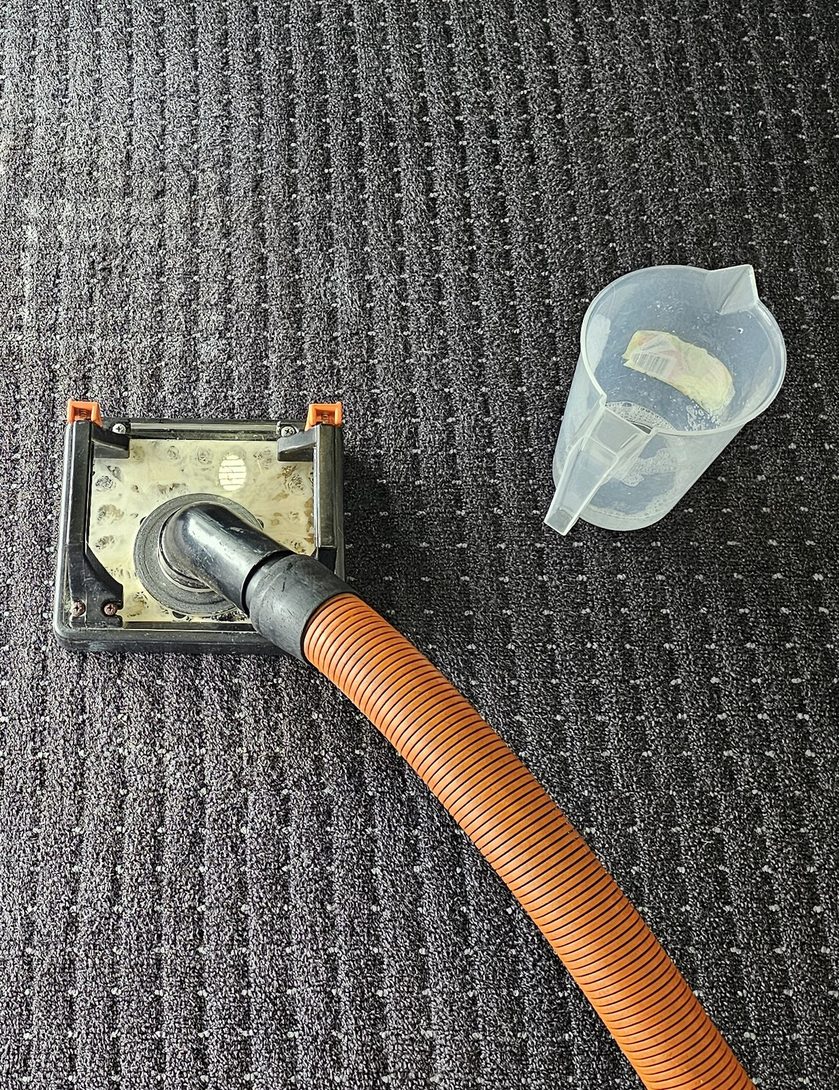
The head is kept flat on the carpet while the vacuum runs, so the water is drawn up out of the backing and from underneath it, not just off the pile.

Truck-mounted or portable

The truck-mounted unit gives the strongest suction, so its hoses run in wherever the van can park close by. Portable extractors take over on upper floors and sites the hoses can't reach.

Glued-down carpet

Neither carpet tiles nor direct-stick broadloom come up, so the extraction has to draw the water up through them from the slab before the drying starts.

Then the drying

Once extraction is finished, the air movers and dehumidifiers go in to dry what's left.

Want to know what arrives on the van?

Flood extraction first, then the drying

The extractor draws the water back up through the tiles and the joins before the air movers and dehumidifiers go down.

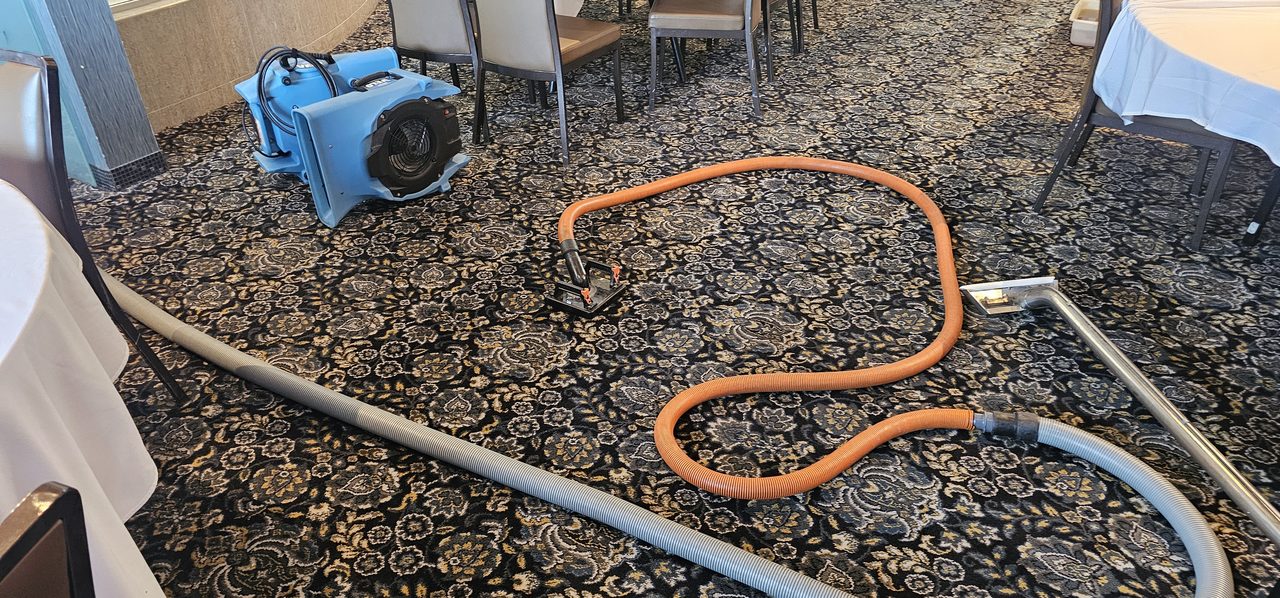
Flood extraction tools and a wand laid out on a Perth function room's carpet, with an air mover ready to start the drying.
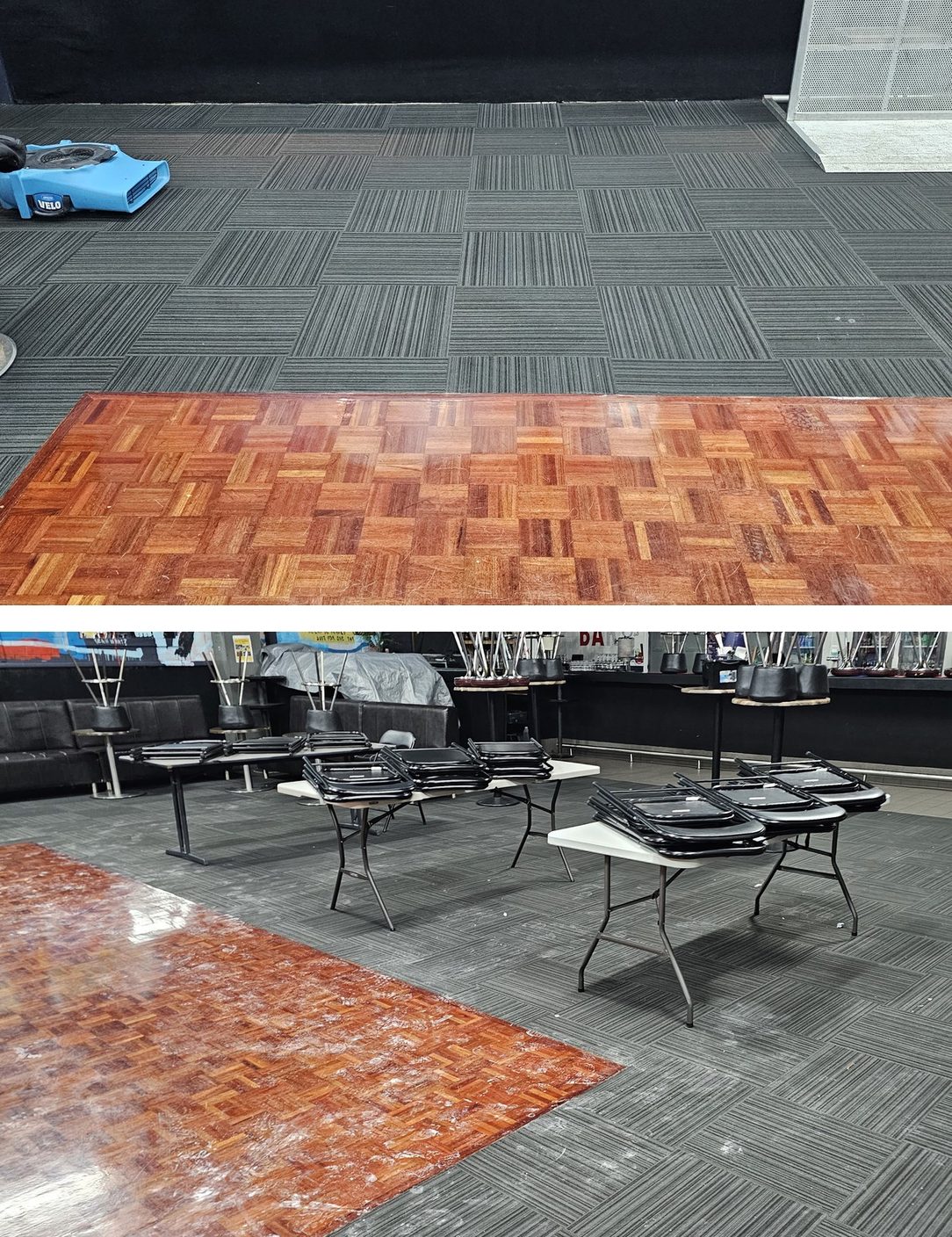
An air mover drying the carpet tiles beside a Perth function venue's parquet dance floor, and the same room once dry, ready for its clean.
Case study

Water damage restoration for a Perth function venue

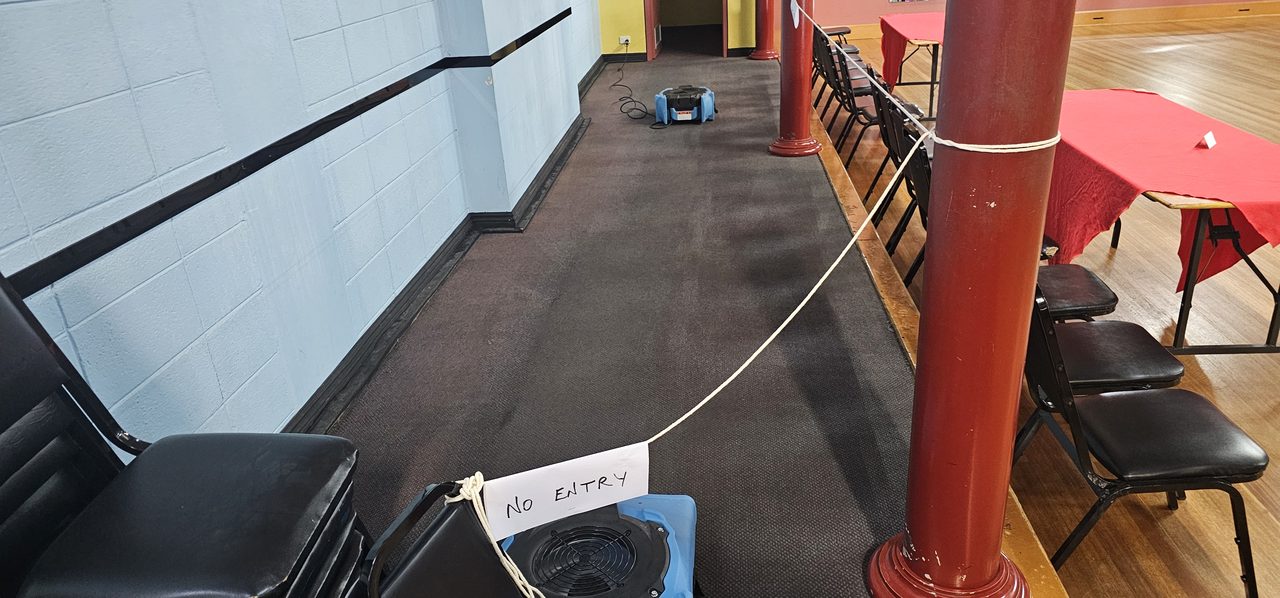
Water spread across the carpet tiles and timber parquet dance floor of a Perth function venue. We extracted it with the truck-mounted unit, screened off the wet area with signs, and set up air movers across the floor.

We returned each day to check the readings and move the equipment, and the floor was dried in good time. The carpet tiles were then cleaned, and the venue was ready for its next event.

The venue

A function venue in Perth

What got wet

Across carpet tiles and a timber parquet dance floor

Equipment

Truck-mounted extraction, then air movers, checked every day

Handed back

Dried in good time, then cleaned for the next event

A venue with a booking this week?

Tell us the date

The extraction and the drying days are set around it, and the scope in writing says when the floor is handed back.

A wet stretch of carpet in a Perth function hall roped off while an air mover dries it, the rest of the room left set for use.

Offices

Office floods usually start with a small failure that runs unnoticed over a weekend: a kitchenette hose, a leaking air conditioner in the ceiling, or a leak from the floor above.

We extract and dry around the workstations, keep cables clear of the water, and screen off the air movers and dehumidifiers where they disturb your staff least. Desks go back into use as the floor under them dries.

Most office floors are carpet tiles, and we dry them where they lie: the water is drawn back up through the tiles and their joins, and the drying equipment is set out around the desks so the rest of the office keeps working.

Tell us how many floors are wet and when the office needs them back, and the drying plan works towards that date.

Floor underfootCarpet tiles on a concrete slab
Water sourceKitchenette hoses and air conditioners
Google reviews

What our clients say about our work

If your floor needs the same, call us or ask below, or see the gallery first.

Zoran did a magical job on my carpets. I was thrilled they came up as well as they did. I thought I was up for replacing them. I give him a ten out of ten.
Lorraine Bull · Google review
We haven’t had our carpets cleaned for more than a 10 yrs and Zoran did amazing job 🌟🌟🌟🌟🌟 Carpets looks as new and perfect. Highly recommend his services. Many thanks
Kena Henderson · Google review
Zoran made our carpets look amazing. He kept us very informed throughout the whole process and was very helpful with other cleaning tips or tricks. Definitely recommend.
Wondering Bird · Google review
Zoran does a fantastic job, very reliable and reasonably priced, highly recommend
Carole Tristram · Google review

Read all our reviews on Google

Cost and scope

Priced on a written scope

Restoration is priced on a written scope. We draw it up on site from moisture readings, the water category and the type of floor.

  • Time since the leak

    Water caught within hours is mostly in the carpet and on the surface, and extraction takes out most of it. Water left over a weekend has spread under the tiles, across the slab and into the next rooms, and each of those adds drying time.

  • Category 1, 2 or 3 water

    Clean water from a burst pipe, grey water from an appliance and black water from a drain are three different jobs. The category decides the treatment and what can be saved.

  • Spread beyond the first room

    Water that stays in one office makes a small scope. Once it has run along a corridor, into two tenancies and across a lift lobby, the scope grows with it, and the moisture readings show how far it went.

  • Days of drying

    The scope names the drying equipment and the number of days, and those two make up most of the cost. Drying carpet in place costs far less than replacing it, and an early start leaves more of it worth drying.

  • Water under glued-down floors

    Glued-down floors are dried where they lie. Water that has run under the tiles or broadloom across the slab takes more extraction passes and more drying days than water held in the pile.

  • Stock to move, hoses to run

    A storeroom full of boxes, a compactus on the wet floor, an upper floor beyond the truck-mounted hoses or a basement car park with long hose runs makes for a longer job.

Water damage work carries the same $385 minimum charge, GST inclusive, as our cleaning, and on a flooded floor it forms part of the scoped price rather than a separate charge. That price covers the extraction, equipment and drying days set out in the written scope, the same document you can give your insurer. Ask below, or call, and the scope is written on the first visit. For a home, call first for a free cost estimate by phone and we scope the job properly when we arrive.

After the flood

Lowering the risk of the next flood

A regular check of hoses, valves and drains catches most of the failures behind commercial floods.

Know where the water turns off

Every minute the water runs adds to the damage. Label the stopcocks and the main valve, and make sure your after-hours keyholder knows where they are.

Replace flexible hoses on a schedule

Braided flexible hoses under sinks and on dishwashers, fridges and coffee machines burst without warning. Have your plumber replace them every few years, sooner if the braid shows rust or the hose bulges, and look at them each time the carpet is cleaned.

Clear gutters and drains before winter

Perth's winter storms overflow blocked gutters, box gutters and car park drains. Have them cleared before June.

Watch for a musty smell

A properly dried floor smells of nothing. A musty smell weeks later means moisture is still trapped somewhere, so call us before anyone paints over it or uses air freshener.

Give your keyholder the numbers

Whoever holds the keys after hours needs your plumber's number and ours, so the first call happens in minutes.

Smell after a flood

Moisture is still there

When a smell returns after a flood, part of the floor never reached its dry standard. We trace the wet patch with a moisture meter and dry it out.

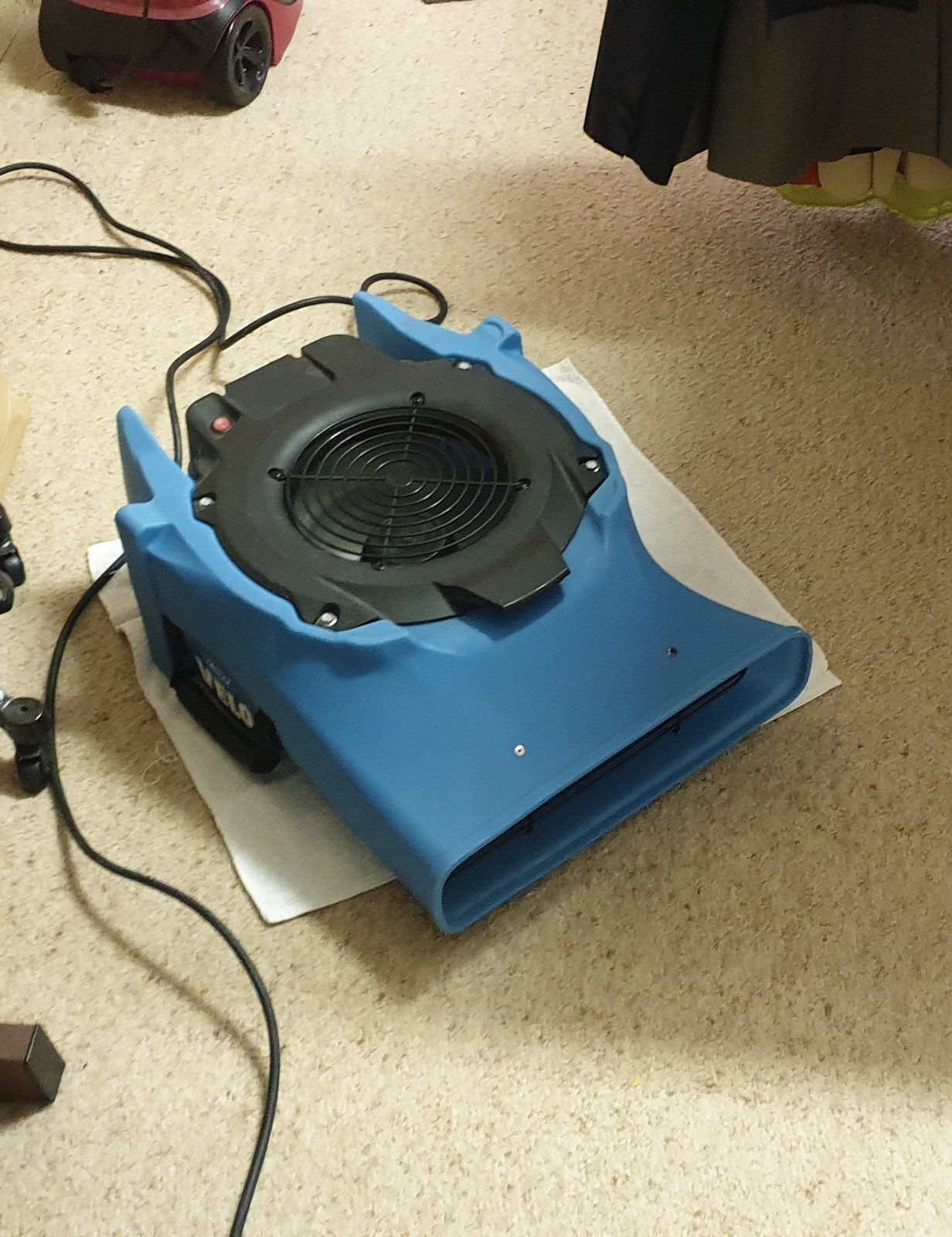
An air mover drying carpet in Perth after a leak, set on a protective sheet and run until the floor reads dry.
Beyond water damage

The rest of the building, once it's dry

Once the floor is dry, the rest of the building's cleaning can go on the same quote, whatever else is on your list. Tell us what else needs doing and it's quoted once the floor is dry.

FAQ

Answers on water damage restoration

Still have a question?

Ask us directly

If your question isn't answered here, call us. You'll get a straight answer about your carpet and your premises, with no obligation.

Do you work at night and on weekends?

Water damage call-outs are taken 7 days a week, evenings and weekends included, so a leak found on a Friday night isn't left sitting until Monday. Ring us the moment the leak is found. On the call, we'll give you a realistic arrival time and walk you through the first steps until we arrive.

Call Zoran on 0460 815 038.

What decides the cost of water damage restoration in Perth?

The written scope does. Our minimum charge of $385, GST inclusive, is the starting point and part of that scope, not an extra. We build the scope from moisture readings taken in each room, and these things shape it:

  • How long the water sat before extraction started
  • Whether the water is clean, grey or black (Category 1, 2 or 3)
  • How far it spread, by the meter rather than by eye
  • The floor itself: carpet tiles, broadloom or timber
  • How many days of drying equipment it needs
  • Contents and access, such as a full storeroom or a wet floor high in the building

You agree the price before the work goes ahead. If later readings show the water went further, the change to the scope comes to you for approval first.

Are you qualified in water damage restoration?

Yes. Zoran qualified by IICRC examination in water damage restoration, carpet cleaning, and carpet repair and reinstallation. We're an IICRC Certified Firm, and we work to the IICRC S500 standard for professional water damage restoration. On your floor, that means:

  • The water is classed as Category 1, 2 or 3 before any drying starts, because the category decides what can be saved
  • Moisture meters measure the job, not touch or guesswork
  • Sign-off comes only when the floor reads the same as an unaffected room
  • Carpet soaked with black water is removed, as the standard requires

The carpet and the floor are ours to handle: we extract the water, dry what's left with air movers and dehumidifiers, and clean the carpet once it reads dry. If you'd like to know how we'd handle your building, just ask Zoran when you call.

Do you do structural drying?

Not ourselves. Our work is Class 1 and Class 2 water damage under the IICRC S500 standard: water in the carpet and the floor, over smaller areas, with the walls barely wet. Class 3 and Class 4 jobs, where water has soaked walls well up, wet the ceilings or got deep into concrete, timber or stone, need structural drying, and that calls for a specialist with the equipment and methods to dry a whole building.

If that's what you're facing, we'll say so on the first call or at the first visit and put you in the right direction, so you're not left waiting while the water spreads.

Can our wet carpet be saved?

Most wet commercial carpet is saved when the water is clean and extraction starts early. Three things decide it: how long the water has been there, which IICRC S500 category it falls into, and the type of carpet. Category 1 clean water, such as a split supply hose, extracted within a day or two usually leaves a drying job rather than a replacement. With Category 2 grey water, the carpet is cleaned with an antimicrobial as well as dried. Carpet soaked with Category 3 black water, such as sewage, is removed, following the standard. The longer any water sits, the further it spreads and the more likely the backing is to delaminate, which pushes the job towards replacement.

Of those three, time is the one you control, so shut off the supply at the valve if it's safe to reach, get boxes and paper up off the floor, and keep foot traffic off the wet carpet. For the first hour, step by step, read our commercial flood guide.

Can carpet laid on underlay be dried in place?

Underlay soaked with clean water can usually be dried in place, as long as drying starts early. Carpet on underlay is uncommon in commercial buildings, where most floors are carpet tiles or glued-down broadloom, but we do find it in some hotels and boardrooms.

Our flood extraction tools draw the water out of the underlay as well as the carpet, pass after pass, then air movers and dehumidifiers dry both layers in place. The moisture meter goes on the underlay and the floor beneath it, and the drying runs until both read dry.

Underlay that has stayed wet too long, or was soaked with grey or black water, can't be cleaned and has to come out. Our readings show which of these applies to your floor.

How can you tell the floor is really dry?

We measure it. A floor is dry when the moisture meter reads the same in the affected rooms as in a room the water never reached, and the drying equipment stays until it does.

Touch isn't a reliable test. The pile can feel dry while the backing of a carpet tile or the slab underneath is still holding water. Moisture left there shows up weeks later as a musty smell, or as brown marks wicking up through the pile. So our readings come from the carpet backing and the slab, not just the pile, before we sign the floor off.

How much noise and disruption does the drying equipment cause?

Noisy up close, and much quieter through a closed door or wall. The air movers and dehumidifiers run day and night until the floor is dry, because drying slows right down whenever they're switched off and the job takes longer.

We set the equipment up to disturb your business as little as we can:

  • The wet area screened off and signed, which keeps most of the noise in
  • Cables routed away from the water and walkways, and power circuits checked before anything runs overnight
  • Desks and rooms back in use as their section of floor dries
  • Equipment moved to the slowest-drying areas at each visit, and taken out the day the floor reads dry

The dehumidifiers give off some warmth, so the room runs a little warmer than usual. If a room has to stay quiet for meetings or appointments, tell us and the equipment layout will be set around it.

Does insurance cover water damage?

That depends on your policy, so your insurer or broker is the one to confirm it. We provide the evidence a claim relies on, recorded while the damage is fresh:

  • A written scope of the wet areas, the work done and the cost
  • Moisture readings from every visit, showing how the floor dried
  • Photos on arrival and again at handover
  • The water category under the IICRC S500 standard, and our view on where the water came from

Your insurer will want your own pictures too, so photograph the wet floor and the leak's source before anything is moved. The claim itself is lodged by you or your broker, and our paperwork can go straight to the assessor. Assessors and building managers sometimes ask about our own cover as well: we hold $20M public and products liability insurance and workers compensation for our technicians, and we'll send the certificates of currency to whoever needs them.

It flooded on Friday and it's now Monday. Is it too late?

It isn't too late, but call us today, because a weekend changes the job. Over a weekend, clean water gathers contamination from everything it soaks into, so by Monday it's treated as grey water and the carpet needs sanitising as well as drying. Carpet that has stayed wet that long can also start to delaminate, with the backing coming away.

Much of a weekend-old flood is still a drying job, and the first visit sorts out which parts. We map the water with the meter, put the drying equipment on everything that can still be saved, and tell you straight away what can't, so you aren't paying to dry carpet that has to go. If the backing has already let go, the floor can't be brought back: our article on when to repair, restore or replace carpet explains delamination.

Does water from a blocked drain change the job?

A drain makes it a black water job. Water that comes up through a drain or sewer is Category 3 under the IICRC S500 water damage standard, however clear it looks. Storm water that has run across the ground outside before coming in is treated the same way.

The standard says carpet soaked with black water should be removed rather than dried, and we follow it, so we tell you that before any drying equipment goes down. Once the carpet is out, we clean and sanitise the concrete and any other hard surfaces before anyone uses the room again. If the water has reached the base of walls or partitions, we show you where it reached so your builder can deal with them.

Before we get there, keep people and stock off the wet area, and have a plumber find and clear the blockage.

What causes a smell months after a leak, and can it be fixed?

A smell that lingers months after a leak means moisture is still held somewhere, and once we find it and dry it, the smell can be removed in most cases. In the floor, we usually find it in one of three places:

  • The slab under carpet tiles, where no air reached
  • Carpet in the lowest corner of a storeroom, under shelving, boxes or a compactus
  • A timber floor beside the carpet

We find the moisture with the meter, dry it out, then clean and deodorise the carpet. If the readings show the moisture is held in a wall rather than the floor, that's a job for a structural drying specialist, and we'll say so. The smell can't go until its source is dry, which our article on carpet odours covers in detail. Air freshener or fresh paint leaves the damp in place, so the smell returns: call us before anyone tries either. If you can see signs of mould, our mould guide shows what to look for.

Is mould part of your water damage work?

Mould goes to a mould remediation specialist rather than to us. Mould remediation has its own IICRC standard, S520, separate from water damage. Carpet that has its water extracted and its drying under way in the first 24 to 48 hours rarely gets that far, which is why we ask you to call the moment you find the water.

If we arrive and find mould already growing in the carpet, on the floor or on the walls, we'll tell you straight away and point you to the right people.

Do you fix the leak or repair the building?

Neither: plumbing, roofing, electrical work and building repairs belong to those trades, and drying out soaked walls and the building structure is structural drying, which belongs to a specialist. We handle what the water did to your carpet and floor: extraction, drying, cleaning and deodorising the carpet.

The plumber can look for the source while we extract, and we set the job up so other trades can work alongside us. Where we find damage outside our work, such as cupped timber boards or water-damaged plasterboard, we flag it so you can book the right trade.

How many days does a flooded floor take to dry?

Three to five days is usual for a commercial floor after water damage. That's much longer than the 4 to 8 hours carpet takes to dry after a routine steam clean, because flood water soaks down to the carpet's backing and the concrete beneath it, while a routine clean wets mainly the pile. Concrete is porous and gives up its water slowly, so the slab is usually the last part of the floor to read dry.

The exact time depends on how much water there was, how long it sat before extraction, the type of floor, and the temperature and humidity in the building. The drying equipment runs around the clock, and we take readings at each visit until the floor matches a dry room. A function venue in Perth with a wet parquet dance floor and carpet tiles, for example, was dried, cleaned and back in use for its next event.

Do wet carpet tiles have to be replaced?

Most don't, when the water was clean and we reach it early. We dry carpet tiles where they lie:

  • Flood extraction pulls the water up out of the tiles, the joins and the slab beneath, pass after pass, until the tools draw no more water
  • Air movers and dehumidifiers then dry the tiles and the slab beneath them
  • The meter tells us when the tiles and the slab read dry, and the tiles are then cleaned with hot water extraction

Tiles wet with grey water are sanitised during cleaning as well. Tiles soaked with black water, such as sewage or a drain backing up, are replaced. If tiles were left over from the original fit-out, set them aside, because they're the closest colour match.

Does glued-down carpet bubble or lift after a flood?

Only if water sits under it long enough to soften the adhesive, and fast extraction usually stops that happening. We extract with flood extraction tools, run from the truck-mounted unit or, where the hoses can't reach, a portable extractor. Drawn slowly across the carpet, they pull the water out of the backing and off the slab, pass after pass, until no more comes up. Air movers then dry the carpet in place.

As it dries, we check for any areas where the glue has let go. If the carpet has lifted, we tell you, and a flooring contractor re-glues it once the slab reads dry, because fresh adhesive won't bond properly to wet concrete. Until then, keep trolleys and heavy chairs off any raised areas so the carpet doesn't crease or stretch.

Do you clear flooded car parks and basements?

Basement car parks, lift lobbies and corridors are part of our flood work: after a storm or a burst pipe, we clear the water from them with the truck-mounted unit before it reaches the carpeted areas next to them.

Clearing the concrete first protects the carpet beside it, which takes far longer to dry. We then check the edges of that carpet with the moisture meter, in case water has already run underneath. In strata buildings, the lobby or car park stays fenced off and the strata manager is kept up to date while we work. Long hose runs down into a basement add time, and the scope allows for them. If a blocked drain or box gutter caused the flood, have it cleared before the next storm.

Industries

Who calls us when a floor floods

How we respond to a burst pipe depends on the building: a surgery brings hygiene rules, a strata lobby brings residents who still need access, and a shop or stockroom brings trading hours to work around. Your building type is listed below, with a page of its own.

Your building not listed? Call anyway; every flooded floor is assessed the same way, on the first visit.

From the blog

Before, during and after a flood

Non-urgent jobs

Book a free water damage assessment

With standing water, don't wait on the form: ring Zoran now on 0460 815 038. For anything that can wait, the building, where the water came from if you know, and how long the floor has been wet are enough for us to arrange a free assessment.

Phone
0460 815 038
Email
commercialcarpetcleaningperth@gmail.com
Postal
PO Box 272, Perth WA 6906
Hours
Open 24 hours, 7 days a week
IICRC Certified
WoolSafe Approved
Fully Insured
Request a free inspection & quote

For domestic cleaning needs, please call 0460 815 038.

Tick all that apply. Not sure what fits? Compare our services, check pricing & quotes or browse the FAQs — or just tell us below.

MoTuWeThFrSaSu

Free and no obligation. We measure up on site, confirm the visit with you by phone, and cover the whole Perth metro area.

We respect your privacy. Your details are only used to contact you about your enquiry.

Water damage restoration

Water damage help, 7 days a week

Describe what you can see when you ring, and we'll help you limit the damage over the phone, at no cost and with no booking needed. We're open 7 days.