
What to Do When Your Commercial Premises Floods
What to do in the first hour when a commercial floor floods, how extraction and structural drying actually work, and when carpet can be saved.
Read ArticleHow mould starts in commercial carpet, how to find it before you can see it, what remediation really involves, and when the carpet has to come out.
Damp does not stay damp. Left alone, a wet floor is not a static problem but a countdown, and mould is what it is counting down to. Every slow leak, every condensate drip, every flood dried in a hurry is travelling towards the same destination, and what varies is how long it takes to arrive.
That makes mould the failure state of building maintenance rather than a separate misfortune. It is also the point at which carpet stops being an asset you clean and becomes a decision you have to make, because some of it can be saved and some of it cannot, and telling those two apart is most of the work.
This article is about mould that has already started: how to find it before you can see it, what remediation genuinely involves, and when the honest answer is that the floor comes out. The emergency itself, the first hour when premises flood, has its own playbook, and if there is water on your floor right now that is the piece to read instead.
Mould is not exotic. It is a fungus, its spores are in the air of every building on earth, and they are entirely harmless until they land somewhere that offers them a living. Four things make a living: moisture, an organic food source, still air, and time. Take away any one of them and nothing grows.
Carpet supplies three without being asked. Food is permanent, in the form of skin cells, food debris, paper fibre, the fine organic fraction of ordinary dust, and in many carpets a jute or latex backing that is itself edible. Still air is guaranteed below the pile, at the perimeter and under the furniture nobody moves. Time is whatever you give it.
Moisture is the one lever you actually control, and that is the whole discipline in one sentence. It does not take a flood, either. Air that sits humid enough for long enough will condense moisture into a cold corner, and the pile holds what lands there. Warmth accelerates all of it, which is why a closed Perth building in February is such a productive place to be a fungus.
The sources repeat from building to building, and after enough call-outs the list stops being surprising. What they have in common is that they deliver small volumes of water to the same square metre for weeks. That is considerably more dangerous than a large volume delivered once and extracted the same afternoon.
Kitchenettes lead the field. A flexible hose weeping behind a kickboard, or a dishwasher connection with a slow drip, puts water into a dark cavity with no airflow at all, and nobody sees it because the joinery is in the way. Air conditioning is next. A blocked condensate drain pan fills a ceiling void quietly for weeks, and the office that receives it is usually the corner one sitting under the fan coil unit.
Then there are the sources nobody thinks of as plumbing. Internal planter boxes without a sealed liner and tray water the carpet as generously as the plant. Older ground-floor tenancies built before slab membranes were standard push moisture up from below, and an impermeable carpet backing traps it there. And there is almost always one flood, a year or two ago, that everybody remembers being dried over a weekend.
Mould announces itself by smell long before it is visible, which makes the nose the earliest and cheapest instrument in the building. What you are detecting is a set of microbial volatile organic compounds, the by-products of a colony that is actively growing rather than dormant. Musty, earthy, faintly like a cellar: that description from a staff member is a finding, not a complaint.
Use it properly. Sensitivity drops within a couple of minutes of exposure, so walk the floor as you arrive rather than after a discussion in the affected room, and get low, because these compounds concentrate near the carpet. Character narrows the search too. Sour and faintly sweet points at spilled milk, a sharp ammonia edge means urine, and only musty means moisture. The method for diagnosing a musty smell against the alternatives is worth reading before you go hunting.
Then confirm with a meter rather than an opinion. A non-invasive moisture meter run across the suspect zone in a grid, with a control reading taken from an unaffected part of the same floor, turns a nose full of suspicion into a number you can put in an email to a landlord. A thermal camera adds the cold patches, which is where evaporation is happening and therefore where the water tends to be.
Once you have it narrowed to a few square metres, measure it. Moisture readings on the carpet backing and the slab, compared with a dry spot on the same floor, settle questions that an hour of standing on the floor never will.
You are reading four things: the underside of the backing, the condition of the underlay, the slab itself, and how far the staining extends compared with what shows on top. Black or grey speckling on the backing, a white crystalline bloom on the concrete, an underlay darker in a shape considerably wider than the visible mark. Each of them says the same thing, which is that the surface has been telling you a flattering story.
Do it around the skirting line and under whatever never gets moved. Spilled liquid finds the edge of a room and stops there, held against the gripper, and the carpet beneath a fixed cabinet or a partition base has never been cleaned, never been dried quickly and, in most buildings, never been looked at.
Mould in an occupied building is a health question, and it deserves a temperate answer rather than either of the two usual ones. A growing colony releases spores and fragments into the air, and damp carpet under a desk puts them close to the breathing zone of somebody sitting still for eight hours a day.
For most healthy adults, ordinary indoor exposure produces irritation rather than illness: a blocked nose, itchy eyes, a cough that mysteriously clears at the weekend. The people who react at much lower exposures are those with asthma or existing allergies, and anyone immunocompromised. That is a real population in any office and a larger one in aged care, childcare and healthcare settings, where the threshold for acting should be correspondingly lower.
The obligation side is simpler than most people fear. Australian work health and safety law expects a business to eliminate or minimise risks to workers so far as is reasonably practicable, and visible mould with a known damp source is a risk somebody has already told you about. Recording the report, the investigation and the fix is usually what turns a complaint into a closed matter rather than a running one.
Nothing about the carpet matters until the water has stopped. This sounds obvious and is ignored constantly, because the carpet is the visible problem while the leak is behind a kickboard or above a ceiling tile. Cleaning carpet while water is still arriving is simply a deposit on doing the same job again in six weeks.
So the first invoice usually belongs to somebody else: a plumber for the hose or the waste, a mechanical contractor for the condensate line, a builder for a failed membrane or an overflowing box gutter. Then the structure has to be dried, and the structure means the underlay, the base of the plasterboard and the top of the slab, not just the pile. It is dried to a reading against a dry standard, not to the point where it feels acceptable underfoot. That is water damage restoration proper, and it belongs before any assessment of what can be saved.
Only then is a verdict on the carpet worth forming. Assessing wet carpet is guesswork; assessing dried carpet is inspection. It is also the moment the cost stops moving, because everything after that point is work you will only have to do once.
Plumber, mechanical contractor or builder, whoever owns the source. Nothing downstream is worth doing while water is still arriving.
Underlay, skirting and slab, with air movers and dehumidification, to a moisture reading against a dry standard rather than to a feeling.
Read the backing, the slab and any underlay, and decide recoverable or not on the evidence rather than on optimism.
HEPA vacuuming, an antimicrobial given its full dwell time, extraction from below, then aggressive drying.
Re-check on the first properly humid week, because that is when anything missed will make itself known.
The single question that decides the money is whether growth is sitting on the carpet or living inside it. Those are two different states rather than two degrees of the same one, and they are not reliably distinguishable from above.
Surface colonisation is what happens when spores settle on a damp pile and find enough soil to start. The face fibre of most commercial carpet is nylon or polypropylene, which is not itself food, so what the colony is eating is the dirt held in the pile. Remove the soil thoroughly, remove the moisture, and you have removed the colony's living.
Colonised backing is another matter entirely. Below the face sits latex or bitumen adhesive, often a jute or polypropylene secondary backing, and beneath that an underlay of foam or rubber whose whole purpose is to trap air, which makes it excellent at holding water. Once hyphae, the fine root-like threads a colony grows into a material, are through that layer, nothing worked into the face of the carpet reaches them. The structure they are inside is porous and the cleaning is not.
| Surface growth | Colonised backing | |
|---|---|---|
| What you see | Discolouration in the pile that partly lifts on a test clean | Little or nothing on top, and speckling on the underside |
| Where the food is | Soil in the pile, not the fibre itself | Backing, adhesive, jute and underlay |
| Smell after drying | Fades once the floor is clean and properly dry | Returns on the first humid week |
| Realistic outcome | Usually recoverable in place | New underlay at minimum, often new carpet |
The verdict is made under the carpet, not on it.
Remediation is a sequence, and skipping any part of it produces a result that looks convincing for a fortnight. The first move is dry, not wet. HEPA vacuuming the affected area and its surrounds lifts loose spores and dust before any liquid is introduced, because wetting a dry colony first turns a containable problem into a smear.
Containment comes next where the extent justifies it. Plastic sheeting and a negative air machine keep what you are disturbing inside the room, rather than letting the air conditioning distribute it politely across the rest of the floor. Then an appropriate antimicrobial is applied and, in the part most often rushed, given its full dwell time, because these products work over minutes rather than seconds.
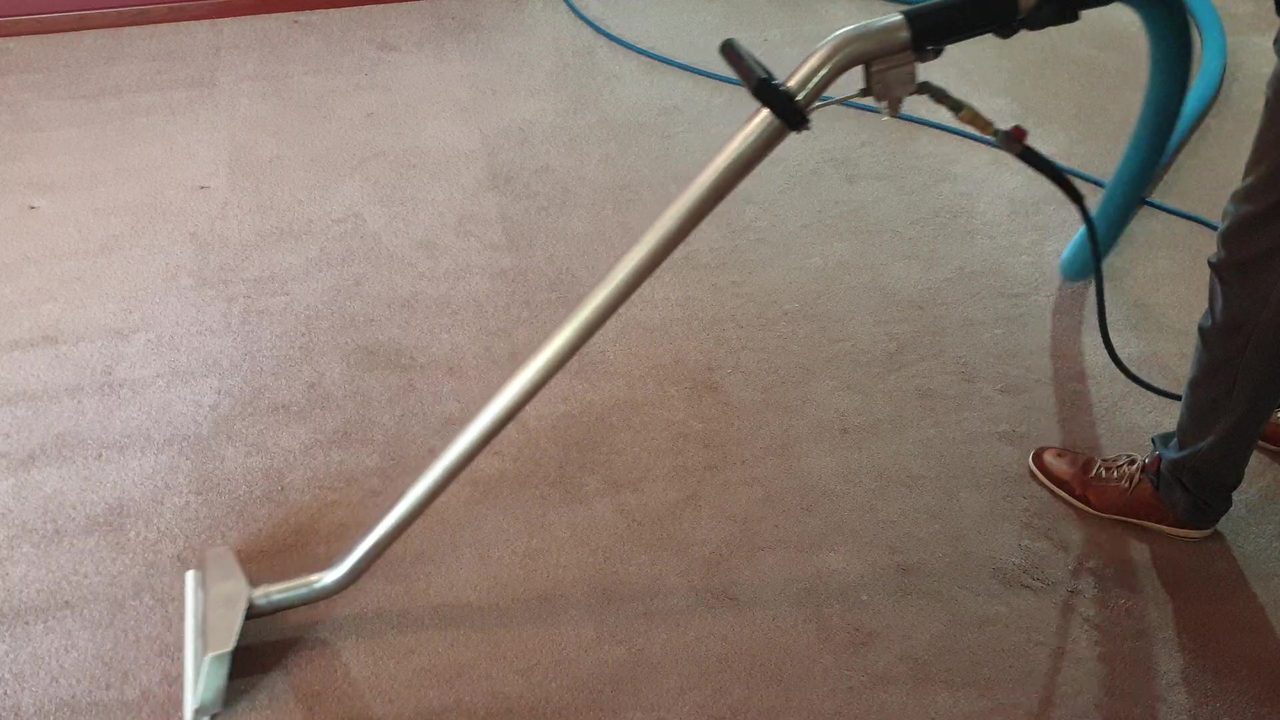
Extraction follows, and on a mould job it is done from below with flood extraction tools that draw through the backing instead of skimming the surface. Then drying, aggressively: air movers sweeping the surface at a low angle, dehumidification sized to the room, and the same drying discipline that governs any wet clean, only with far less room for error. A final HEPA vacuum once everything is dry removes what the process has loosened.
Two responses are almost universal, and both make the situation worse than doing nothing. The first is fragrance. A plug-in unit or a scented spray does not touch the colony, but it does remove the one early warning system the building has. Months later somebody moves a cabinet and finds a problem several times the size of the one that was masked.
The second is a quick surface clean. A light wet clean over a live moisture source adds water, cleans the top centimetre, and leaves the growth below with a fresh drink and a tidier ceiling. Where the source is still running, that is not remediation. It is catering.
Bleach deserves its own note, because it is the folk remedy everybody reaches for. On carpet it strips colour permanently, and it does not penetrate porous materials well enough to reach hyphae in a backing or an underlay. Killing is not the objective in any case: dead spores and fragments remain allergenic, so the aim is removal of the material rather than a body count.
Now and then the right recommendation is to take the material out, and making that call early costs a client far less than making it after two failed treatments. The markers are consistent, and they are mostly about depth and duration rather than about area.
Growth through the backing and into the underlay across any meaningful area is the clearest of them. So is water of the third category, meaning sewage, drain backflow or ground water, which brings contamination that carpet and underlay are not designed to be cleaned free of. So is a return: where competent remediation has been done, the building is dry and the growth is back, the material has answered the question for you.
The work itself is straightforward once the decision is made. Carpet up, underlay out, slab cleaned and, where moisture is coming through it, sealed or otherwise addressed before anything new goes down. It belongs in a shutdown or a weekend rather than a Tuesday, and it should be scheduled after whatever fixed the water, so the new floor does not quietly inherit the old problem.
Keeping mould out is mostly moisture discipline, and two habits carry most of the weight. The first is that every wet clean is dried to a target rather than to a hope, with air movement in the room and nobody closing the door on a damp floor at five o'clock on a Friday.
The second is humidity in buildings nobody is standing in. The Christmas shutdown is the classic case: plant switched off for a fortnight, a warm still box, and a small December spill becoming a February discovery. Leaving the air conditioning running on a modest setpoint through a long closure costs a fraction of one remediation. The same applies to a suite sitting between tenancies, which is where we find some of the worst growth, purely because nobody opened the door for four months.
Coastal and river-side sites earn extra attention. Buildings near the water, along the river and down to Fremantle, carry higher ambient humidity through the year, and a June week of onshore weather will hold moisture in a floor far longer than the same building would inland. Add the winter storms that test every roof and box gutter, and the sensible pattern is an inspection after the first serious rain rather than a hopeful one in spring.
None of this needs a specialist to notice. A regular maintenance clean, at least once a year, puts somebody down at floor level across the whole tenancy, which is how a damp patch beside the kitchenette gets found while it is still just a damp patch. If you have a musty corner you cannot explain, we would rather come and find the water than sell you another clean. Commercial Carpet Cleaning Perth is owner-operated by Zoran, IICRC certified and Woolsafe accredited, police-cleared and insured, working across the Perth metro area seven days a week and after hours. Ask for a free on-site quote or call 0460 815 038.
What to do in the first hour when a commercial floor floods, how extraction and structural drying actually work, and when carpet can be saved.
Read ArticleA smell in your carpet is a source problem. Here is how to find what is causing it, treat it below the surface, and know when the underlay has to go.
Read ArticleCarpet works as a filter for dust, allergens and fine soil. Here is how regular vacuuming and deep cleaning keep that filter working in Perth workplaces.
Read Article