
How Clean Carpets Improve Workplace Health and Air Quality
Carpet works as a filter for dust, allergens and fine soil. Here is how regular vacuuming and deep cleaning keep that filter working in Perth workplaces.
Read ArticleWhat carpet cleaning chemicals actually contain, what green labels do and do not mean, and why method and rinsing matter more than the bottle.
The question used to come from nobody. Now it arrives from three directions at once: a staff member who wants to know what is being sprayed near the desk where they sit forty hours a week, a tenant representative working through a building wellness questionnaire, and your own procurement or ESG reporting, which increasingly asks for the environmental credentials of every contractor who sets foot on site. What is actually in the carpet cleaning chemicals has become a normal question, and a facility manager deserves a better answer than the word eco printed on an invoice.
The honest answer is more interesting than the marketing. Some of the scrutiny is deserved, because a few ingredient classes that were standard twenty years ago earned their bad reputation fairly. Some of it is misdirected, because the greenest-looking label on the shelf can sit on a product that performs poorly and has to be over-applied to compensate. And the single biggest influence on how much chemistry ends up living in your carpet is not which bottle was bought at all; it is how the clean was performed.
This article sets out the chemistry in plain English, explains what the certification labels do and do not tell you, and finishes with the questions that separate genuine practice from brochure print. The aim is that the next time the question arrives, from staff, tenants or your own reporting, you can answer it specifically.
A commercial carpet cleaning product is a recipe, and nearly every recipe on the market draws from the same four or five ingredient classes. Once you can name them, a Safety Data Sheet stops being an intimidating document and becomes a short list of familiar characters, each present for a specific job.
| Ingredient class | What it is there to do | Where the concern sits |
|---|---|---|
| Surfactants | Lower the surface tension of water and prise oily soil off the fibre | Older types biodegrade slowly; modern ones are far better behaved |
| Solvents | Dissolve grease, ink and adhesive that water alone cannot touch | The volatile ones evaporate into the room air as VOCs |
| Builders | Soften the water and raise alkalinity so surfactants work harder | High pH is hard on skin, wool and anything left as residue |
| Polymers | Wrap loosened soil in crystals that the vacuum removes | The least concern of the group; they dry inert and vacuum away |
| Fragrance and dye | Make the product pleasant to sell | Do nothing for cleaning; fragrances are common sensitisers |
Five ingredient classes cover nearly everything a carpet product contains. Only some of them earned the scrutiny.
Surfactants are the heart of any cleaning product. The word is a compression of surface active agent, and the molecule has a split personality: one end is attracted to water, the other to oil. That lets it burrow into the greasy film binding soil to a carpet fibre, surround the oily particle and float it free so water can carry it away. Water on its own beads up and slides over that film; water with surfactant gets underneath it. Every detergent in your building, from the hand soap to the dishwasher powder, works on the same principle.
Builders are the supporting act. Perth's scheme water is moderately hard, and the calcium and magnesium in hard water bind to surfactants and blunt them, so builders are added to tie up those minerals and let the surfactant do its actual job. Many builders also push the solution towards alkalinity, because oily and fatty soils release more readily at a higher pH. That is useful in a commercial kitchen and unnecessary in an office corridor, which is exactly why one product should not be doing both jobs.
Three ingredient groups attracted most of the criticism, and the criticism was largely fair. The first is high-VOC solvents. VOC stands for volatile organic compound, which simply means a substance that evaporates readily at room temperature, and the butyl-based glycol ethers common in older pre-sprays evaporate straight into the air of the room being cleaned. In a well-ventilated warehouse that is a smell; in a sealed CBD tenancy with the air conditioning recirculating overnight, it is a headache waiting for the first people in the next morning. Even citrus solvents, marketed on their natural origin, are VOCs like any other.
The second is strong alkalinity. pH is the scale chemists use for acidity and alkalinity: it runs from 0 to 14, with 7 as neutral, and each whole step is a tenfold change, so a pH 12 degreaser is a hundred times more alkaline than a pH 10 one. Heavy restoration products sit at 11 to 13, where they are genuinely effective on grease and genuinely hard on everything else: skin, dyes and above all wool, which is a protein fibre that alkalinity attacks directly. Woolsafe accreditation exists precisely because wool wants chemistry near the middle of the scale.
The third is fragrance, which deserves its own short trial because it is the one ingredient class with no cleaning function whatsoever. A perfume in a carpet product exists to signal cleanliness to the human nose, and it can do that whether or not any soil actually left the building. Worse, fragrance compounds are among the most common airborne sensitisers, the substances most likely to trigger a reaction in people with asthma or fragrance sensitivity, and they linger in the pile long after the visit.
Our view on fragrance is unfashionable but simple: a properly cleaned carpet smells of nothing. If a floor needs perfume to seem clean, the question worth asking is what the perfume is covering. An unscented room a day after cleaning is a better credential than a scented one an hour after it.
There are two kinds of writing on a cleaning product, and they carry very different weight. Certification marks such as GECA, from Good Environmental Choice Australia, mean the product has been assessed by an independent body against a published standard covering ingredients, biodegradability, packaging and manufacture, and the maker can lose the mark if it stops complying. Marketing terms such as plant-based, natural and non-toxic have no regulator behind them at all; a manufacturer can print them on almost anything, and plenty do.
The deeper problem with the marketing terms is that they answer the wrong question. Toxicity is a matter of dose, exposure and residue, not of where an ingredient came from. A plant-derived surfactant over-applied and never rinsed out sits in the pile against everyone's skin and airways; a synthetic one dosed correctly and extracted to nothing has effectively left the building. Feedstock is a detail. Dose and residue are the story.
Here is the point this whole subject turns on. Cleaning has four levers, which the industry abbreviates to TACT: time, agitation, chemistry and temperature. They trade against each other. Increase the dwell time, the mechanical agitation or the water temperature, and the chemistry can come down, often a long way, with no loss of result. A contractor whose method is strong can run mild chemistry; a contractor whose method is weak has only one lever left, and reaches for a stronger bottle.
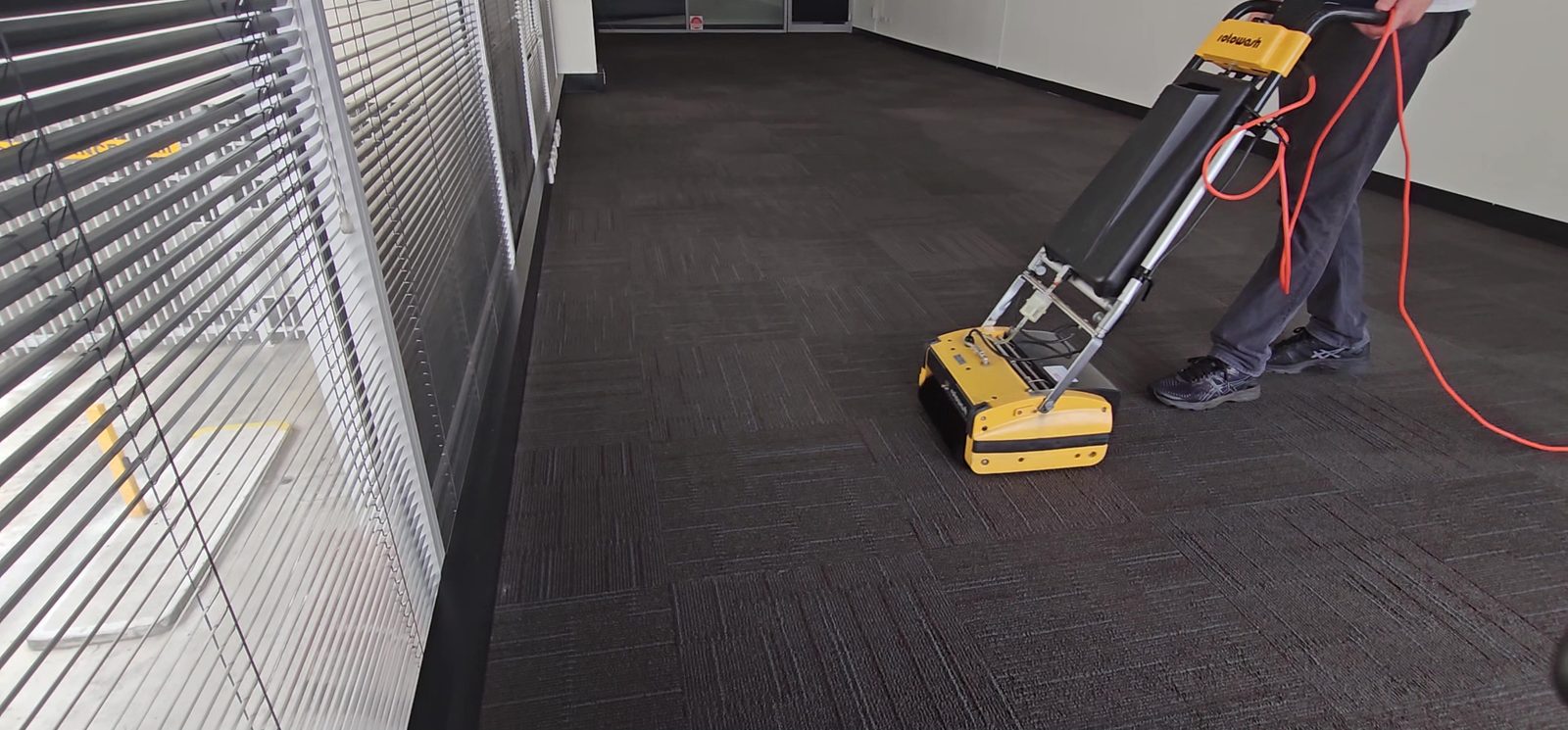
In practice that looks like this. Truck-mounted hot water extraction delivers water hot enough that heat does much of the work a harsh degreaser would otherwise do, because grease that clings stubbornly at 20 degrees releases readily at 80. Counter-rotating cylindrical brushes, the Rotowash machines we run, drive agitation down to the base of the tuft so the pre-spray needs to loosen soil rather than dissolve it outright. A measured dwell time lets a modest product finish its work instead of being hurried off the floor. You can see how these pieces fit together across our methods; the pattern in all of them is machinery and patience doing what stronger chemistry would otherwise be asked to do.
The greenest chemical is the one that leaves with the rinse water.
Whatever went into the carpet during a clean, the question that matters to the people who work above it is what remains a week later. Occupants are barely exposed to the diluted solution during the visit, particularly an after-hours one; their real exposure is to residue, day after day, through skin contact and the fine dust that worn residue becomes. Sticky residue also re-soils, which is why a badly rinsed floor looks worse a month later, and alkaline residue keeps working on the fibre long after the cleaner has been paid.
Proper practice closes that loop. The pre-spray does the cleaning; the extraction rinse, often deliberately mild and slightly acidic, neutralises leftover alkalinity and carries the spent solution, and the soil with it, into the waste tank. The fibre is left near neutral with nothing tacky on it. This is why the rinse standard matters more than the label on the bottle: a certified green product applied and never extracted leaves a less healthy room than a conventional one rinsed to nothing.
Chemistry gets the attention, but water is the quieter half of the environmental question, and in Perth it is not a theoretical one. This city waters itself from desalination plants and a groundwater system under long-term pressure; the February you spent watching the sprinkler roster is the same climate your cleaning contractor's water use sits inside. A whole-floor extraction clean puts real volume through a building, and it is fair to ask where that water comes from and where it goes.
Hot water extraction is less thirsty than it looks, because it is a closed loop: most of what the wand lays down is drawn straight back into the waste tank rather than left in the building. What is in that tank is trade waste, and it must be discharged to the sewer, where it is treated, never to a stormwater drain. That distinction matters more in Perth than in most cities, because our stormwater system is not connected to treatment; it runs to soakwells, urban wetlands and ultimately the ocean. A contractor tipping a waste tank into the gutter is not cutting a corner, they are polluting a waterway, and it is a fair thing to ask a tenderer to confirm in writing.
The larger saving, though, comes from choosing the method to match the job. Hot water extraction earns its water where carpet is heavily soiled or carries many different stains; lightly soiled carpet does not need it. Low-moisture encapsulation cleans lightly soiled carpet with a small fraction of the water of extraction, as a rule of thumb up to 90 per cent less, and the saving compounds: less water heated, less moisture for the air conditioning to carry away, no floor out of service while it dries. Choosing extraction where the soil calls for it and encapsulation where the soiling is light is the biggest environmental decision in the whole contract.
An honest guide has to say this part plainly: some jobs need the strong shelf, and refusing it is not the green option. Kitchen grease walked into a restaurant's dining carpet laughs at a neutral detergent; it needs alkalinity and heat. A biohazard clean, after blood or other bodily fluids, is governed by the need to actually disinfect, which is a health obligation rather than a preference. Mould growth after a slow leak needs treatment that kills and removes it, because a mild wipe-over takes off the visible bloom and leaves the colony in the backing to return.
Under-dosing these situations out of environmental caution produces dirtier outcomes, and eventually a more expensive one. Soil that survives the clean becomes grit that abrades the fibre; contamination that survives becomes the reason a carpet is condemned. Follow that road far enough and you reach the skip bin.
The resolution of this apparent contradiction is precision. Strong chemistry is not banned from a green practice; it is confined. The heavy product goes on the grease lane behind the servery, the contaminated square metre, the mould-affected corner, applied at the correct dilution, given its dwell time and then rinsed thoroughly out, while the other 95 per cent of the floor gets the mild chemistry it actually needs. That is very different from spraying a harsh product across an entire floor.
It is also the argument for keeping carpet alive rather than treating cleaning as an expense to minimise. We make the longer version of that case in our piece on cleaning as sustainability; the short version is that no product choice on this page saves as much as a floor that never gets replaced early, and everything above serves that end.
Anyone can print a leaf on a business card, and most contractors now do. Practice shows up in specifics, so when you are comparing commercial cleaning quotes, ask questions that have checkable answers rather than inviting a recitation of adjectives. A professional operation will not be offended; the good ones are quietly pleased someone finally asked.
You can hear the difference in the answers. The Safety Data Sheets appear without fuss, because they are already in the vehicle. Dilution is controlled by dosing caps or a metering system, not poured by eye against the light. The cleaner tests dye fastness and checks fibre and pH before any strong product touches an unfamiliar carpet, and describes their rinse standard without being prompted, because it is how they were trained rather than something retrieved for the occasion.
Even mild, well-rinsed chemistry deserves respectful timing when the building holds people who are more affected by it: staff with asthma, anyone pregnant, migraine sufferers, and the small number of people with genuine chemical sensitivity for whom a freshly cleaned room is a difficult place to be. None of this requires a medical opinion from you or from us. It is ordinary courtesy and ordinary risk management, and it costs almost nothing to get right.
Timing is the cheapest control available. A Friday evening clean gives the carpet a full weekend to dry and the tenancy two days of air changes before anyone spends a working day over it; even a standard after-hours clean puts twelve hours and a night of ventilation between the visit and the first person at a desk. Running the air conditioning on fresh air during and after the clean, rather than shutting the system down, carries the small amount of moisture and volatiles away instead of trapping them in the room.
The other half is simply telling people. A short notice naming the date, the areas, the products used and where the Safety Data Sheets can be seen turns an unknown smell into a known plan, and it flushes out quiet concerns in advance, which is exactly when you want them. We have written separately about carpet and indoor air; for this article's purposes the point is narrower: a carpet that has been properly rinsed, fully dried and vacuumed is a benign neighbour, and the scheduling above is how you make sure nobody meets it before it is one.
Strip the marketing away and a genuinely greener carpet clean is a short list of unglamorous habits: sensible products, certified where certification exists, dosed by measure rather than by eye; heat, agitation and time doing the work so the chemistry can stay mild; a rinse standard that leaves the fibre at neutral with nothing behind; water recovered and lawfully disposed of; the strong shelf kept for the few jobs that truly need it; and a carpet kept on the floor for its full working life instead of landfilled early. None of that fits on a leaf logo, which is rather the point.
Every question in this article is askable of anybody, and every answer to it is checkable. A safety data sheet exists for each product on a van and can be handed over on request; a dilution is either measured or it is guessed; a rinse standard is either written down or it is invented on the night. If a contractor is uncomfortable with any of that, you have learned something useful about them without having to test a single claim about the environment. Ask us and it goes in writing.
Carpet works as a filter for dust, allergens and fine soil. Here is how regular vacuuming and deep cleaning keep that filter working in Perth workplaces.
Read ArticleThe biggest environmental lever on commercial flooring is not the cleaning product, it is how long the carpet lasts. The maths, and how to report it.
Read ArticleHow encapsulation polymers trap soil, why the vacuum finishes the job, what each machine does, and where low-moisture cleaning fits a Perth office.
Read Article