
How Clean Carpets Improve Workplace Health and Air Quality
Carpet works as a filter for dust, allergens and fine soil. Here is how regular vacuuming and deep cleaning keep that filter working in Perth workplaces.
Read ArticleA smell in your carpet is a source problem. Here is how to find what is causing it, treat it below the surface, and know when the underlay has to go.
A smell is not a thing in the air. It is a stream of molecules leaving a physical source, and it keeps leaving until the source is gone. That single idea changes how you handle a carpet complaint, because the question is never what will cover this, it is where is it coming from.
Deodorising products either add a stronger smell over the top, bind to some odour molecules, or oxidise what they physically touch, which is only ever the top of the pile. All three can produce a genuine improvement for a few days. None removes a spoonful of milk that ran down a seam into the underlay eight months ago.
The pattern in offices is a supermarket spray, then a stronger spray, then a plug-in unit, then a call to us. By then the building has spent money on the symptom and the source has had another season to feed. If a smell has returned twice after the same treatment, start looking for it instead.
Facility managers often describe the same odd timing. The carpet was fine through summer, then one week in winter a whole corner of the floor smells sour again. Nothing was spilled. It is not imagination, and it is not the cleaner's fault.
The compounds we perceive as odour are volatile: they have to leave the residue and enter the air before a nose detects them. Dried organic residue in the base of a pile or inside underlay is not inert, it is dormant. Add moisture and two things happen at once. It rehydrates and partly redissolves, releasing compounds locked in a dry crust, and bacteria living on that food source become active again. Warmth accelerates both.
That is why Perth carpets behave as they do. Through a hot dry summer, indoor humidity sits low and residue stays crusted and quiet. Through a wet winter, with rain-soaked shoes coming in and doors closed, the same residue softens and starts working again. A carpet that smells fine in February and reeks in July has not developed a new problem. It has an old one that finally got the conditions it needed.
Across offices, schools, aged care and retail, the causes of a persistent carpet odour are fairly predictable. Knowing the shortlist saves a lot of wandering around a floor with your nose in the air, because each source has a signature and a typical location.
Almost every stubborn commercial odour we are called to falls into one of these groups, and the character of the smell narrows the list before the meter goes down. Sour, and faintly sweet underneath it, points at milk or coffee that has gone through the backing. Sharp and ammonia-like points at urine, and it will usually be strongest late in the day. Earthy and musty points at moisture and microbial growth, which sends you looking for where water is getting in rather than for what was spilled.
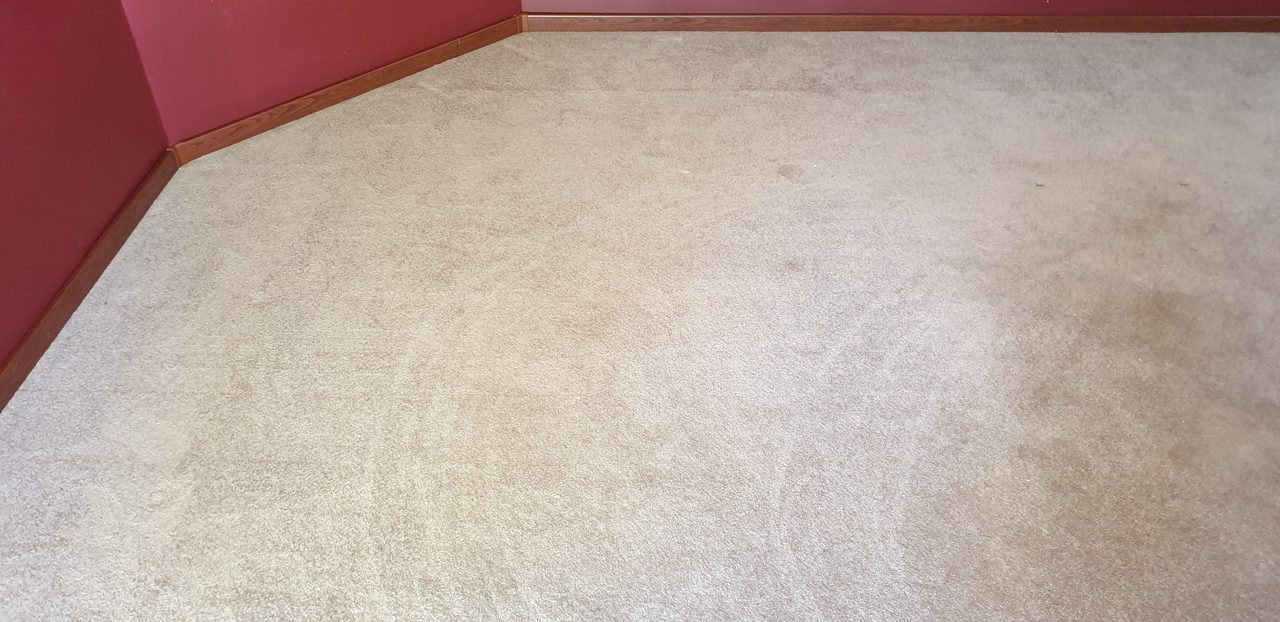
The carpet within a few metres of a kitchenette is the hardest working odour surface in most offices, and the least examined. Milk is the worst offender because the volume is small, the mark is faint and nobody reports it. A splash from a carton, the drip trail from an overfilled cup, the ring under a poorly lined bin. It dries invisible and starts decomposing.
Coffee is different. Everyone treats it as a stain problem, so the mark gets blotted and the matter is considered closed. But a full cup carries far more liquid than the pile can hold, and the surplus soaks straight past the backing into the layer below, where nothing has touched it and nothing has dried it. Months later the stain is gone and the smell is not.
Bins are the other silent source. A liner with a small tear leaks a little each day onto the same square of carpet, and because the bin sits over it nobody sees the mark until it is moved during a fit-out. When a client says a smell appeared from nowhere after furniture was rearranged, that is usually what happened.
Urine is chemically stubborn in a way food residue is not. As it dries it leaves salts in the fibre and backing, and those salts are hygroscopic: they attract moisture out of the air. That is why urine is the most reliably humidity-triggered odour of all, and why a room can be clear at nine in the morning and obvious at four in the afternoon.
In childcare and early learning, accidents are routine and usually well managed at the surface, but repeated events in the same corner build a load in the underlay that surface cleaning never reaches. Aged care is the same, with the added factor that rooms are occupied, so treatment must be planned around residents rather than a floor closed off for a day.
The cleaning was fine — it was applied to the wrong depth.
Pet-friendly offices are common enough now to be their own category. A dog that marks a partition leg returns to the same spot, because the residue is a signal to the animal long after people stop smelling it. Ground-floor lobbies get the same problem from outside, concentrated in the band of carpet just past the threshold. The logic never changes: find the full extent of the deposit, not just the visible part.
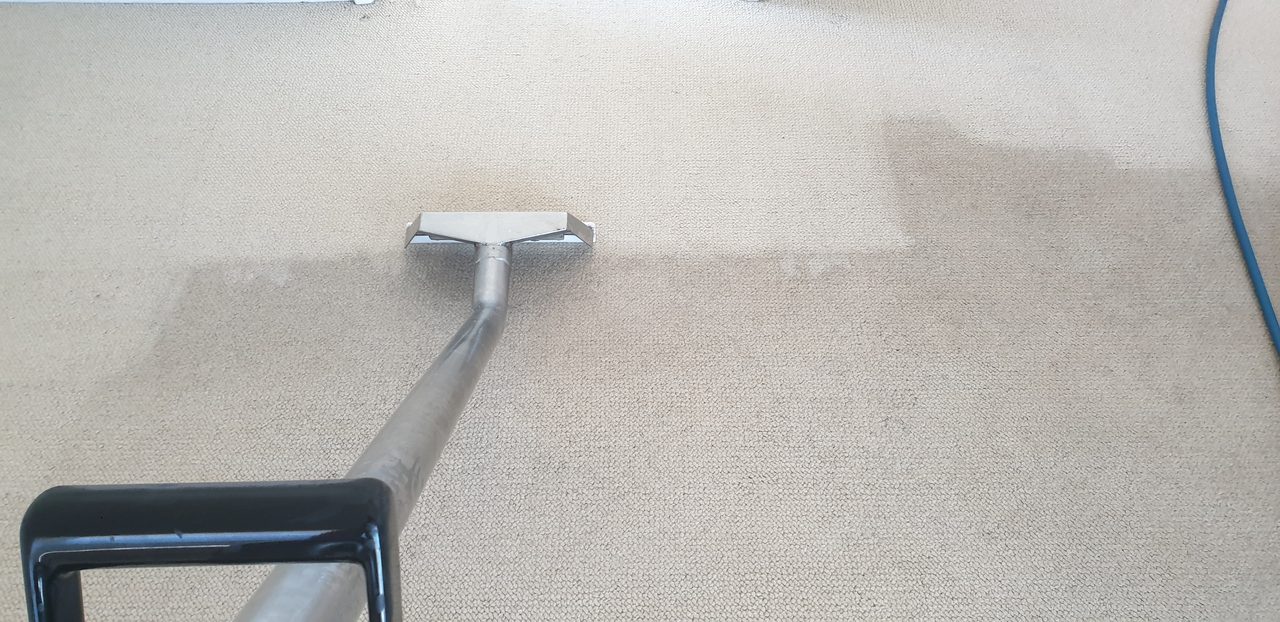
The musty, earthy smell people describe as damp is microbial growth releasing volatile compounds, and it needs three things: an organic food source, a suitable temperature and moisture. Carpet and underlay supply the first two permanently. Moisture is the one variable that changes, which is why drying speed after a water event matters more than the size of the event.
Slow-dried water damage is the classic cause: a burst flexible hose over a weekend, a roof leak in a Perth winter storm, or the unnoticed drip from a chiller, a fridge line or an air conditioning condensate tray. The last of those produces a smell with no visible flood at all, because the water arrives in small volumes, in one place, every day.
The distinction that matters is between a carpet that is damp and one that has been damp. Once growth is established in the underlay and on the underside of the backing, drying stops it advancing but does not remove it. If the odour is musty rather than sour, treat it as a moisture investigation first: look for the water before you look for the stain.
Not every odour in your carpet started in your carpet. Soft surfaces act as a sink for airborne compounds produced elsewhere, and in most tenancies the carpet is the biggest one there is. A takeaway below a first-floor office, a loading dock where vehicles idle, a smoking area near an intake, or a neighbouring suite that has had a small fire will all load your floor over weeks.
The test is straightforward. If the smell is even across a floor with no hot spot, and strengthens at particular times of day or when the air conditioning cycles, it is more likely arriving than emanating. A genuine carpet source almost always has a gradient.
Sewage is the exception you must never treat as a cleaning job alone. A backflow through a floor waste, a failed pan connector seal or a blocked line under a slab puts a health problem in the room before it puts an odour in it. Correct the plumbing first, assess the affected material honestly, and handle the area as contaminated. Cleaning a floor still receiving contamination achieves nothing.
One odour is created by cleaning rather than solved by it. If a carpet is wet down heavily and not extracted properly, or extracted properly and then left in a closed building with no airflow, it stays damp for a day or more. Damp carpet holding residual soil and detergent grows bacteria, and the result is the sour, faintly animal smell most people call wet dog.
It is a process failure, not a chemistry failure. Too much water goes in, not enough comes out, and nothing moves air across the pile afterwards. A Perth winter makes it easy to do, because the building is closed and the outside air is damp.
| What it smells like | What it usually is | When it is worst |
|---|---|---|
| Sour, faintly sweet | Milk or coffee through the backing | Humid weather, or after furniture is moved |
| Sharp, ammonia-like | Urine in the fibre and backing | Late in the day, and on humid days |
| Earthy, musty | Microbial growth from a slow-dried floor | After rain, and through a wet winter |
| Sour, faintly animal | Moisture trapped in the backing after a clean | Warm, closed rooms with no air moving |
| Even everywhere, no hot spot | Arriving from elsewhere, not the carpet | When the air conditioning cycles |
Timing is evidence as much as character is. The sour, faintly animal smell described in this section is the one smell on the list that a clean itself can create.
Prevention is unglamorous: control the moisture applied, extract thoroughly, and put air movers on the floor rather than trusting the building. On lightly soiled carpet, low-moisture encapsulation avoids the risk almost entirely. A carpet already left to sour needs cleaning properly and then drying properly, not simply drying, because the bacterial load is now part of the problem.
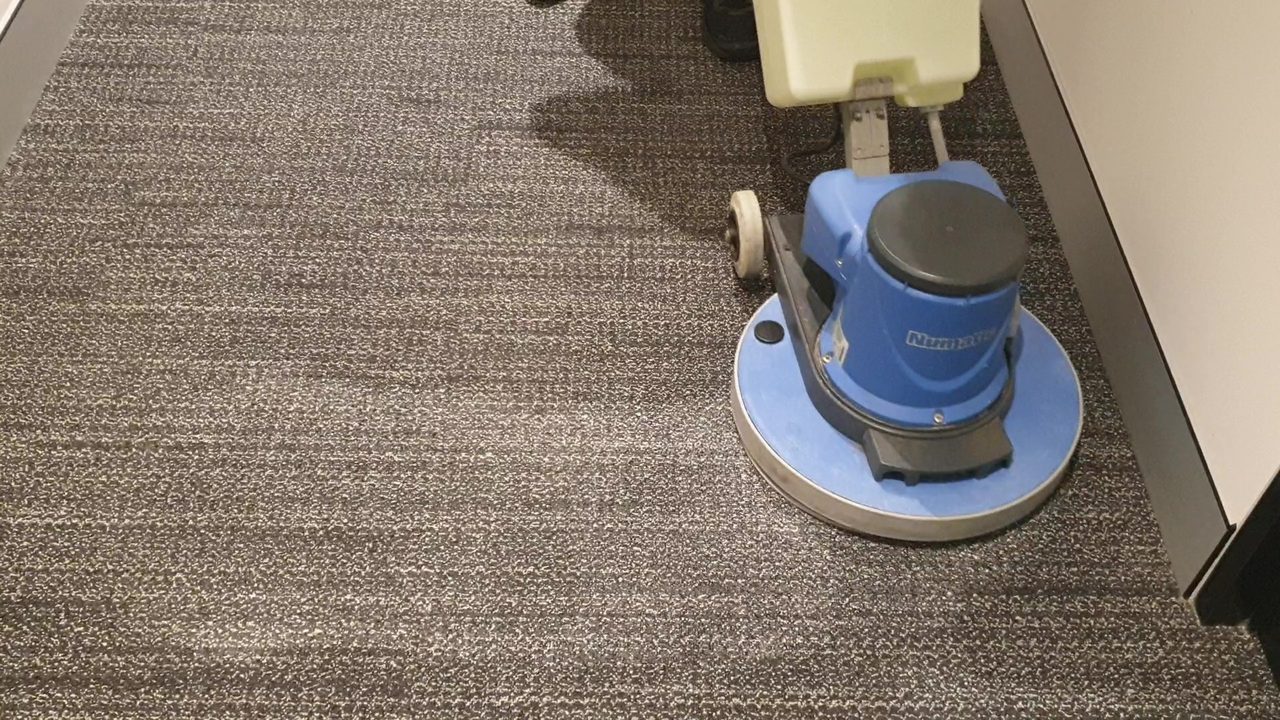
The nose is the best gradient detector available, but only if it is used systematically and early. Sensitivity drops sharply after a few minutes of exposure, so the walk has to happen when you first arrive, not after half an hour of discussion in the affected room.
Work the floor as a grid rather than drifting toward where you think the problem is. Divide it into zones, walk each one and rank them instead of pinpointing immediately, then re-walk only the strongest zones and get low. Odour concentrates near the floor, so a smell obvious at knee height and faint standing up is coming from the carpet rather than the air.
Once the zone is narrowed, a moisture meter turns opinion into a record. A non-invasive meter run in a grid usually shows a clear anomaly where residue has drawn in moisture or water is still arriving, and a reading taken well clear of the suspect zone gives the baseline that makes the number meaningful. Note readings with their locations: that is your evidence for a landlord, insurer or strata committee later.
When the zone is small enough, measure it. A moisture meter on the carpet backing and the slab tells you more in thirty seconds than an hour of surface inspection: readings above a dry spot on the same floor show where liquid has soaked through, and how far it has spread below the pile, which is often far wider than the mark on top.
The perimeter deserves attention because liquid runs to the edges of a room and sits there, held against the gripper and the skirting. So does the area under a partition base or a heavy cabinet, where nothing has ever been cleaned or dried quickly.
A UV torch is useful but oversold. Some urine residue fluoresces, which helps map an area quickly in a darkened room. But detergent residue, optical brighteners from a previous clean, adhesives and lint fluoresce too, so a glowing patch is a prompt rather than proof. A well-established deposit can also show almost nothing while smelling strongly. Use UV to generate candidates, then confirm with your nose and the meter.
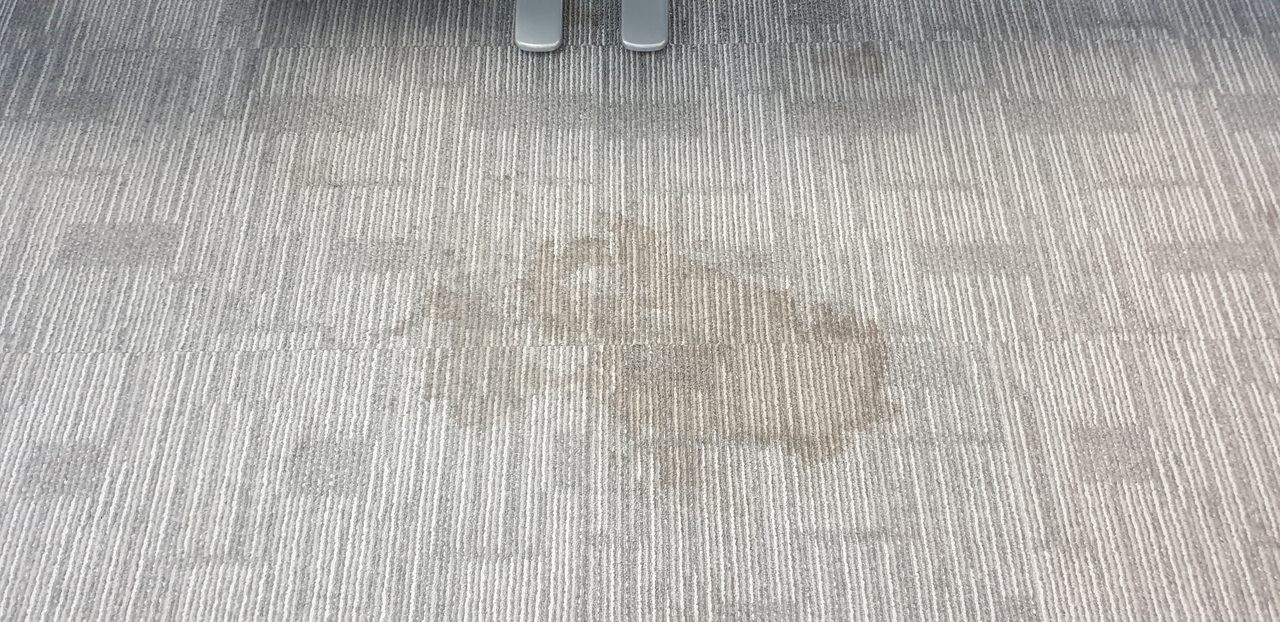
If the source is in the underlay or on the slab, any treatment that stops at the pile will fail, no matter how good the product is. This is the most common reason a customer tells us the carpet has been cleaned twice and still smells. The cleaning was fine. It was applied to the wrong depth.
Sub-surface work means flooding the affected area with the correct solution so it reaches the full depth of the contamination, then extracting from below with flood extraction tools, the same tools used in water damage work, which draw liquid up through the backing and out of the underlay rather than off the surface. Several passes are normal, and the extraction is what actually removes the source.
Chemistry matters here in two ways that get ignored. Enzyme products need dwell time, far longer than a cleaner in a hurry allows, because enzymes break organic material down rather than dissolve it. And pH has to suit the target: alkaline products handle greases and general soils but do little against urine salts, which need an acidic rinse stage. The right product applied briefly, and the wrong pH applied thoroughly, fail the same way.
Sometimes the honest answer is that treatment is not the best value. Underlay is a sponge by design — a foam or rubber layer built to trap air, which makes it just as good at trapping liquid — and once it is saturated with urine over a long period or has supported mould across a broad area, treatment costs more labour than the material is worth.
We make that call on practical grounds: how large the area is, how deep the contamination has gone, whether the concrete beneath is stained, how long the source has been active, and what the room is used for. A square metre in a quiet corner is worth treating. Repeated saturation across a childcare room over two years usually is not.
Where the underlay has to come out, that is a job for a carpet layer, with the slab treated and sealed if needed before new underlay goes down. That belongs in a weekend or a shutdown period rather than a Tuesday. Say it plainly, because a client told the truth once will accept a bigger job, while a client sold three failed treatments will not believe the fourth recommendation.
Carpet gets blamed for a great deal it did not do. An office chair holds more absorbent material per square metre than the floor does, and second-hand chairs are a specific trap: an organisation buys a lot from a closing business, they arrive looking clean, and within a fortnight that part of the floor develops a smell no carpet cleaning touches. The same applies to fabric screens, acoustic panels and soft seating, which sit closer to nose height.
The test is easy. Move a suspect chair to an unaffected room, leave it overnight with the door closed, and walk in the next morning. The answer is usually obvious in a second.
Then there is distribution. Air conditioning does not create odour but it spreads it efficiently, particularly through return air paths. A localised source near a return grille has its emissions drawn in and delivered across the whole floor, which is why a smell can seem general when it is not. If it is present at every supply diffuser but has no gradient anywhere, look at the returns, the filters and the ductwork, and involve your mechanical contractor.
Odour complaints tend to be handled emotionally, because they arrive as a personal reaction from a staff member rather than as a fault report. A short, repeatable process takes the heat out of it and produces a record that stands up with a landlord, an insurer or the board.
Log the complaint properly: where, when, what it smells like, and whether it is worse at particular times or in particular weather. Two or three reports usually reveal the pattern. Then investigate physically before you buy anything, because treatment depends entirely on the source and its depth. Only then choose between a surface clean, a sub-surface treatment, a repair to whatever is letting water in, or new underlay.
One habit is worth building in from the start: avoid fragranced masking products in shared workplaces. Beyond not fixing anything, synthetic fragrance triggers headaches and respiratory irritation in some people, so you exchange one complaint for another. The goal is a floor that smells of nothing at all.
If you have a smell you cannot place, we would rather come and find it than sell you another clean aimed at the wrong depth. We are IICRC certified and Woolsafe accredited, and we carry flood extraction and structural drying equipment alongside truck-mounted hot water extraction, so the investigation and the treatment can happen in the same visit. We work across the Perth metro area seven days a week, including after hours. Call Zoran on 0460 815 038 or email commercialcarpetcleaningperth@gmail.com.
Carpet works as a filter for dust, allergens and fine soil. Here is how regular vacuuming and deep cleaning keep that filter working in Perth workplaces.
Read ArticleWhat to do in the first hour when a commercial floor floods, how extraction and structural drying actually work, and when carpet can be saved.
Read ArticleA practical guide to office carpet stains for Perth facility managers, with first aid for every spill, the right fix for each stain and when to call us.
Read Article