
Encapsulation Carpet Cleaning: The Low-Moisture Method Perth Offices Rely On
How encapsulation polymers trap soil, why the vacuum finishes the job, what each machine does, and where low-moisture cleaning fits a Perth office.
Read ArticleWhy carpet drying takes as long as it does, the four levers that shorten it, where to stand air movers, and what changes between a Perth summer and winter.
Ask anyone what they remember about their last commercial carpet clean and it will not be the cleaning. It will be the afternoon the floor spent damp: the barrier tape, the detour past the lift lobby, the faint humid smell hanging over reception. The clean itself is planned to the half hour, while drying is left to look after itself. That is backwards, because drying is the half of the job the building actually notices.
The good news is that drying is neither a mystery nor a fixed cost. Dry time is the product of a handful of physical factors, and every one of them can be pushed in your favour with a little planning and no exotic equipment. Steam-cleaned carpet normally takes 4 to 8 hours to dry. The decisions made on the day set which end of that range you get.
This article explains how water leaves carpet, the four levers that control how fast it happens, and the Perth-specific quirks that make a February clean and a July clean two different exercises. It is about the ordinary dampness of a scheduled clean, not about when a floor actually floods; a flood is a different scale of problem with its own playbook and its own urgency.
Once the wand has done its work, water leaves carpet only one way: as vapour. Each fibre holds a thin film of moisture, and molecules at the surface of that film escape into the air one at a time. There is no drain at the bottom of the pile and nowhere for the water to run; evaporation is millions of tiny departures, and everything that happens in the room either speeds those departures up or gets in their way.
A carpet does not drain dry; it evaporates dry, one molecule at a time.
Three things govern the rate. Warmth, because warm water molecules escape more readily and warm air can hold more vapour before it is full. Air movement, because the layer of air sitting directly on damp pile saturates within minutes, and saturated air accepts nothing more; moving air sweeps that blanket aside and replaces it with air that still has appetite. And a destination, because if the room itself is sealed, the room air fills up just as the boundary layer did, only more slowly, and drying tapers towards a stop long before the carpet is dry.
Every practical technique in the rest of this article is one of those three factors in disguise. Air movers are air movement. Air conditioning is warmth and a destination at once. Propping open a door to a corridor is a destination. Nothing on a cleaning truck repeals the physics; the craft is in stacking all three so they work together rather than leaving the weather to do the job alone.
It helps to sort everything that affects dry time into four levers, because each is controlled by a different person. The first two belong to the cleaner and are settled before the wand is switched off for the day. The second two belong to the building, which is to say to you, and they go on working, or failing to work, for hours after the van has left the car park.
The first lever is how much water goes in, and the method sets it. Low-moisture cleaning dampens only the tips and upper pile, so there is very little to evaporate and the floor is walkable within an hour or two in almost any weather. Hot water extraction flushes the whole pile deliberately, which is exactly what a restorative clean is for, and accepts a longer dry as the price of that depth. Which one a floor needs depends on its soil and is recommended at the inspection. The drying follows from that choice.
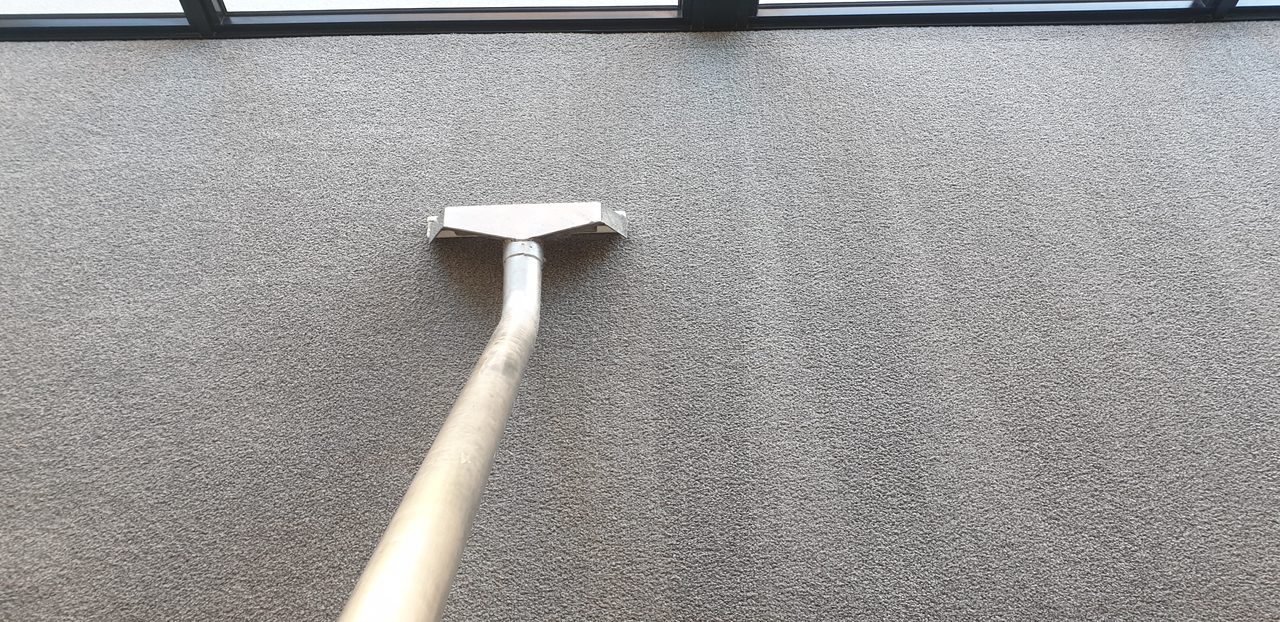
A dry stroke is a pass of the extraction wand with the vacuum running and the spray switched off. Every wet stroke lays solution down and pulls most of it back; a dry stroke only takes water away. It is the least glamorous technique in the trade and the single most effective thing anyone does for dry time, because water removed through the wand never has to evaporate at all.
The arithmetic is lopsided in the wand's favour. A vacuum pass removes in seconds a quantity of water that evaporation would need an hour or more to shift, which is why the last minutes of a well-run extraction clean look uneventful: the operator going back over ground that already looks clean, spray off, listening. This is also where a truck-mounted system earns part of its keep; the blower on the truck pulls a stronger, steadier airflow through the wand than a portable machine can manage, so each dry pass recovers more.
When you are comparing cleaners, this is one of the few technique differences visible from the doorway. A cleaner in a hurry makes one wet pass per lane and moves on, and the floor pays for the saved minutes with hours of dampness. It is a fair question for any quote: what do you do after the last wet pass? The answer should involve the wand, not just a fan.
An air mover is a low, snail-shaped blower that throws a flat ribbon of fast air along the floor. It does nothing clever. It simply strips away the saturated boundary layer sitting on the damp pile faster than the room can rebuild it, which multiplies the evaporation rate for as long as it runs. On a still winter afternoon in an internal corridor with no window, it is the difference between a floor that dries and a floor that sulks.
Placement matters more than horsepower. The instinctive mistake is to aim the machine straight at the wettest patch from a metre back, where the airflow strikes the floor, bounces, and dries a small ellipse while the rest of the room waits. The right setup points the snout almost parallel with the skirting, outlet close to the floor, so the ribbon of air hugs the carpet and travels the full length of the wall before it loses its energy.
Set the machine in a corner with the outlet near the floor, angled fifteen to forty-five degrees into the wall, so the air ribbon travels along the skirting.
Add further movers around the room facing the same rotational direction, so each picks up the flow of the one before and the room develops a slow circular current.
A door to a corridor lets the moving air exchange with drier space instead of looping endlessly through its own humidity.
Shift the machines every hour or so; the lanes directly in their path dry first and the dead corners behind them dry last.
How many is enough? As a rule of thumb, one mover per average office room, or one per fifteen to twenty-five square metres of open floor, is generous for cleaning-day dampness, and even a single well-aimed machine changes the afternoon. Ask whether your cleaner carries them as standard; ours ride in the van precisely for the winter jobs and the windowless corridors that need them.
The building's air handling is the biggest drying machine on site, and it is routinely switched off at exactly the wrong moment. Refrigerated air conditioning dries air as a side effect of cooling it: moisture condenses on the cold coils and leaves the building through the condensate drain. Run it during and after a clean and it behaves as a slow, building-sized dehumidifier, quietly exporting the water your carpet is giving up.
Heating helps differently, and only in company. Warm air can carry more moisture, so heating speeds evaporation off the pile, but heating a sealed room simply produces a warmer, damper room; the water has moved into the air, not out of the building. Heating needs to be paired with exchange, a window ajar, a door to a ventilated corridor, or an air handling system actually bringing fresh air in, before it earns its power bill.
This is a conversation to have with building management before the booking, not a discovery to make after it. Many Perth CBD towers run air handling on reduced weekend cycles that can be extended on request, and a one-line email to the facilities desk asking for the floor's air to run until midnight costs nothing. Tenancies with their own split systems are simpler still: leave them running on a dry or cool setting and let them work.
For carpet drying, Perth is two different cities depending on the month. In February the easterly arrives off the inland dry enough to crack lips, afternoon humidity falls away, and a steam-cleaned floor with a window open dries near the 4-hour mark. The same weather that makes the red dust a nuisance on the windowsills is a gift to a wet carpet.
July is the other city. Rain on the glass, windows shut, and indoor air drifting towards saturation mean evaporation has almost nowhere to send the moisture. The same clean that dried quickly in February takes the full 8 hours or longer, through no fault of the cleaning. Coastal suburbs feel it most; the afternoon sea breeze that rescues a Fremantle office from the heat in summer arrives carrying its own moisture in winter.
The practical response is seasonal scheduling rather than seasonal complaint. Book winter extraction for the morning, so the floor dries in daylight while the building's systems are running. On lightly soiled carpet, a low-moisture encapsulation clean is walkable within an hour or two in any season. Save the whole-floor flush for the warm half of the year where you can, and let the climate do half the work for free.
Every dry-time figure you are ever quoted is an estimate, because the honest answer is always that it depends on the day. That said, planning needs numbers, and the ranges below are what industry practice would expect on a typical Perth commercial job with sensible airflow. Treat the short end as a dry summer day with everything done right, and the long end as a cool, still one with no help from the building.
The spread within steam cleaning deserves its own note. Truck-mounted extraction dries faster than portable extraction not because less water goes in but because more comes out: the truck's vacuum recovers a larger share of the moisture before evaporation is asked to do anything at all. The gap between a well-dried extraction and a poorly dried one is measured in hours, and it is opened or closed entirely at the wand.
| Method | Typical dry time | What moves the number |
|---|---|---|
| Encapsulation / low moisture | 1-2 hours | Barely weather-dependent; only the tips and upper pile are dampened |
| Bonnet or dry compound | Under 1 hour | Appearance work only; almost no water goes in |
| Truck-mounted hot water extraction | 4 to 8 hours | Dry strokes, air movement and the season decide which end of the range |
| Portable extraction | Towards 8 hours, sometimes more | Weaker recovery leaves more water for evaporation to deal with |
Typical ranges with reasonable airflow; a sealed winter building can push any of them out, and a dry February afternoon can beat them all.
Use the table when you brief the building, not only when you book the clean. The number that matters is not the dry time itself but the hour the space is next needed; work backwards from that. A floor needed at 8.30 am wants an evening clean with the air handling running overnight. Timing like that is exactly the conversation a quote should include.
Walking on damp carpet does not damage it. The fibres are wet, not fragile, and a footstep compresses the pile in exactly the way it does every other day of the year. The genuine problems are less obvious and mostly travel on shoes: what a sole brings to damp carpet, and what damp carpet leaves on a sole.
Damp pile is an excellent soil trap, which is the whole point of wetting it and the whole problem with walking on it. Soil on a dry sole mostly stays on the sole; soil pressed into damp fibre transfers, and it bonds as the moisture dries around it. A dozen people cutting the corner of a freshly extracted corridor can lay down a faint dark track of soil that sets like a stain and greets the cleaner as a complaint a week later. If a crossing is unavoidable, clean dry shoes or overshoes on a single agreed path do no measurable harm.
The real safety issue is not on the carpet at all but at its edges. A shoe that has crossed damp carpet carries a film of moisture onto the vinyl, tile or polished concrete beyond, and damp smooth flooring underfoot is a genuine slip hazard. Slips at flooring transitions are a staple of workplace incident registers, so this is worth treating seriously: the wet-floor signs belong at every carpet-to-hard-floor edge, not in the middle of the room where the carpet is quietly holding everyone's weight without incident.
A carpet that is drying well smells of very little. A carpet that is drying slowly announces itself with a flat, musty note that strengthens overnight instead of fading. That smell is rarely the carpet and almost never the cleaning solution; it is microbial activity waking up in the soil that remains in any used carpet, and microbes need only two things to get going, moisture and time. Slow drying supplies both.
As a rule of thumb, the industry treats carpet that dries within about eight hours as unremarkable, and carpet still clearly wet at 24 hours as a problem to act on rather than an oddity to tolerate. Somewhere between 24 and 48 hours of sustained wetness the risk shifts from odour to growth, territory covered properly in our guide to mould in commercial carpet. The point here is simpler: a scheduled clean should never get anywhere near those numbers, and if yours regularly does, something upstream is wrong.
Slow drying also leaves visible fingerprints. Wicking, where soil or backing discolouration travels up the fibre as moisture evaporates from the tips, appears as browning marks or the ghostly return of stains that had gone. A clean that dried fast rarely wicks, because the moisture was never in the pile long enough to make the journey. Whenever the same building produces the same damp morning after every clean, the fix is upstream: less water in, more water out, more air across, more air exchanged.
Drying deserves the same fifteen minutes of planning the clean itself gets. Decide when the space is genuinely needed and work backwards to a start time. Settle who leaves the air handling running and until when, which interior doors stay open, and where the signage stands. Ask the cleaner what happens after the last wet pass, and expect an answer that involves the wand and the airflow, not a shrug. None of it costs money; all of it decides whether Monday morning smells of nothing at all.
The last thing worth saying is about who owns the number. Drying time is the one part of a carpet clean that a building can influence more than the contractor can, and it is the part buildings routinely give away. The air handling schedule, whether the interior doors stay open, whether the space is being used the same evening, what time of year the work is booked into: all of those sit with the building, not with whoever holds the wand. A contractor who is asked for a dry-by time and given none of that information is being asked to guess, and a guess is exactly what will come back. There are dry-time answers for specific situations among our frequently asked questions.
How encapsulation polymers trap soil, why the vacuum finishes the job, what each machine does, and where low-moisture cleaning fits a Perth office.
Read ArticleSteam cleaning versus encapsulation for Perth commercial carpets: what each one does at fibre level, real dry times, costs over a year, and how to choose.
Read ArticleWhat to do in the first hour when a commercial floor floods, how extraction and structural drying actually work, and when carpet can be saved.
Read Article