
A Twelve-Month Carpet Maintenance Calendar for Perth Buildings
How Perth's dry summers and wet winters set the timing of vacuuming, encapsulation and deep cleaning, plus budgeting, records and working around tenants.
Read ArticleWhy grout traps soil a mop can't remove, how high-pressure extraction actually cleans it, and how often Perth entries, kitchens and amenities need doing.
Walk across the foyer of almost any commercial building in Perth and look down. The tiles might gleam, but the grout lines between them often tell a different story: darker than they used to be, uneven from one area to the next, and grubbiest in exactly the places people walk most. That darkening grout is one of the most common complaints facility managers hear, and it is almost never solved by asking the cleaners to mop more often.
What makes it frustrating is how gradually it happens. Grout darkens a shade at a time, so nobody notices until a tile is lifted for a repair and the original colour underneath makes the rest of the floor look filthy. By then the assumption is that it has stained permanently, and the cleaning contract gets blamed for something a mop could never fix.
The reason is simple once you understand what grout is. Tile is hard and easy to wipe clean. Grout is the opposite. This guide covers why mopping falls short, what professional cleaning involves, what different tile types tolerate, and how often each area needs attention.
Grout is a cement-based paste of fine sand, cement and water, pressed into the gaps between tiles. As it cures, the cement forms a rigid structure around the sand grains, but that structure is never solid. Mixing water that does not chemically bind into the cement has to leave, and as it evaporates it leaves a network of microscopic capillaries running through the joint. That is not a defect, it is how cementitious material sets.
The consequence is that grout behaves like a very hard sponge. Liquid touching it is drawn inwards by capillary action rather than sitting on top, and anything dissolved in it travels in too. Grease, coffee, soft drink, cleaner residue and the fine mineral fraction of dust all migrate below the surface where no cloth can reach them.
| Property | Glazed tile | Grout line |
|---|---|---|
| Surface | Hard, effectively non-porous | Cement paste threaded with capillaries |
| Height | The walking surface | Sits a millimetre or two lower |
| Spilt liquid | Sits on top | Drawn inwards by capillary action |
| What a mop lifts | Most of it | Almost none of it |
The tile was never the problem.
Geometry compounds the chemistry. Grout sits a millimetre or two below the tile faces, so every particle pushed across the floor eventually finds a joint to fall into. Tile behaves nothing like this. A glazed face is effectively non-porous, so soil sits on top where a mop can lift it. The problem was never the tile.
It helps to be specific about what is being removed, because grout darkening is rarely one substance. In a commercial building the deposit is layered, and each layer needs different chemistry to shift.
That is why a single all-purpose cleaner disappoints so often. A degreaser that handles kitchen soil does little against mineral scale, and an acidic scale remover will damage the wrong sort of tile while leaving grease untouched. There is a hygiene dimension too: damp, organically loaded grout suits mould and bacteria, which is why an amenity block can smell faintly even when the surfaces look acceptable.
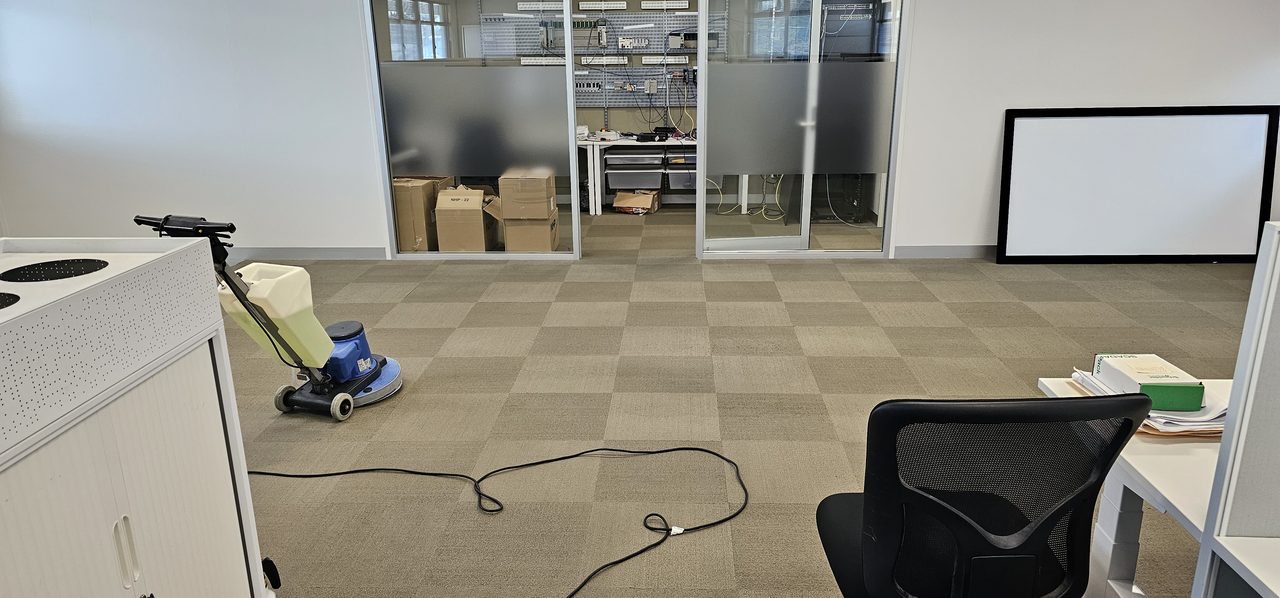
Think about what a mop bucket really is. You fill it with water and detergent, dip the mop, wipe a few square metres, then wring the mop back into the same bucket. From the second wring onwards you are not applying a cleaning solution. You are spreading a progressively more concentrated soil suspension across the floor.
Heavily mopped floors frequently have the darkest grout in the building, because the tiles are being rinsed and the grout is being used as the drain.
That dirty solution wipes off glazed tile easily, which is why the floor looks fine while it is wet. It does not wipe off grout. It soaks in, the water evaporates, and everything it was carrying stays behind a fraction of a shade deeper than yesterday. Heavily mopped floors frequently have the darkest grout in the building, because the tiles are being rinsed and the grout is being used as the drain.
Detergent compounds it. Most floor cleaners are alkaline and slightly soapy, and unless the floor is rinsed afterwards, which rarely happens, a sticky film is left behind that grabs the next day's grit. Above all, mopping lacks the two things that shift embedded soil: agitation to loosen it, and any means of extracting the dirty solution rather than leaving it to dry in place.
Plenty of buildings have tried to solve this with a hired steam mop or a domestic hard-floor machine, and the result is almost always disappointing on grout. The gap is not marketing, it is physics. A domestic steam mop produces a small amount of hot vapour and presses a microfibre pad against the floor. It sanitises the tile face and lifts light surface soil. What it cannot do is deliver enough water to flush a capillary network, apply real pressure into a recessed joint, or recover anything at all. Whatever it loosens dries back down, usually in the grout. Domestic wet-and-dry machines add a soft brush and a small vacuum, which is better, but the pressure is minimal.
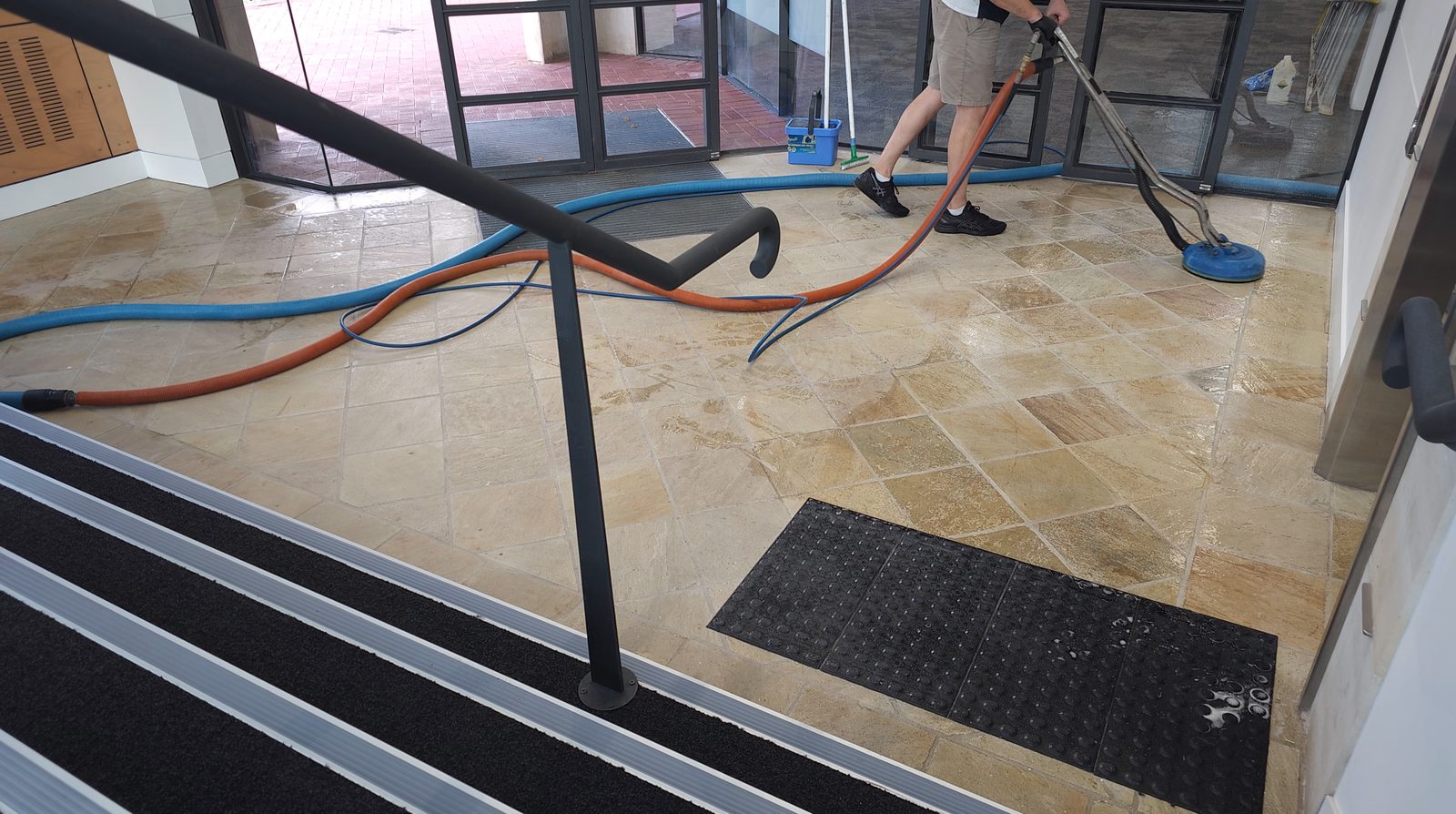
Commercial work uses a different arrangement: a truck-mounted or high-capacity portable unit heating water well beyond what a domestic appliance manages, a high-pressure line delivering it into the floor, and a vacuum recovering it fast enough to stop the floor flooding. That combination of heat, pressure, flow and simultaneous recovery is what empties a grout line, and none of it fits in a machine you carry in one hand.
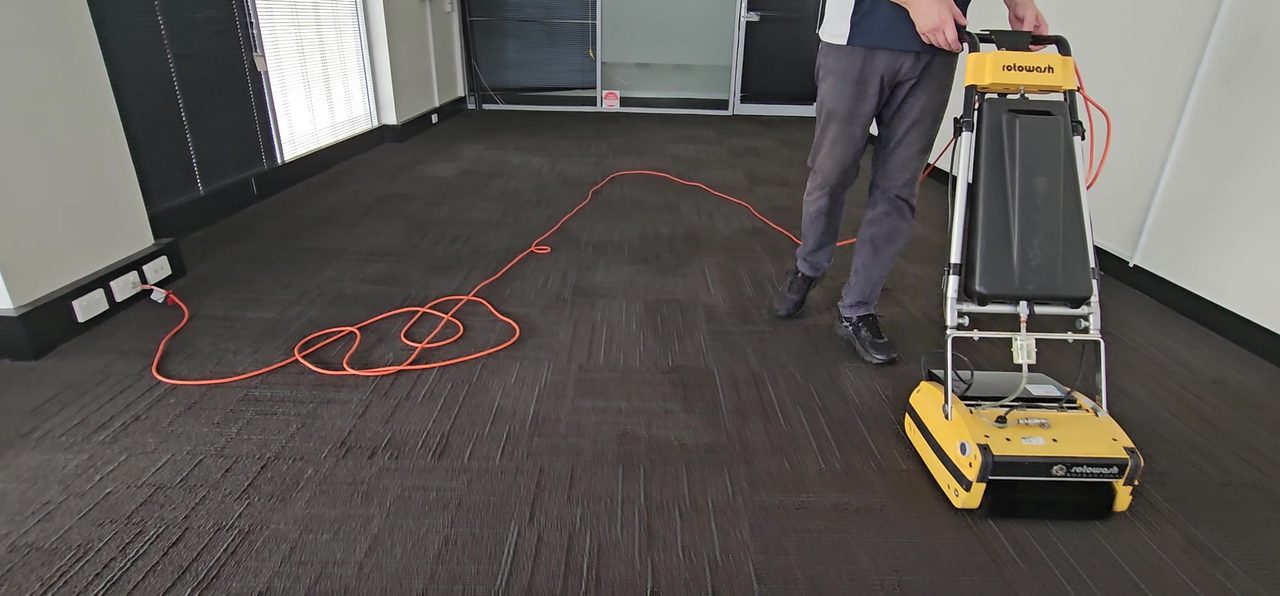
Professional cleaning solves the two problems mopping cannot, in a deliberate order. First, a suitable solution is applied and given dwell time, the step most people skip. The chemistry needs several minutes in contact with the soil to break the bond between grease and cement before any mechanical work pays off.
Next comes agitation, usually a scrubbing machine such as a Rotowash, or a stiff brush worked along the joints by hand around fixtures. Agitation lifts the softened soil out of the pores and into suspension where it can be carried away. Then the step that defines the result: high-pressure rinsing with immediate extraction. A spinning enclosed head sprays hot water into the tile and grout under pressure while a powerful vacuum recovers it in the same instant, taking the dirty water into a waste tank rather than letting it settle back into the joints.
The solution needs several minutes in contact with the soil to break the bond between grease and cement.
A scrubbing machine, or a stiff brush worked along the joints around fixtures, lifts the softened soil into suspension.
An enclosed spinning head sprays hot water into the tile and grout under pressure.
The vacuum carries the dirty water to a waste tank instead of letting it settle back into the joints.
That recovery step is the difference between a floor that looks clean for a fortnight and one that is genuinely clean. On neglected floors the change is dramatic enough that clients assume the grout has been recoloured. It also leaves the floor damp rather than wet, which matters when the area reopens in the morning.
The fastest way to ruin a hard floor is to treat every surface as though it were glazed ceramic. Pressure, temperature and above all chemistry have to suit the material, and a commercial building often has three or four different surfaces between the car park entry and the boardroom. The general rule is that dense glazed surfaces are forgiving and anything calcareous or absorbent is not, so where a floor is unfamiliar a test patch in a corner is not caution, it is professionalism.
Some floors also disappoint for reasons no cleaning method can address. Grout that has cracked or washed out of the joint needs regrouting by a tiler before cleaning is worth doing, because pressure applied to a failing joint will simply take more of it away. Tiles that sound hollow underfoot have lost their bond to the screed and will eventually lift regardless of how they are cleaned. Knowing which of these you are looking at before work starts saves an argument about a result that was never achievable.
Tile and grout cleaning is not only an appearance question. Slips, trips and falls remain a common cause of workplace injury, and hard floors in kitchens, amenities and entries are where they happen. A tiled floor is specified with a slip-resistance rating for a reason, and that rating assumes the surface is clean.
What actually causes a slippery commercial floor is usually a film rather than water. Airborne kitchen grease on a quarry tile, soap and body oil in a change room, or unrinsed detergent in a lunchroom all create a thin lubricating layer that fills the surface texture the floor relies on for grip. It can look dry and still be treacherous. Staff notice before management does, which is why the first sign is often someone putting down a rubber mat.
Deep cleaning earns its keep here in a way that has nothing to do with appearance, by stripping that film back to the bare surface. If a slip incident is ever investigated, a documented hard-floor schedule is a better position than a verbal assurance that the cleaners mop nightly.
Soiling is never evenly distributed. A handful of zones account for most of the complaints and most of the deterioration, and knowing which they are lets you spend the maintenance budget where it changes something. The pattern is remarkably consistent across offices, gyms, schools and hospitality venues, because it follows how people move rather than what the building is used for.
Everything outside those zones ages slowly by comparison, which is why a single site-wide frequency almost always gets it wrong in both directions at once.
Perth gives hard floors a particular workout, and it changes twice a year. Through the hot dry summer the dominant problem is abrasive mineral soil. Coastal sand blows in from the west, red dust arrives from the east, and construction sites shed limestone dust. That material is hard and angular, dulling tile faces and packing into every joint.
Winter reverses it. Wet footwear brings in a slurry of water and soil at the entry, and liquid soil goes where liquid goes: into the grout. Buildings that look fine in February often reach August with distinctly darker entry lanes, and the damp keeps joints wet long enough for the organic deposit to establish.
Both seasons make the case for entrance matting, the cheapest hard-floor maintenance money can buy, though a saturated mat is just a reservoir feeding the floor behind it. The other Perth factor is access: in CBD towers and food premises the work has to happen outside trading hours, with loading dock bookings and after-hours passes to arrange.
A deep clean empties the grout of what mopping has packed into it. The pre-spray, alkaline on ceramic and neutral on stone, breaks down the grease and body oils in the joint. Agitation loosens the soil bound into the cement. The high-pressure rinse then flushes the capillaries while the vacuum recovers the dirty water in the same pass. On most floors the joints come up a clear step lighter, because the darkening was deposit rather than the grout itself.
A clean has limits, so we name them before the work starts. It cannot fix grout that has cracked, crumbled or worn below the tile face. It cannot bring back colour lost to acid, bleach or dye either. Those joints need regrouting by a tiler. Tiles that sound hollow underfoot have lost their bond to the screed and are also a job for a tiler. Where only a few joints have failed, the tiler regrouts those and we deep clean the rest of the floor.
A periodic deep clean sets the floor back to a good baseline. What happens in the following weeks decides how long that baseline holds, and most of it sits within the existing cleaning contract rather than requiring anything extra.
The two biggest wins are rinsing and dilution discipline, and neither costs anything. It is also worth agreeing what cleaners should escalate: a joint starting to crumble, a floor waste holding water, or a saturated mat are all small jobs caught early.
Not every tiled area ages at the same rate, and the schedule should reflect that rather than treating the whole floor plate as one job. Cleaning everything annually usually means the entry is a year overdue while the storage room did not need touching.
Use the guide below as a starting point. At the free on-site visit we tell you how often we would clean each area. The choice stays yours. The practical test is the grout, not the tile: if joints in a traffic lane are visibly darker than joints under a desk, the floor is due.
Tiled floors vary enormously, from polished porcelain in a corporate foyer to quarry tile in a commercial kitchen, and the right approach depends on the tile, the grout, the soil and how the space is used. Before you ask anyone for a price, walk the building yourself with the grout in mind rather than the tile. Compare a joint in the middle of a traffic lane with a joint under a desk or behind a door, because that difference, not the overall look of the floor, is the honest measure of how far things have drifted.
It is also worth knowing what a good assessment should tell you. Beyond a number, it should identify the surface you actually have, what is sitting in the joints, whether any grout needs repair before cleaning is worthwhile, and what result is realistically achievable. Grout that has been dyed, etched by acid or worn out of the joint will not come back, and hearing that at the quote stage is far better than discovering it afterwards.
The underlying shift is to stop treating hard floors as self-maintaining. Carpet already gets this right in most buildings: a daily routine that keeps soil moving off the surface, and a periodic deep clean that removes what the routine can never reach. Tile deserves the same rhythm, and grout is the part that quietly records whether it is happening.
The last thing worth checking is who owns the hard floors in your building's paperwork. Tile routinely falls between the cleaning contract, which covers mopping, and the maintenance budget, which covers repairs, and periodic deep cleaning belongs to neither of them. That gap, rather than any decision anybody made, is why so much grout in commercial buildings has never been properly cleaned in its life.
How Perth's dry summers and wet winters set the timing of vacuuming, encapsulation and deep cleaning, plus budgeting, records and working around tenants.
Read ArticleMost Perth buildings run their entrance matting too short and pay for it in worn traffic lanes. How the three-zone system works and how to audit yours.
Read ArticleThe questions Perth facility managers can put to any commercial carpet cleaner about certification, insurance, quotes, site walks and method.
Read Article