
The True Cost of Neglecting Commercial Carpet Maintenance
Deferring carpet maintenance does not save money, it moves it. Here is the real cost stack, the arithmetic, and how to build the business case.
Read ArticleMost Perth buildings run their entrance matting too short and pay for it in worn traffic lanes. How the three-zone system works and how to audit yours.
Almost every conversation we have about worn carpet ends up at the front door. A facility manager shows us grey, flattened traffic lanes running from reception into the lift lobby and asks how often they should be cleaning. The honest answer is usually that frequency is not the problem. The building is letting far too much soil through the entry, and everything downstream is damage control.
Entrance matting is the least interesting item on any building services budget. It has no moving parts, nobody notices it when it works, and it is easy to defer another year. It is also, square metre for square metre, the highest-return spend you can make on carpet care. Soil that never enters the building never has to be cleaned out of it, never abrades a fibre, and never turns up later as an early capital replacement.
Effective entry matting is not one mat. It is three zones doing three different jobs in sequence, and skipping any of them shifts the load onto the carpet behind.
The first zone sits outside the threshold or at it. Its job is scraping: knocking loose grit, gravel and larger debris off the sole before the shoe crosses the door line. This is coarse, open, drainable matting designed to let debris fall through and sit below foot level rather than be picked back up.
The second zone is the transition inside the door. It combines scraping with early moisture removal, taking the finer grit the first zone missed and beginning to pull water out of the tread. It handles the heaviest working load of the three and wears fastest.
The third zone is pure wiping and drying — a dense textile mat that absorbs residual moisture and fine dust so that what steps onto your carpet is, as close as practical, a dry clean shoe. Most buildings have a version of zone one and nothing recognisable as zone three, which is exactly why their carpet greys near the entry.
If you take one thing from this article, take this: matting works on steps, not on area. A shoe does not release its soil on contact. It releases it progressively, and the fine grit locked into the tread pattern needs several compressions to shake free. A mat crossed in one or two strides has intercepted a small fraction of what that shoe was carrying.
The practical target is several steps per zone, which means a total matted run measured in metres rather than centimetres — a continuous soil-removal corridor from the footpath to the point where your good carpet begins. The busier the entry, the longer that run needs to be.
This is where nearly every building falls short. A single mat inside a glass door is not an entry system, it is a token: it catches the first hit of gravel and passes everything else through. The cost never appears on an invoice. It appears as traffic lanes that dull years ahead of the carpet either side of them, as more frequent deep cleaning to hold the same standard, and eventually as carpet replaced early. Extending a matted run is a one-off spend measured against a recurring one.
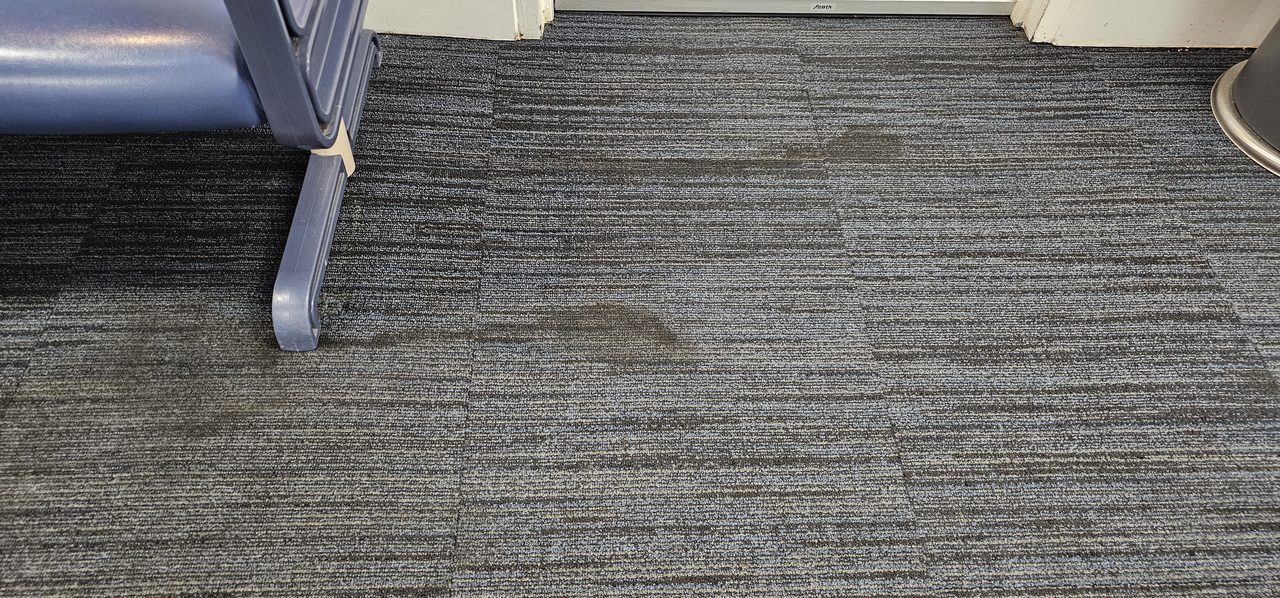
Not all tracked-in soil does the same kind of damage, and the distinction determines what you should worry about most. Abrasive soil is the dry, hard, angular material: sand, grit, road base, crushed limestone, fine mineral dust. Under a shoe it behaves like sandpaper. Each footfall grinds those particles against the fibre, scratching the surface, cutting filament edges and rounding off the twist that makes carpet look bright. That damage is mechanical and permanent — no cleaning method recovers a fibre abraded flat, and the traffic lane looks dull afterwards because it genuinely is dull.
Staining soil is the wet and oily material: car park oils, tar and bitumen, drink spills, food residue, tracked-in wet soil. It looks worse than it is. It discolours the carpet, sometimes dramatically, but it sits on and in the fibre rather than destroying it, and professional extraction or spotting generally lifts it.
| Soil | What it is | What it does | Can it be cleaned out? |
|---|---|---|---|
| Abrasive | Sand, grit, road base, crushed limestone, fine mineral dust | Grinds against the fibre, scratches it and rounds off the twist | No — the damage is mechanical and permanent |
| Staining | Car park oils, tar and bitumen, drink spills, food residue, wet soil | Discolours the carpet but sits on and in the fibre | Usually yes, by extraction or spotting |
One column has an answer that arrives with a machine. The other is decided at the front door, years before anybody notices.
That asymmetry should shape your priorities. Staining soil can be cleaned out, and cleaning is the right answer to it. Abrasive soil is a permanent-damage problem, and the real defence is stopping it at the door. Matting is not about keeping carpet looking clean this week; it is about keeping the fibre intact for the next decade.
The soil load at a Perth entry is not the same as the load in a cooler, greener city, and it changes with the season and the suburb. Specifying matting off a generic template misses that, because the material arriving at a coastal entry in February is nothing like what arrives at the same door in July.
Through summer the dominant threat is dry and abrasive. Fine coastal sand travels a long way inland on the afternoon sea breeze and finds every doorway on a western elevation. Red dust arrives from the east on hot northerly winds. Limestone and cement dust from any construction site within a few streets is exceptionally hard underfoot, and it keeps arriving as long as the site is active.
Through winter the problem flips to water. Perth rain arrives in bursts, so everyone crossing a wet threshold carries moisture plus whatever the car park surface has dissolved, and wet soil penetrates deeper into the pile. Car park oils sit underneath both seasons, transferring onto soles and then into carpet as greasy traffic patterns vacuuming will never touch.
Specifying the right mat for each zone matters more than spending heavily on any single one. An absorbent textile mat outside, or a rubber scraper inside where it does nothing for moisture, wastes both the mat and the space it occupies.
The most common error we see is a single good wiper laid right at the threshold, where coarse debris it was never designed to handle overwhelms it. It then holds that grit at the surface and passes it to the carpet on the next shoe.
A recessed matwell — a shallow rebate in the floor that lets matting sit flush — is the tidiest solution available. It removes the trip edge and looks deliberate rather than improvised.
It fails in two predictable ways. The first is depth. If the well was formed shallower than the mat it now holds, the insert sits proud and you have reintroduced the trip edge you paid to eliminate. If it was formed too deep, the mat sits low and the rim becomes a lip that catches toes and trolley wheels. Retrofitting a mat into a well built for a different product is a common and expensive mistake.
Take the mat out of the well rather than vacuuming over the top of it.
Clear the grit and sand that has migrated underneath and gathered in the base.
Where the well is drained, make sure it still drains.
Put the insert back, and write the cycle into the cleaning specification.
The second failure is neglect. A matwell is a tray, and trays fill. Grit and sand migrate under the insert and gather in the base of the well where nobody looks. Left long enough, the well becomes a reservoir of exactly the abrasive material the mat was installed to capture, and every footstep grinds the insert against it from below.
The fix is simple and almost never scheduled: lift the insert on a cycle, vacuum out the well, check any drainage, and put it back. Write it into the cleaning specification with a named frequency, because if it is not written down it does not happen.
Both models work. The decision comes down to who will actually do the maintenance, and how honestly you can answer that. A rented mat service swaps mats on a fixed cycle: the provider takes the soiled mat away, launders it properly and leaves a clean one. The advantage is that maintenance is contractual rather than aspirational — it happens whether or not anyone remembers, and the cost sits in operating expenditure as a predictable line. The disadvantages are that you pay indefinitely, your choice is limited to the provider's range, and the swap frequency is set by contract rather than by the weather.
Owning your mats gives you control of specification and length. You can build the long run your entry actually needs rather than the standard sizes a service offers, and there is no ongoing rental. The catch is that an owned mat only performs if someone launders and rotates it, and in most buildings that responsibility quietly evaporates.
A hybrid suits many Perth sites: own the outdoor scraper and any matwell insert, which are hard to service on a swap cycle anyway, and rent the interior wipers where laundering discipline matters most. If you own everything, book the mats into the same cycle as your periodic carpet cleaning.
This is the counterintuitive part, and it is why under-maintained matting is sometimes a net negative. A mat has finite capacity. Once the pile is loaded with grit or the fibre is saturated with water, it stops removing soil from shoes and starts donating it back.
A saturated wiper at a wet winter entry is the clearest example. By mid-morning on a rainy Perth Tuesday, a single interior mat can be holding as much water as it can carry, and from that point every dry shoe crossing it picks moisture up rather than giving it away. The dark, damp patch just past the mat that appears every winter is not condensation — that is the mat handing back what it collected.
Once the pile is loaded with grit or the fibre is saturated, a mat stops removing soil from shoes and starts donating it back.
The same applies to dry soil. A grit-loaded scraper holds sand at the surface where the next sole presses into it, making the mat a grinding plate rather than a trap. At a coastal entry after a run of windy days, an outdoor scraper can reach that point well before its next scheduled clean.
The practical response is to vary frequency with the weather rather than keep a fixed schedule. Interior wipers at busy entries need vacuuming daily, with periodic deep laundering beyond that. Keep a spare set for wet weeks so a saturated mat can be swapped mid-day, and rotate mats end-for-end so the leading edge is not always taking the punishment.
Matting sits in the highest-traffic part of your building, which makes it a slip risk and a trip risk at the same time. An entrance mat that injures someone is a very different conversation from one that looks tired. Mats fail in a handful of predictable ways, and every one of them is visible to anyone who bothers to look down on the way past.
None of it is expensive to manage. Check edges and corners as part of the daily entry clean, retire any mat with a curl that will not lie flat, and use a backing appropriate to the floor beneath. Note entry condition in your routine inspection records — for aged care, healthcare, schools and government sites, a documented check on the wettest entries through winter is exactly the evidence you want on file.
Every site has one entry that gets the attention and several that do not. The neglected ones are usually where the soil is coming from.
Staff entries from the car park are the biggest offender in offices across the metro. The reception mat is generous because visitors see it, while the door most of the building actually uses has a small mat or none at all — and it opens onto the bitumen, the oils and the sand. Whatever you spend on presentation matting at the front, match it at the staff door.
Warehouse roller doors and loading docks are a different problem. The opening is wide, forklifts run through it, and conventional matting is either destroyed or becomes a hazard. Accept that the dock is dirty and defend the internal boundary instead: put the real matting at the door between the warehouse and the carpeted office.
Coastal sites from Fremantle up to Joondalup need extra scraper length on western elevations, because sand arrives in volume every afternoon. CBD towers have their own quirk — the ground floor lobby is well matted, but the goods lift and back-of-house corridor that trades use are not, and soil reaches tenancy carpet from that direction all day.
Matting concentrates soil. That is the point of it — you are gathering into a few square metres what would otherwise spread across the whole floorplate. It only pays off if that concentrated soil is removed on a schedule matching how fast it accumulates.
Most cleaning specifications treat entrance mats as an afterthought, covered by a general instruction to vacuum floors. In practice that means the same quick pass given to a quiet office corridor, when the entry mat may hold many times the soil load. Write mats into the specification as their own line: vacuum both directions, lift and vacuum beneath, and check the matwell.
Good matting does not remove the need for periodic deep cleaning. Fine soil still gets past, and traffic lanes still need extraction to pull out what vacuuming cannot reach. What it does is lengthen the interval between cleans at the same presentation standard, which is where the money comes back.
This audit needs no equipment. Do it at your two or three busiest entries, once in dry weather and once on a wet day, because the same entry scores very differently in each.
Start outside and walk in at normal pace, counting your footfalls on matting before you reach carpet. That number is your headline score, and only a few footfalls means soil is getting through regardless of how good the mats are.
Then look down and behind. Rub the mat pile with your fingers — if grit comes up, it is loaded. Lift a corner and look underneath. Finally, compare the carpet in the first metre past the mat with carpet ten metres further in. That comparison is the most honest measure of an entry system that exists.
If your entries fail the footfall count, extending the matted run is the highest-value change available to you and it rarely needs a capital submission. Add length before you add quality — an ordinary mat of the right length beats a premium mat people cross in one stride.
If the mats are long enough but loaded with grit or wet through, you have a maintenance problem rather than a specification one. Fix it in the cleaning contract by naming the mats explicitly, setting a frequency that rises in winter, and requiring matwells to be lifted and cleared.
And if the lanes behind a genuinely good entry system are still going dull, that is ordinary wear catching up, which is what periodic deep cleaning exists for. Hot water extraction pulls out the embedded soil and stains that vacuuming leaves behind. Lightly soiled carpet suits encapsulation, which uses very little moisture. The site visit decides which method we recommend.
| What the audit shows | What it means | What to do |
|---|---|---|
| Only one or two footfalls on matting | The run is too short to remove much soil | Add length before you add quality |
| Mats loaded with grit or wet through | A maintenance problem, not a specification one | Name the mats in the cleaning contract, with a frequency that rises in winter |
| Long, clean mats but lanes still dulling | Ordinary wear catching up | Professional cleaning yearly as the minimum, method set at inspection |
Three possible results from walking your entries, and the change each one calls for.
None of this needs a consultant. Walk the entries, count the footfalls, lift the mats, and compare the carpet in front of them with the carpet further in. Whatever that tells you is worth acting on before the next cleaning quote, because the entry is what decides how hard that carpet has to work.
We look at the entries when we quote a site, since it is usually the cheapest change available to a building. Commercial Carpet Cleaning Perth is owner-operated by Zoran, working across the Perth metro seven days including after hours and weekends, with pricing from $385 (GST inclusive). Call 0460 815 038 if you want the entries assessed along with the floors behind them.
Deferring carpet maintenance does not save money, it moves it. Here is the real cost stack, the arithmetic, and how to build the business case.
Read ArticleHow to set commercial carpet cleaning frequency by zone, traffic and sector, and build a Perth maintenance schedule that protects the carpet.
Read ArticleSeven signs Perth facility managers can diagnose themselves, the tests that confirm each one, and how to tell cleanable soil from permanent wear.
Read Article