
How to Read a Carpet Cleaning Quote
Two quotes for the same floor are rarely the same job. The anatomy of a proper commercial quote, the red flags, silent exclusions and how to compare them.
Read ArticleHow commercial carpet cleaning is priced in Perth: square metre rates, minimum visits, the six cost drivers, and why cheap quotes measure less.
Ask three companies to price the same 400 square metre office and the answers can vary threefold. One is under a thousand dollars, one is over two, and the third sits somewhere between with a page of conditions attached. To a facility manager trying to build a budget, it looks like an industry that prices by guesswork, or worse, by what it thinks you will wear.
It is neither. Commercial carpet cleaning has no shelf price because it is not a product; it is hours of labour, machinery and chemistry applied to a floor that each quoting company may be imagining quite differently from its rivals. The spread between quotes is almost never three views of the same job. It is usually three different jobs wearing the same address.
This post lays out how the Perth market actually prices, what genuinely moves the number, and what honest ranges look like, so that the next spread of quotes reads as information rather than noise. It stops short of the one promise nobody can keep. A real price for your floor needs a tape measure and a look at the carpet, not a paragraph on the internet.
Nearly all commercial carpet cleaning in Perth is priced per square metre of carpet actually cleaned. Not the floor plate on the lease, and not the building's net lettable area: the carpet a machine will genuinely pass over, measured on site. Hard flooring, kitchens and the footprint of fixed joinery come out of the count, which is why two tenancies of identical size on paper can carry quite different carpet areas.
The rate is bracketed by volume. A large contiguous area attracts a better per-metre rate than a scatter of small rooms, for reasons that are mechanical rather than generous: the machine stays running, the hoses stay laid, and the operator spends the night cleaning rather than setting up. As a rule of thumb, the more carpet a single visit covers without packing up, the less each metre of it costs.
Underneath the brackets sits a minimum visit charge. Ours is $385 including GST. It is part of the job's price, never a fee on top. The minimum exists because the fixed costs of a visit, the travel, the setup, the chemistry and the pack-down, arrive whether the job is forty metres or four hundred. A tiny office does not escape those costs. It simply has fewer metres to spread them across.
A 2,000 square metre call centre floor and a 100 square metre suburban office are not the same job scaled up and down. On the big floor, the hour of travel, parking, setup and hose-laying is spread across two thousand metres, and once the machine is moving it runs in long uninterrupted passes for most of the night. On the small office, that same fixed hour hangs over one hundred metres, and the cleaning itself is all edges, doorways and furniture legs.
This is why per-metre comparisons between buildings mislead. The strata manager paying a low rate across a long open lobby run is not getting a better deal than the accountant paying three times that rate on a partitioned suite; they are buying different production rates. The honest comparison is the total for the visit against the work the visit actually contains.
Once the metres are measured, six inputs decide where your floor lands within the range. Every legitimate quote in Perth is an answer to the same six questions, whether the company would describe it that way or not: what method, how dirty, how hard to reach, how much furniture, what hours, and how far from the depot.
None of these is padding. Each one maps directly to minutes on site, litres of water through the machine, or wages at an hour when wages cost more. When two quotes for the same floor differ sharply, the difference almost always lives in one of these six rows, and usually in the first three.
| Driver | Eases the rate | Raises the rate |
|---|---|---|
| Method | Low-moisture encapsulation on a lightly soiled floor | Truck-mounted extraction on heavy soil |
| Soil level | Cleaned within the last twelve months | First professional clean in three years |
| Access | Ground floor, vehicle at the door | Tower level, dock booking, long hose run |
| Furniture | Cleared floor or open plan | Desks, filing and planters moved and reset |
| Hours | Weekday daytime, floor available | Overnight or weekend window |
| Travel | Inside the metro core | Outer suburbs at the far ends of the run |
Every row maps to minutes, litres or wages. When quotes for one floor differ sharply, the gap lives in these rows.
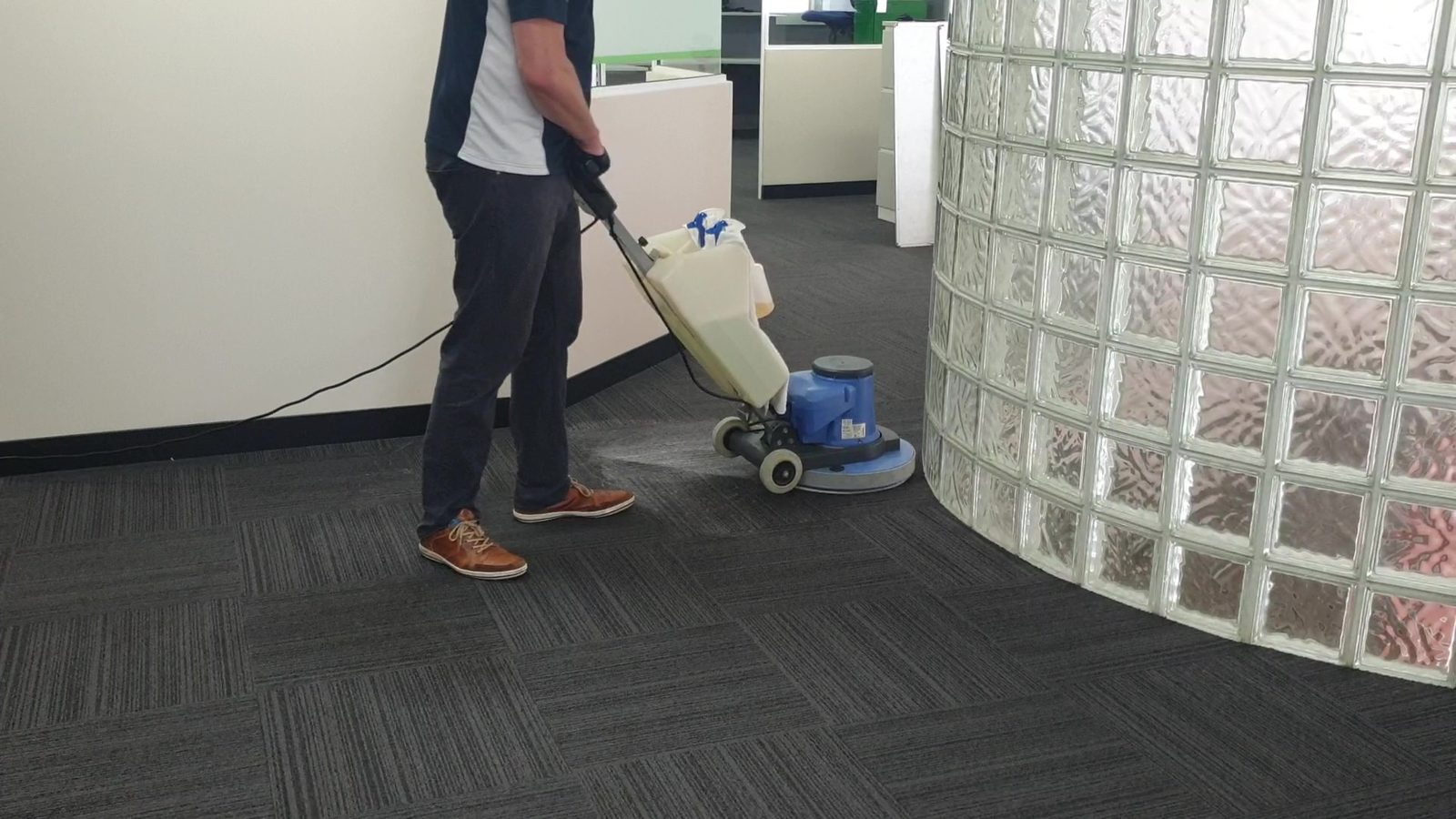
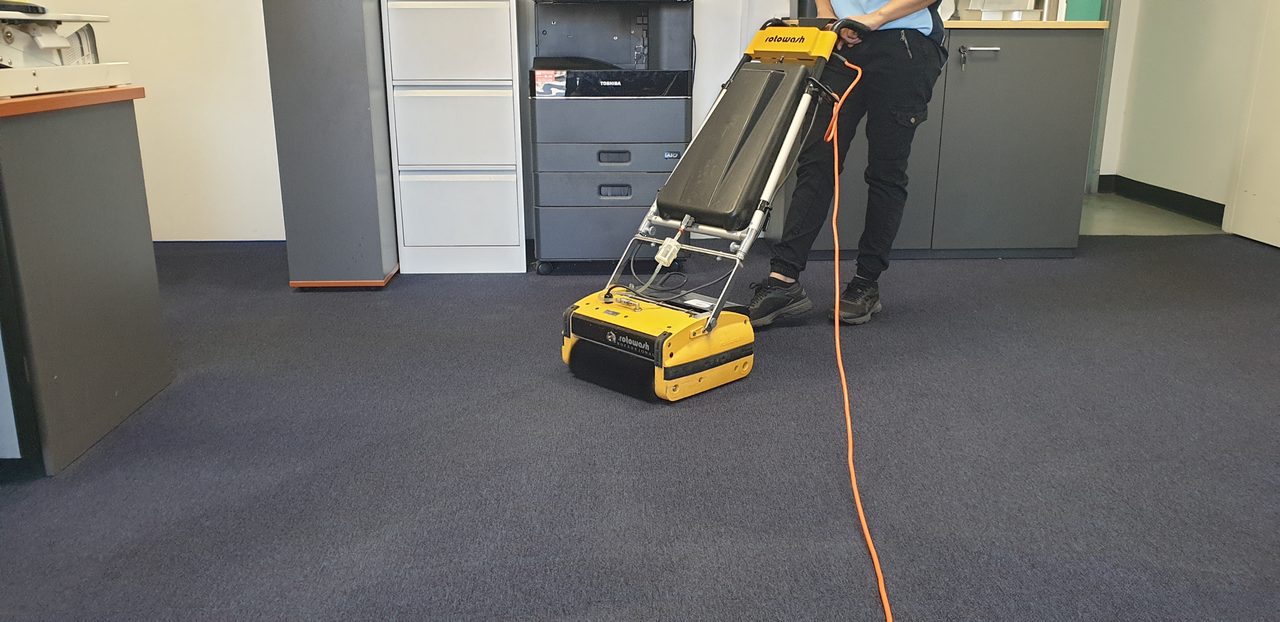
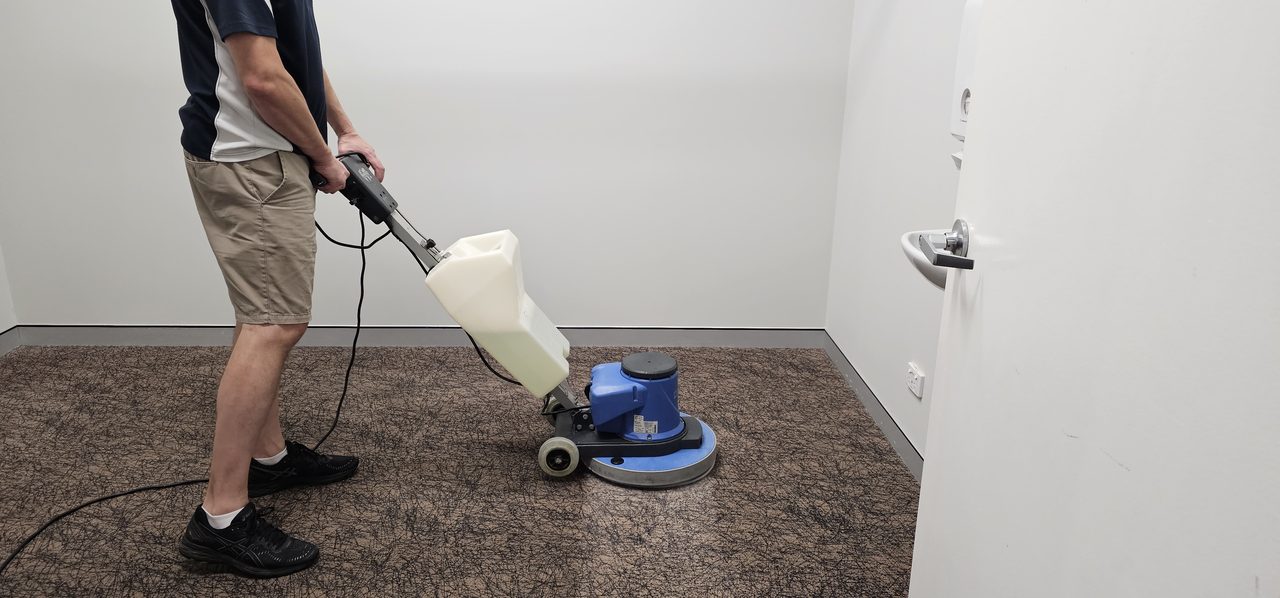
Method moves the rate more than any other driver, because it decides how much water goes into the carpet, how many passes each metre needs, and how much machinery has to run. Low-moisture encapsulation covers ground quickly: a cylindrical brush machine works a polymer through the pile at walking pace, and there is no tank of recovered water to manage. Truck-mounted hot water extraction is slower per metre and brings far more equipment to bear, which is exactly why it costs more, and exactly why heavily soiled carpet needs it.
Which method suits which floor depends on the soil, the stains and the fibre. We recommend it at the free site visit, not from a price list. What matters for pricing is simpler: an encapsulation clean and a steam clean are different products at different rates, even on the same carpet on the same night. A quote cannot be judged until you know which of the two it describes.
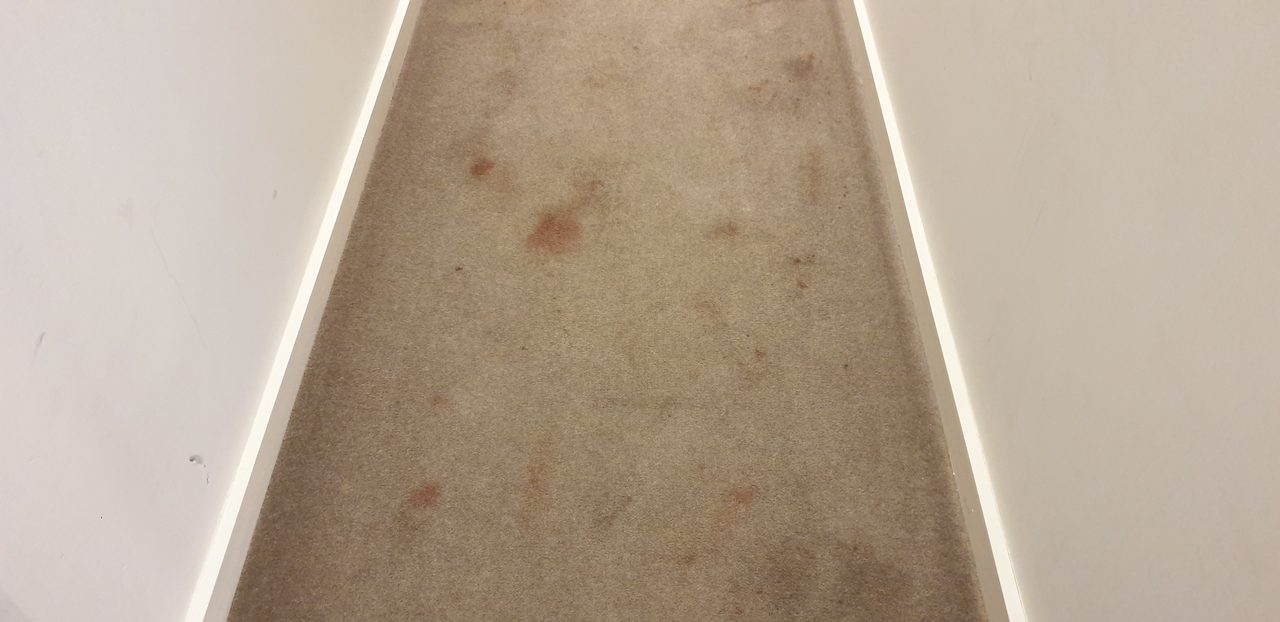
The cheapest way to buy cleaning over the long run is to have the carpet cleaned before its soil turns heavy. Lightly soiled carpet suits encapsulation and its lower rate. A carpet left until the soil is heavy needs agitation and a steam clean. It pays the higher rate every time.
Where the building sits and when it can be handed over price the job as surely as the carpet does. A ground-floor suite in Osborne Park with parking at the door is the cheapest access in the trade: hoses out, machine in, nobody to negotiate with. A tenancy on level twenty of a St Georges Terrace tower involves a loading dock booking, a security escort and portable equipment brought up in the goods lift, which cleans just as well but takes longer to set up.
Hours matter because most commercial floors are only available when the business is not standing on them. Overnight and weekend windows carry a loading, since somebody has to be paid to work them, but they are also simply when the work happens. We operate seven days including after-hours for exactly this reason: a floor that must be dry before staff arrive at seven cannot be cleaned at two in the afternoon.
With the drivers in view, ranges can be stated without pretending to more precision than the trade allows. Commercial per-metre rates in Perth broadly span the low single dollars up to around ten dollars, depending on method, soiling, access and the shape of the tenancy. The bottom of that span belongs to encapsulation across large, open floors with light soil. The top belongs to restorative extraction on neglected carpet in difficult buildings.
Most ordinary office work lands between those poles, and the same floor can move between bands over its life. A suite extracted annually sits comfortably in the middle. Let it run three years untouched and its next clean is priced from a higher band. Clean it regularly before the soil turns heavy and its rate comes back down.
| The job | The band |
|---|---|
| Encapsulation, large open floor with light soil | The low single dollars per metre |
| Hot water extraction, a typical office in fair condition | The middle of the span |
| Restorative extraction, heavy soil or difficult access | The upper single dollars, approaching ten |
| Any visit, however small | From $385 including GST |
Bands, not quotes. A written price needs the metres measured and the carpet seen.
Treat the bands as orientation, not as a menu. Every number we put in writing follows a free site visit, because the visit is where the six drivers stop being estimates. A quote produced after measurement is firm. A number produced over the phone is a guess wearing a dollar sign.
When one quote lands far below the rest, the useful assumption is not that you have found the bargain of the season. It is that the low bidder is pricing a different job. The commonest version is a bonnet pass sold as a deep clean: a rotary machine spins an absorbent pad over the top of the pile, which brightens the first few millimetres, photographs well, and leaves the soil beneath untouched to wick back within a fortnight. Sold as the whole job, it is not a deep clean.
The quieter versions are exclusions, and they work because the person comparing quotes rarely walks the floor at midnight to check. An excluded item does not appear as a line saying excluded; it appears as silence. The quote that never mentions stairs, furniture, spotting or dry time is not including them by default. In commercial cleaning, silence is an exclusion.
The defence is to read scope rather than totals before comparing anything, and we have written separately about reading the quote itself in detail. Before price enters the conversation at all, the questions to ask before hiring will filter out most of the operators whose low numbers were never going to survive contact with your floor.
A standing arrangement changes the pricing before it changes the cleaning. The rate is agreed once, holds for the term, and every visit lands at a known figure the finance team saw coming, which for most facility managers is worth nearly as much as the figure itself. Budget certainty is the first thing a contract buys.
The second is priority. Contract clients hold the good windows in the calendar, the long weekends and the quiet weeks, and a spill or an incident between visits is slotted in at an agreed call-out rather than negotiated from scratch while the stain sets. The contractor also learns the building, which quietly removes cost: known parking, known access, no induction repeated, no re-quoting.
The third is that contract floors never fall into rescue territory. Each visit meets lightly soiled carpet, which suits encapsulation and its lower rate. None of this requires a long lock-in. A plain agreement with simple exit terms captures the whole benefit.
The arithmetic that surprises most building owners is that raising the cleaning frequency usually lowers the annual cost. It feels wrong, since more visits means more invoices. But a floor cleaned rarely is always cleaned expensively: every visit meets years of accumulated soil, so every visit is a restorative job priced from the top of the range, with the slowest method, the longest hours and the most chemistry.
Run the comparison across a year rather than a visit and it inverts. Regular cleans of lightly soiled carpet at the low end of the range can total less than a single rescue clean at the top of it. That is before counting what each regime does to the carpet. Industry testing has long shown that soil left in pile abrades fibre with every footstep, so the rarely cleaned floor is also the floor that reaches replacement soonest, which is a cost that makes cleaning prices look like rounding.
A floor cleaned rarely is always cleaned expensively.
How often your particular floor should be cleaned is its own question, governed by traffic, sector and entrances, and we have set out the right frequency for different buildings separately. For pricing purposes the principle is enough. Frequency is not a cost you are minimising; it is the lever that decides which band every future quote comes from.
Everything above gives you ranges, and ranges are where a responsible pricing conversation starts, not where it ends. Be sceptical of any firm figure offered sight unseen. A price quoted over the phone is a guess with your name on it, and the gap between the guess and the invoice tends to be discovered on the night, in your building, at variation rates.
Our own process is deliberately short. Zoran, the owner, walks the site personally, measures the carpet that will actually be cleaned, checks fibre, soil and access, and puts a firm figure in writing. The number quoted is the number invoiced. Site walks are free, metro-wide, seven days a week, and after hours if your building can only be seen empty then.
If a floor in your building needs a real number rather than a band, book a free site walk or call 0460 815 038. Twenty minutes with a tape measure beats any table on the internet, including the ones above.
Two quotes for the same floor are rarely the same job. The anatomy of a proper commercial quote, the red flags, silent exclusions and how to compare them.
Read ArticleThe questions Perth facility managers can put to any commercial carpet cleaner about certification, insurance, quotes, site walks and method.
Read ArticleDeferring carpet maintenance does not save money, it moves it. Here is the real cost stack, the arithmetic, and how to build the business case.
Read Article