
Strata Common Areas: Who Pays and What Standard to Specify
How WA strata schemes fund common area carpet cleaning, where the lot boundary sits, and how to write a specification that makes three quotes comparable.
Read ArticleStairs, lift cars and corridors carry every footstep the building makes. Why the narrow zones wear years early, and how to clean and schedule them.
Take the floor plan of any Perth office building and shade the carpet by how many feet cross it in a day. The open floor comes out pale almost everywhere: traffic spreads across desks, breakout corners and walkways, and no single fibre works very hard. Then look at the corridor, the lift car and the stairs. They come out black. Every person in the building, every trip they make — arriving, leaving, lunch, meetings, the printer — funnels through the same few narrow strips of carpet.
The arithmetic is blunter than most maintenance budgets acknowledge. People do not use the full width of a corridor; they walk a single lane about ninety centimetres wide down its middle. Put fifty staff on a floor and let each make eight passes a day, and that lane takes four hundred footsteps daily — around two thousand a week, and something in the order of a hundred thousand a year, all landing on the same strip of pile.
The open floor behind it might see a tenth of that traffic spread across ten times the width. So when the corridor dulls and flattens while the rest of the floor still looks new, nothing has gone wrong with the carpet. The building is simply wearing it exactly where the building walks, and any maintenance plan that prices every square metre the same is subsidising the quiet areas at the expense of the ones doing all the work.
Concentration does not just speed wear up; it changes its character. Carpet fails through two mechanisms working together. The pile crushes — tufts flatten under repeated compression and stop springing back — and the fibre abrades, as gritty soil trapped in the pile is ground against it by every passing sole. On an open floor both processes are slow, because any given tuft is stepped on occasionally. In a traffic lane the same tuft is stepped on hundreds of times a day.
An open floor shares its traffic around. A corridor makes every fibre take every footstep.
The two mechanisms then feed each other. Crushed pile packs tighter, holds grit deeper where the vacuum cannot reach it, and presents the sides of the fibres rather than the tips to the next shoe. Abraded fibre loses the smooth surface that reflects light evenly, which is why worn traffic areas look dull even when they are clean. Each pass makes the next pass slightly more damaging.
This is why the narrow places do not just wear faster — they wear disproportionately faster, and they reach the point of no return years before the open floor. A carpet with a rated life of ten years can still be presentable at year nine everywhere except a two-metre stretch outside the lift, and that stretch decides when the whole floor gets replaced. Protecting the lanes is really a way of protecting the replacement date.
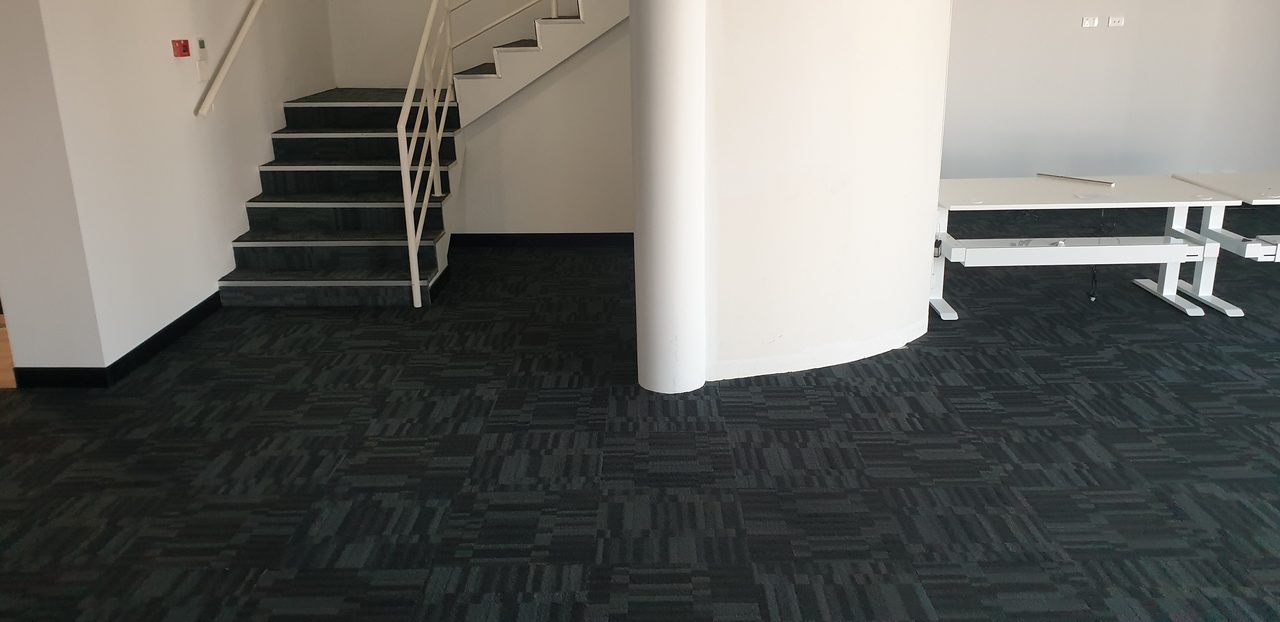
Stairs are the hardest case of all, because they add geometry to the concentration problem. The nosing — the rounded front edge of each tread — takes the landing force of every descending foot. Coming downstairs, the ball of the foot strikes the nosing carrying full body weight plus braking force, and it lands on carpet that has been stretched over a right angle, so there is less pile facing the traffic exactly where the traffic hits hardest.
Wear on stairs is also strongly patterned. Nearly everyone holds or shadows the handrail, so traffic runs off-centre and the carpet wears in a lane a hand-span from the balustrade. The bottom two treads and every landing take pivoting loads as people turn, which scuffs and twists the pile rather than simply compressing it. Look at any older flight and you can read the traffic in it like a map.
The awkwardness is why stairs are so often the worst-presented carpet in a building. No full-size machine fits a tread, so every tread is cleaned individually with a hand tool, and the return flights of a Joondalup walk-up office take real time to do honestly. Cleaners paid by the square metre have every incentive to skim them, and it shows within weeks.
It is worth separating fire stairs from feature stairs when you plan. A feature stair in a reception atrium is a presentation asset and earns presentation-level care. Fire stairs and back-of-house flights collect grit from goods areas and car parks, and their job is to not become a hazard; they need the nosings vacuumed properly and a periodic deep clean, not weekly attention.
A lift car is the concentration problem taken to its logical extreme. The floor of a typical passenger car is around two square metres, and everyone who occupies any upper level of the building crosses it at least twice a day, before you count meetings, deliveries and coffee runs. No other carpet in the building comes close to its footsteps-per-square-metre figure.
The wear inside a car is distinctive. You step in, turn a half-circle to face the doors, and stand with your weight settling through the balls of your feet while the car moves. That pivot, repeated thousands of times, produces the dark, flattened circle in the centre of the car that every older lift in every CBD tower seems to have. It is twisting wear, not just compression, and it is the hardest kind for pile to recover from.
The door sill makes it worse. The track the doors run in collects grit at ground level, and a share of it is carried over the threshold on every entry, straight onto that same two square metres. A lift car effectively has a doormat's job and a doormat's soil load with none of a doormat's design, which is why the carpet in one ages faster than anywhere else you can point to.
Lobby wear has its own signature: a crescent in front of each set of doors, where people wait, shuffle forward and edge sideways as the car arrives. Nobody stands still while waiting for a lift — watch a busy lobby for two minutes and you will see a slow, constant scuffing dance played out on exactly the same arc of carpet.
The ground-floor lobby takes the aggregate of every level above it, since everyone entering or leaving the building crosses it. Upper-floor lobbies are lighter but still carry multiples of their own floor's open-plan traffic. In a building with good entrance matting, the lobby crescent is where the surviving grit finally settles, which is why it darkens even when the entry is well defended.
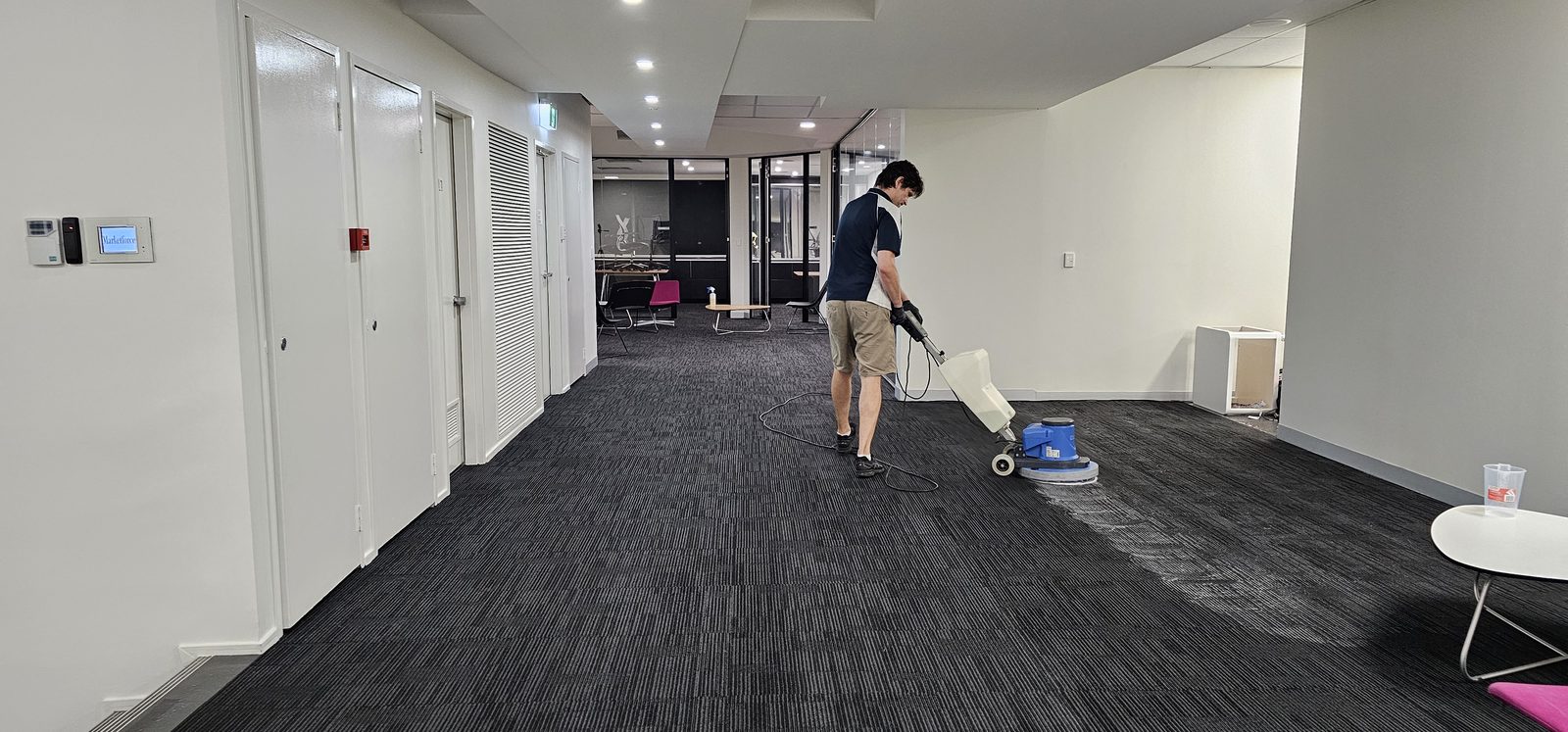
Corridors soil and wear down the centre for the simple reason that people walk down the centre. Given a clear corridor, foot traffic settles into a lane roughly shoulder width along the middle, and the carpet either side of it can stay close to its original colour for years. The contrast is what the eye reads as a dirty floor — the lane on its own would pass, but the clean edges sit right beside it as a permanent before-and-after.
Doorways sharpen the effect. Traffic that spreads slightly along a corridor compresses back to door width at every opening, so wear fans out from each doorway in a worn delta. The same pinching happens wherever the architecture narrows the choice of path: kitchenette thresholds, the mouth of the printer alcove, the turn into the meeting-room wing.
In apartment towers and mixed-use buildings the corridor is usually common property, which puts its carpet in the hands of the strata rather than any one resident, and gives it a committee's decision-making speed. We have covered strata common areas separately, including what standard to specify; the point here is only that a corridor's wear does not wait for consensus.
Colour and pattern decide which of two problems you see first, and they are different problems. Soiling is material sitting on the fibre, and cleaning removes it. Wear is damage to the fibre itself, and nothing removes it. A plain pale carpet confesses soiling almost immediately — unforgiving, but honest, because it sends you the invoice while the problem is still cleanable.
Heathered and flecked mid-tones are chosen for commercial floors precisely because they hide soiling, and they are very good at it. The risk is what the hiding does to behaviour. A carpet that never looks dirty tends to be cleaned less, while the grit it is hiding keeps grinding away at the pile. By the time a heavily patterned lane finally shows, the change you are seeing is usually structural, and the cleaning that would have prevented it is years overdue.
| Choice | Hides soiling? | Hides wear? | The catch |
|---|---|---|---|
| Plain pale | No | No | Honest but relentless — it demands frequent cleaning and shows every lapse |
| Plain dark | Mostly | Partly | Shows lint, drying marks and pale grit instead; Perth's white beach sand loves it |
| Heather or fleck | Yes | For years | Postpones cleaning while grit grinds on; the lane surfaces only once damage is structural |
| Bold pattern | Yes | Until the pattern blurs | Wear erases pattern unevenly, and a half-erased motif is more conspicuous than a plain lane |
Camouflage buys time between cleans. It does not change what the grit is doing underneath.
None of it hides texture. Crushed pile reflects light differently from standing pile, so a traffic lane shows as a matt stripe whenever you look along the floor towards a window — what the trade calls low-angle light. Walk your own corridor towards the glass late on a Perth afternoon and the lanes will declare themselves whatever the pattern. Choose camouflage to buy time between cleans, not to skip them.
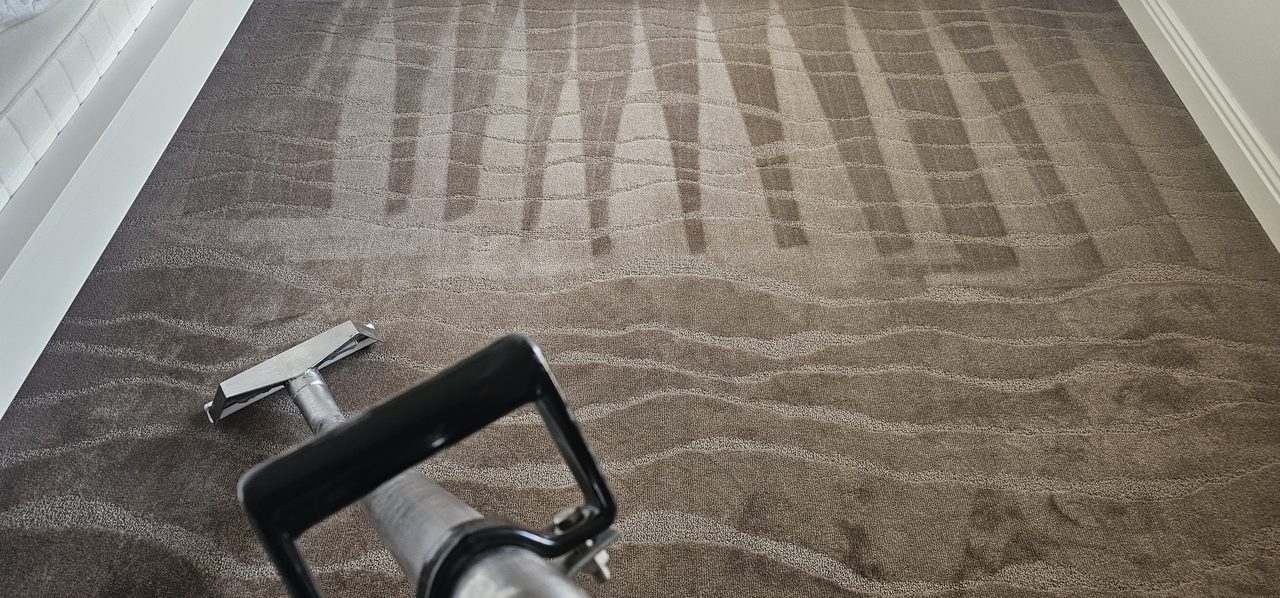
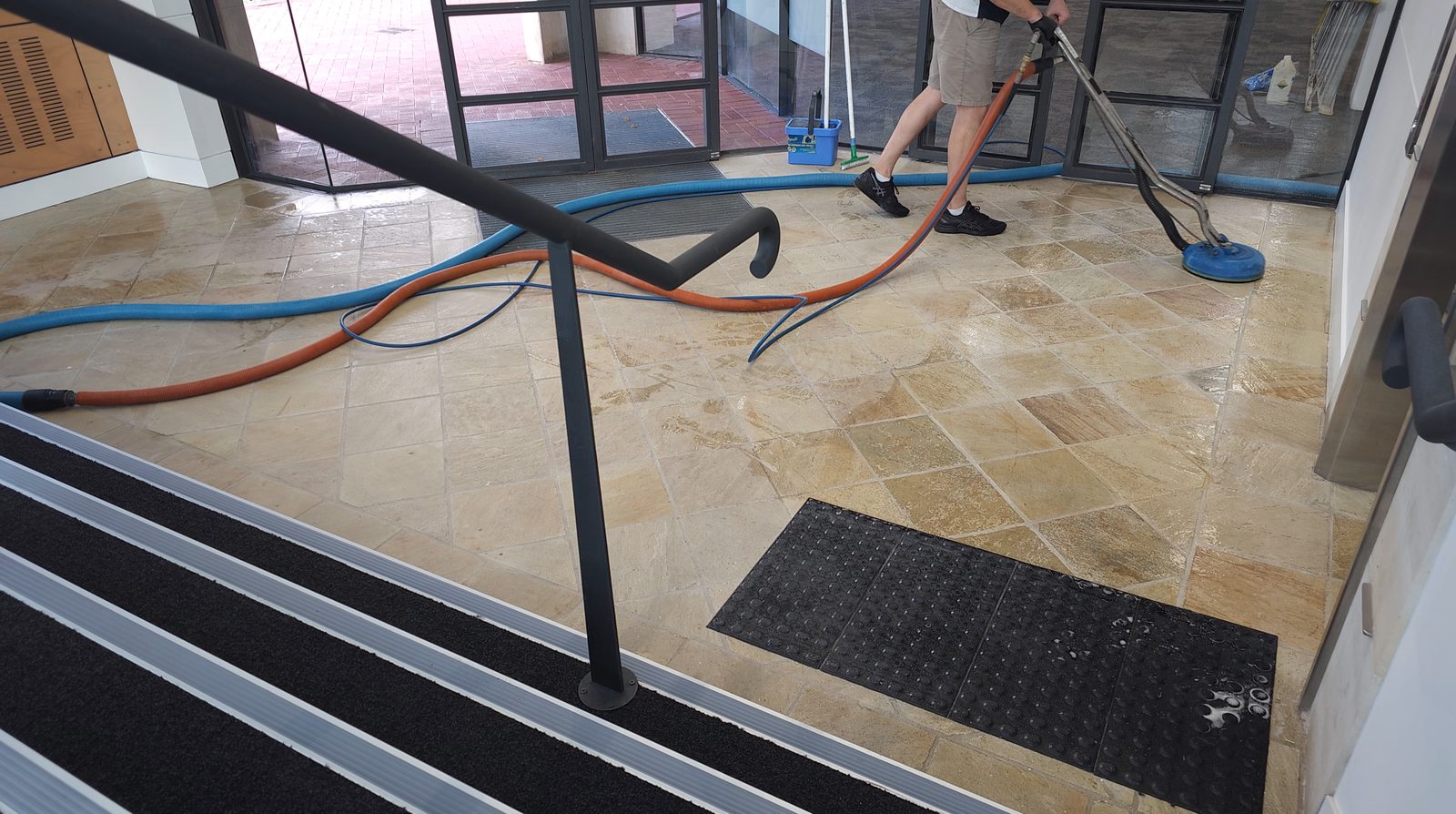
Cleaning these zones well is mostly a matter of taking them seriously as separate jobs. For compacted, grit-loaded lanes, truck-mounted hot water extraction is still the deepest reset available, and the machine stays in the vehicle — only the hoses come inside. Running hose up a stairwell is routine, but it should be done with corner guards on the nosings and turns, because a loaded hose dragged across a bare stair edge does its own damage on the way past.
On the treads themselves, the standard floor wand does not fit and was never meant to. Each tread is worked separately with a hand tool, which is slow, and that slowness is the honest cost of stairs. Where the treads are only lightly soiled, encapsulation is the method we recommend. A Rotowash-style brush machine drives the product into treads and walkways, leaving them walkable within an hour or two.
Drying is the true constraint, because a stairwell is the one space nobody can route around. The practical answers are timing and airflow: clean after hours so the flights dry overnight, place air movers on the landings to push air down the treads, and on wide stairs work one half at a time so a walking line stays open along the rail. A corridor gets the same logic — clean the centre lane in the evening, dry it with moving air, and the building never knows you were there.
Every tread and every nosing, edge to edge, with a detail head — most of the damaging grit leaves the stairs dry.
Corner guards on nosings and wall corners, hoses secured so they cannot saw against an edge or a door frame.
Hand tool from the top down, so rinse water and footsteps never cross finished work.
Air movers at the landings, timed so the flight is dry before the building needs it back.
Carpet tiles earn their keep in exactly these places, because tiles can be rotated. The hardest-worked positions — the centre of the lift car, the lobby crescent, the doorway deltas — can be swapped with visually identical tiles from low-traffic positions along walls and under benches, spreading the wear across the whole stock instead of sacrificing the same few tiles. A lift car floor can be re-tiled in minutes between peak periods.
The discipline is in the details. Hold attic stock from the original batch, because later dye lots rarely match. Clean the surrounding tiles before rotating, or the incoming tile will sit like a patch on a faded shirt. And mark pile direction before lifting anything — carpet pile leans the way it was manufactured, and a tile turned ninety degrees reads as a different shade under light even though it is the identical product.
All of this leads to one principle. The narrow zones need cleaning more often than the open floor, which itself needs professional cleaning every year. How much more depends on their traffic. When we walk the site, we suggest a number of cleans for every zone. You decide what to book. The full logic of matching frequency to traffic is covered in our guide to how often carpet should be cleaned. The short version is that frequency should follow footsteps. The footsteps are here.
The budget objection usually evaporates on inspection, because the multiplier applies to frequency, not to spend. These zones are small. A lift car is two square metres; a lobby crescent is ten; even a full corridor lane is a fraction of the floor it serves. Cleaning them more often adds a modest amount to the year while pushing the replacement date for the entire floor further out — the cheapest square metres on the schedule doing the most expensive job on the asset register. The list below shows what decides how often each zone needs cleaning.
Before you schedule anything, be clear about which problem each zone actually has, because cleaning restores colour and nothing restores fibre. The test is comparison: look at carpet the traffic never reaches — under a cabinet, along the skirting — beside the lane. If a freshly cleaned walkway still looks matt and flat against its protected neighbour, that section is worn, not dirty, and more cleaning will not move it. It is worth understanding when worn carpet can be saved before anyone prices a full replacement, because stairs, lift cars and lane sections can often be re-covered, re-tiled or patched on their own.
One category deserves urgency rather than patience. A frayed or delaminating nosing is a trip hazard on the most unforgiving surface in the building, and most safety inspections will treat it as one. Exposed backing on a stair edge is a repair-now item whatever the budget cycle says; everything else in this article can wait for a scheduled visit, but that cannot.
The audit takes five minutes and no equipment. Walk your main corridor towards the window and look along the floor for the matt stripe. Run a palm over the nosings of the busiest flight and feel for fibre gone hard or thin. Stand in the lift and look at the centre of the car. Then stand where people wait in the lobby and look down at the crescent. Those four looks tell you where your building actually spends its footsteps, and the answer will rarely match where its cleaning budget goes.
That mismatch is fixable in one conversation. Giving the narrow zones extra visits within your commercial carpet cleaning costs little more than spreading them evenly, and it protects the strips of carpet that decide the replacement date for the whole floor. Ask for stairs to be priced as flights, lifts as lifts and lanes as lanes, because a single rate spread across a whole building hides exactly the places that are wearing out.
How WA strata schemes fund common area carpet cleaning, where the lot boundary sits, and how to write a specification that makes three quotes comparable.
Read ArticleHow to set commercial carpet cleaning frequency by zone, traffic and sector, and build a Perth maintenance schedule that protects the carpet.
Read ArticleMost Perth buildings run their entrance matting too short and pay for it in worn traffic lanes. How the three-zone system works and how to audit yours.
Read Article