
The True Cost of Neglecting Commercial Carpet Maintenance
Deferring carpet maintenance does not save money, it moves it. Here is the real cost stack, the arithmetic, and how to build the business case.
Read ArticleIs the carpet dirty, damaged or done? The tests that separate the three verdicts, what restoration brings back, and when replacement is the honest answer.
Every commercial floor eventually produces the same meeting. The carpet looks tired, somebody senior has finally said so, and the question arrives on the facility manager's desk with a deadline attached: clean it, repair it, or replace it? The three answers sit at very different points on the budget, and they are not interchangeable. A tired appearance is a symptom, not a diagnosis, and it has three possible causes that look almost identical from standing height.
Misreading the floor is expensive in both directions. Replace a carpet that was merely dirty and you have written off years of remaining service life along with the capital that bought them. Keep cleaning a carpet that is structurally finished and every invoice is money removed from the replacement fund of a floor that was always going to be replaced.
How a floor arrives at this point — the deferred cleans, the compounding grit, the budget line that kept getting trimmed — is covered in the cost of neglect. This post picks up where that one ends. The floor is tired now, the history cannot be changed, and someone has to read the evidence honestly and put the right amount of money in the right place.
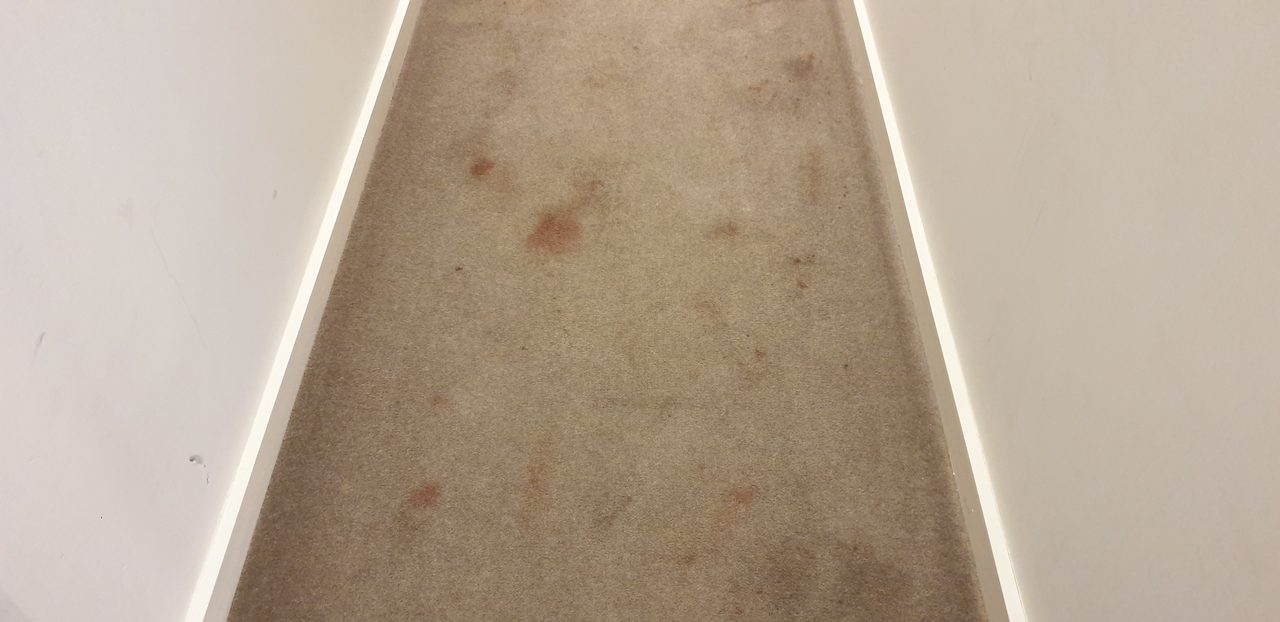
The three verdicts describe three different floors that happen to share a surface. A soiled carpet is structurally healthy underneath its grime: the tufts still have their height, the backing still holds, and the dull cast in the lanes is a film of fine soil sitting on the fibre. A damaged carpet has local faults — a split seam, a burn, a rippled corridor, a bleach spot — inside a floor that is otherwise sound. A finished carpet is failing as a structure, and it is failing everywhere at once.
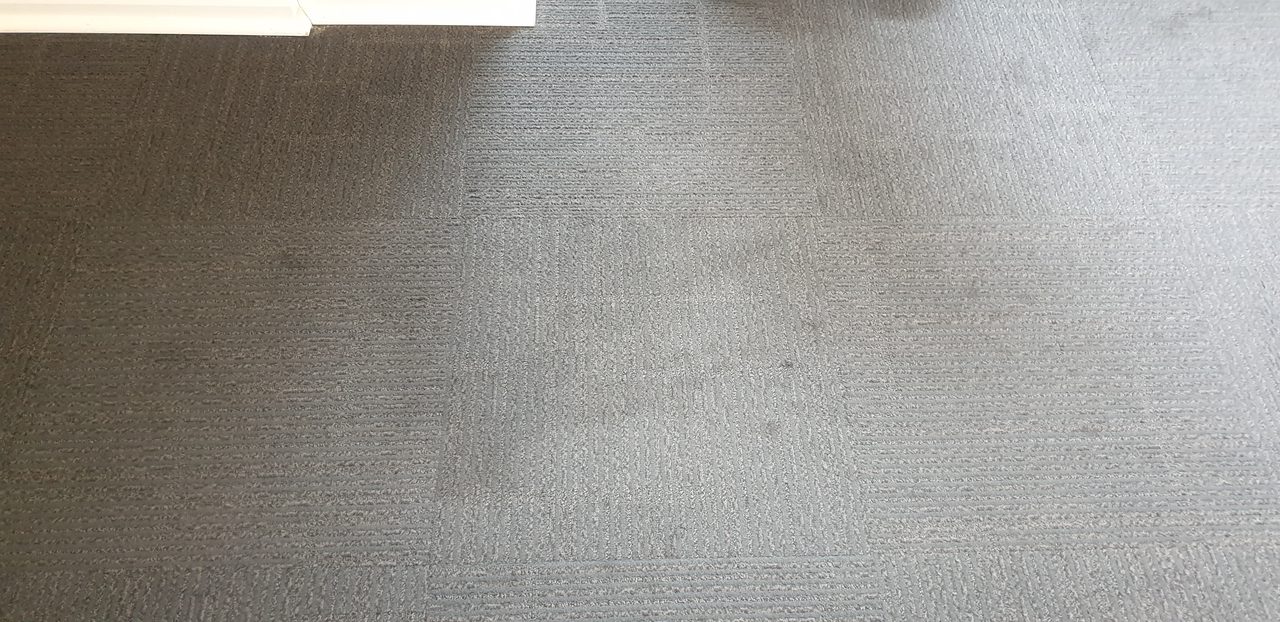
They look alike from standing height because soil and wear produce the same visual result through different mechanisms. Soil darkens and dulls the pile; abrasion scratches the fibre until it throws light back in every direction at once. Both read as grey, flat and old from a metre and a half up, which is exactly where every judgement about carpet gets made. The diagnosis lives at knee height. Get down, part the pile, and compare what you find with a protected patch under a cabinet, because that patch is what the whole floor used to be.
Each verdict has a test that separates it from the other two, and none of the tests requires special equipment.
Restoration is not the same job as a maintenance clean. A maintenance clean holds a good floor where it is; a restorative clean is a deliberate attempt to pull a neglected floor back, and it uses the heavy end of the toolkit. In practice that means restorative extraction: truck-mounted hot water extraction with thorough pre-vacuuming, a dwell period for the pre-spray, mechanical agitation to break the soil film, and slow overlapping passes at high heat and strong vacuum. It is a longer and more expensive visit than a routine clean, and it recovers far more.
What comes back is often startling, because commercial fibre is engineered to take exactly this kind of second chance. The transformation is largest on the floors that had already been quietly priced for replacement, which is why the verdict matters so much: the same money spent on a floor in the next category returns almost nothing.
The honest boundary sits at the difference between what is on the fibre and what has happened to it. Soil sits on the fibre and can be released. Abrasion removes fibre, and removed material is simply gone. A traffic lane that has been ground a couple of millimetres below the surrounding pile will still be lower after the best clean in Perth, because cleaning does not manufacture nylon. Fibre scratched deep by years of quartz sand keeps scattering light and reads faintly grey forever, however clean it is.
Ultraviolet fade is the same category of loss. Carpet beside west-facing glass takes a beating through a Perth summer that dye chemistry cannot survive indefinitely, and the pale band along the window line by February is not soil — it is destroyed dye. A bleach spot is the same mechanism in miniature and in fast-forward. In every one of these cases the tired look is caused by an absence, of fibre or of colour, and no chemistry puts back what is not there.
A clean can take the soil out of a fibre. It cannot put the fibre back.
This is the test of expectations to run before spending anything: is the problem something added to the carpet, or something subtracted from it? Additions — soil, spills, residue, most stains — are the province of cleaning. Subtractions belong to the next two sections, because they are answered with a repair bill or a replacement plan, not a cleaner-smelling version of the same tired floor.
Broadloom's mid-life faults are seams and tension, and both are cheap to fix early and expensive to ignore. Broadloom widths are joined over adhesive seam tape, and the adhesive ages. Joins begin to peel or fray, usually across doorways where traffic crosses the seam at right angles, and a lifted edge is a trip hazard long before it is an eyesore. Reseaming — re-cutting the edges, re-taping and sealing them — is a small job while the fray is small, and the fray never stays small.
Ripples are a tension problem. Broadloom is stretched onto gripper strips around the perimeter of a room, and over years of humidity swings, heavy traffic and trolley wheels it can relax and lift into waves. A rippled floor is restretched with a power stretcher, a lever tool that re-tensions the carpet onto the gripper, and the floor comes up tight again. The timing is the whole game: a ripple that keeps being walked on folds into a crease, the crease cracks the latex inside the backing along the fold line, and a cracked backing holds that line permanently, stretch or no stretch.
To understand the one terminal diagnosis, it helps to know what commercial carpet actually is. The fibre is stitched through a primary backing, locked in place with latex adhesive, and a secondary backing is glued on beneath to give the sheet its strength and stability. Delamination is that sandwich coming apart: the latex fails, the secondary backing separates, and the carpet stops being a structure. Age does it eventually; flooding and repeated over-wetting do it early, which is one of the quieter costs of a badly handled water event.
The symptoms are distinctive once you know them. Bubbles and blisters that shift underfoot. Ripples that come back within weeks of a professional restretch, because the stretcher is pulling on a top layer no longer connected to the bottom one. A dry, gritty crackle when a corner is folded back, which is perished latex breaking. Rows of tufts coming away in the vacuum, because the adhesive holding the tuft bind has let go.
Delamination ends the conversation. There is no repair for adhesive that has failed across whole square metres, cleaning cannot help, and aggressive wet cleaning actively makes it worse. The correct response is to stop spending, keep the floor safe — a delaminating stair edge or doorway needs attention for trip risk immediately — and move the money into the replacement the floor was always going to become.
Compare the two paths per square metre and the shape of the decision is obvious. Replacement is a stack: the product itself, underlay or floor preparation, uplifting and disposing of the old carpet, installation labour, the after-hours premium most commercial work attracts, and the internal cost of decanting furniture and losing the area for days. Restoration is a service visit. As a rule of thumb it runs at a small fraction of supply-and-install cost per square metre — often a tenth or less, and your own quotes will confirm the ratio.
That ratio drives the strategy. If there is any realistic chance the floor is dirty rather than done, restoration is the rational first move, because even a partial recovery buys years of service for a small percentage of the capital cost. The same ratio cuts the other way with equal force: on a floor that is structurally finished, every clean converts money into nothing, which is why the diagnosis has to come before the spending rather than after it.
| Restore or repair | Replace | |
|---|---|---|
| What you pay for | A service visit, or a few square metres of making good | Product, uplift, disposal, installation and downtime |
| Scale of cost | As a rule of thumb, a small fraction of replacement | The full capital cost of the floor, plus the disruption around it |
| Downtime | Hours, usually after hours | Days per area, with furniture decanted and rebuilt |
| The wrong call when | The floor is failing structurally everywhere | The floor was only ever dirty |
The exchange rate between the two columns is why the diagnosis matters more than either quote.
The question is never really clean versus replace, settled forever. It is buy years now, cheaply, or buy a floor now, expensively — and on most tired buildings the honest answer involves doing both, in different places, which is where staging comes in.
Buildings do not wear evenly, so a single verdict for a whole floor plate is usually the wrong resolution. Carpet fails first in the zones that fail first — stairs, lift lobbies, pinch-point corridors and the first few metres inside every entry — where traffic concentrates into a narrow band and grinds it. The open-plan field behind those zones may have half its life left while the lift lobby is worn to the backing. Replacing everything to fix the lobby throws away the field's remaining years.
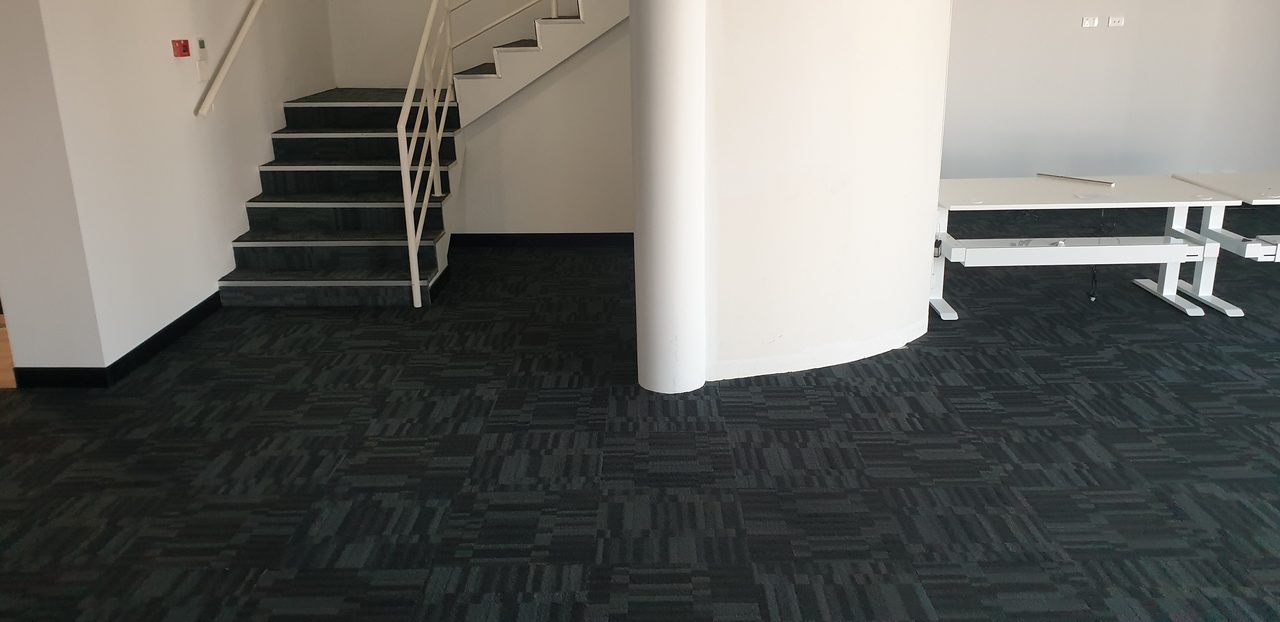
Staging splits the verdicts by zone and funds them accordingly: replace the areas that are structurally finished now, restore the areas that are merely dirty, and schedule the remainder across the next two or three budget years. Carpet tiles make this simple, because new tiles go down one zone at a time over a weekend. Broadloom stages at natural boundaries such as doorways, lift thresholds and the break between floors, so the line between old and new lands where the eye already expects a change.
The one trap is colour. New carpet laid beside seven-year-old carpet will not match, even in the same product from the same manufacturer, because the old floor has faded and worn in ways no dye lot can anticipate. A near-miss looks like an error; deliberate contrast looks like design. A distinctly different lobby tile with a clean border reads as intent, and nobody ever asks when the rest of the floor is being done.
The cheapest way to settle the argument is not another meeting, it is a test. Have the worst traffic lane restoratively cleaned — a strip a few metres long through the ugliest part of the floor — and let the result make the case. The cost is trivial against either path it informs, and unlike opinions, the strip cannot be argued with. We run test cleans as part of a free on-site quote when a floor genuinely sits on the boundary, for exactly this reason.
Judge the strip dry, in ordinary daylight, and against the right benchmark — the protected carpet under a cabinet, not your memory of the floor when it was new. If the strip transforms and holds its recovery, the floor was dirty, and the whole area deserves the same clean. If it comes up cleaner but stays grey and flat beside the protected patch, the fibre is worn, and you are now reading a repair or staging decision. If the cleaning raises bubbles, ripples or a discolouration that creeps back as it dries, the structure itself is telling you it is finished.
One strip, one week, and the meeting becomes short. The verdict arrives with evidence attached, quotes can be sought for the right remedy instead of all three, and nobody spends replacement money on a dirty floor or cleaning money on a dead one. For the price of a small service visit, it is the best-value diagnostic in commercial flooring.
Whatever the verdict, write it down. Photograph the lanes, the protected patches and the test strip, date everything, and file it with the cleaning invoices. If the verdict is replacement on a carpet that has failed unusually early, check your warranty position before you sign anything, because commercial wear warranties can carry part of the cost — and they will ask for exactly the maintenance records you have just filed. If the verdict is restoration, the same records become your make-good evidence at the end of the lease.
The decision rests on three facts you can check yourself. Pile height in the lanes against the protected carpet tells you whether fibre is missing. The backing, folded at a corner, tells you whether the structure holds. The test strip, judged dry, tells you how much a clean brings back. Ask anyone advising you, us included, to show you those three at the pile.
We walk commercial floors across the Perth metro 7 days a week. Every walk ends with an honest assessment of which verdict your floor has reached. Where the carpet is finished, we tell you so and you keep the money for the new floor. The walk is part of our free on-site quote. Where a floor sits on the boundary, we run a test strip rather than guess. We are an IICRC Certified Firm and clean to the IICRC S100 standard.
Deferring carpet maintenance does not save money, it moves it. Here is the real cost stack, the arithmetic, and how to build the business case.
Read ArticleMost commercial carpet warranties quietly require documented professional cleaning. What the clauses demand, the records that survive a claim, the traps.
Read ArticleStairs, lift cars and corridors carry every footstep the building makes. Why the narrow zones wear years early, and how to clean and schedule them.
Read Article