
Repair, Restore or Replace: Reading the End of a Carpet's Life
Is the carpet dirty, damaged or done? The tests that separate the three verdicts, what restoration brings back, and when replacement is the honest answer.
Read ArticleThe biggest environmental lever on commercial flooring is not the cleaning product, it is how long the carpet lasts. The maths, and how to report it.
Open any building's sustainability report and you will find energy, water, waste streams and procurement, each with a number attached. Flooring, if it appears at all, appears as a line about cleaning products. Yet the biggest environmental decision anyone makes about commercial carpet has nothing to do with what it is cleaned with. It is how many years the carpet stays on the floor before it goes into a skip.
The reason is proportion. Commercial carpet is a petrochemical product with a substantial manufacturing footprint and, in Australia, almost no recycling path at end of life. Nearly all of its environmental cost is committed before the first person walks across it. Every additional year of service spreads that fixed cost thinner; every early replacement books the whole cost again. Duration is the denominator, and nothing else on the flooring ledger moves the result as much.
This article is for Perth businesses with ESG reporting obligations or a genuine sustainability commitment, and for the facility managers asked to feed them. It sets out what a floor costs before day one, what actually happens to carpet at end of life in Australia, the arithmetic of extending service life, and how to turn floor life into a line item a report can defend under questioning.
By the time a new floor is walked on for the first time, most of its environmental story has already been written. The face fibre of nearly all commercial carpet is nylon or polypropylene, polymerised from oil or gas. Beneath it sit backing layers of synthetic latex, bitumen or PVC, bonded under heat. Tufting, dyeing and heat-setting consume energy and water at industrial scale, and very little of this happens anywhere near Perth, so the finished product then travels a long way to reach the site.
| Stage | What it involves |
|---|---|
| Fibre | Nylon or polypropylene polymerised from oil or gas, then extruded, spun and heat-set |
| Backing | Synthetic latex, bitumen or PVC layers bonded under heat to lock the tufts in place |
| Manufacture | Tufting, dyeing and finishing, with industrial energy and water inputs at every stage |
| Freight | Most commercial carpet reaches Perth by sea or by road across the Nullarbor |
| Installation | Underlay, adhesives and cutting waste, which on a complex floor plate can run to several per cent of the order |
Life-cycle studies of commercial flooring consistently place the large majority of total environmental impact in these stages, not in cleaning and maintenance.
Set a decade of professional cleaning beside that and the comparison is not close. A truck-mounted extraction visit uses water measured in hundreds of litres, detergent measured in litres, and a few hours of engine and heater run time. Repeat that once a year or more for ten years and it remains a modest operational footprint sitting on top of a very large embodied one. Life-cycle assessments of flooring have made this point consistently: manufacture dominates, and use-phase cleaning does not.
The consequence is worth stating plainly. If almost all of the impact is locked in at manufacture, then the question of what the carpet is cleaned with is a fine-tuning question, and the question of how long the carpet lasts is the whole game. A sustainability conversation about flooring that never mentions service life has missed its own subject.
When commercial carpet comes up, it goes to landfill. Strip-out contractors cut it into lengths, load it into skips, and that is the end of the story for almost every square metre removed from an Australian commercial building. Industry estimates have long put the country's carpet waste in the tens of thousands of tonnes a year, and the commercial share of it arrives in concentrated bursts every time a fitout cycle churns.
The obstacle is not indifference, it is chemistry and geography. Carpet is a composite: face fibre of one polymer, backing of another, glued and fused into a product that was never designed to come apart. And in Western Australia the picture is harder again, for reasons worth spelling out.
The arithmetic that matters here is annualisation, and it is the same arithmetic finance already applies to the asset. Take the embodied footprint of a floor, which is fixed at manufacture, and divide it by the years of service the floor delivers. A floor that comes up after eight years carries its whole manufacturing cost across eight years. The same floor kept in service until year fifteen or sixteen carries the same cost across twice the span, and its annualised footprint roughly halves.
The gap between those two lives is not hypothetical. Commercial carpet is engineered for long service, and manufacturers' wear warranties commonly run to ten years or more. Yet neglected floors in busy buildings are routinely replaced somewhere around the eight-year mark, and usually for presentation rather than structural failure. The fibre is still bound to the backing; it has simply been dulled by compacted soil in the traffic areas nobody cleaned.
No other decision on the flooring ledger moves the number like this. Switching detergents adjusts a small operational figure. Doubling service life halves the dominant one. And because the extra cleaning visits that make the longer life possible carry only a modest footprint of their own, the exchange is overwhelmingly favourable. In accounting terms, maintenance buys years, and years are the currency the whole calculation is denominated in.
Commercial carpet rarely wears out on its own schedule. It is worn out, mechanically, by the grit that traffic grinds through it. Perth supplies that grit generously: quartz sand carried in from the coast, red dust on the easterly, limestone fines from whatever is being built next door. Each particle is harder than the fibre it rests against, and every footstep works it like an abrasive. We have written separately about the neglect spiral this feeds; the short version is that soil left in the pile makes every following month more damaging than the last.
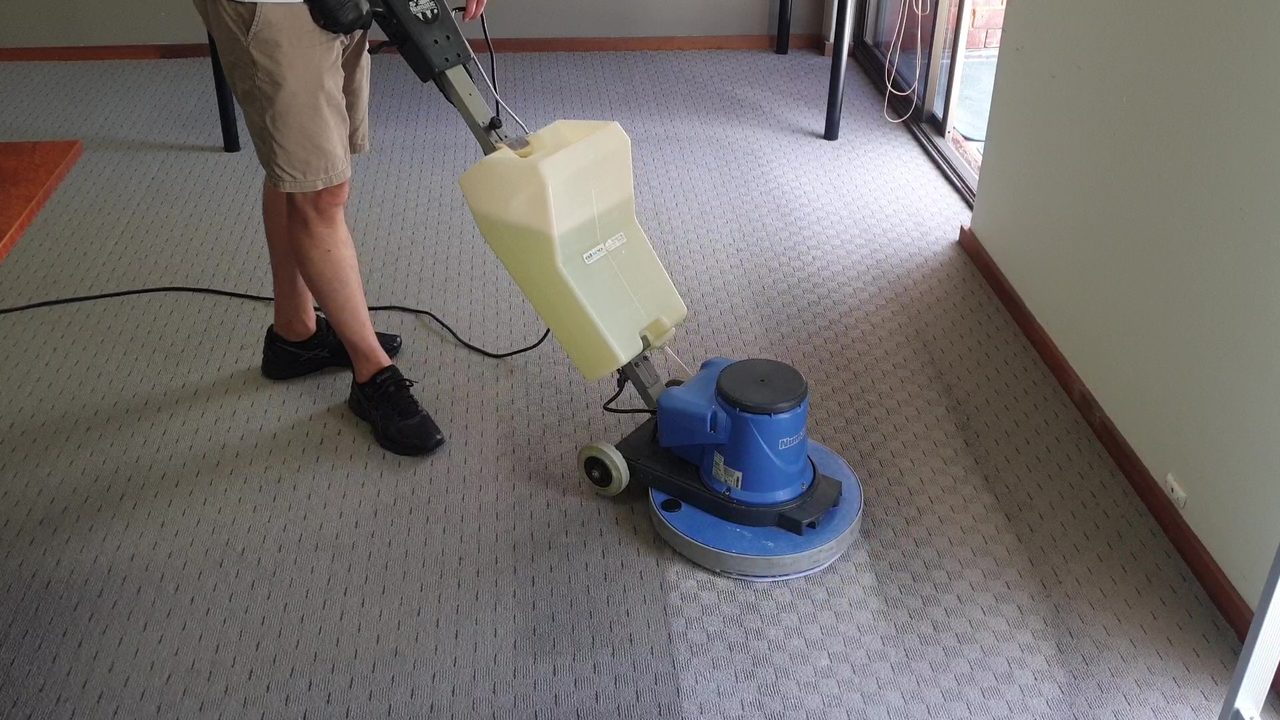
Regular maintenance interrupts that process at two depths. Regular vacuuming removes dry soil while it is still loose at the surface, before traffic can drive it down. Professional cleaning takes out the soil that vacuuming leaves behind. Our advice is a yearly clean as the minimum, with the busiest areas done more often. On lightly soiled carpet, low-moisture encapsulation lifts the soil from the upper pile. Where soil is heavier, hot water extraction flushes the base of the pile and removes the embedded grit no vacuum can reach. We recommend the method once we have inspected the floor.
Life extension here is literal, not a figure of speech. A fibre that is not scratched this year is service life banked, because no future clean can restore a filament once grit has scored it. That is what makes when you clean worth more than how hard you clean, and why the cheapest year of a carpet's life to protect is always the current one.
When sustainability and carpet cleaning appear in the same sentence, the first question is nearly always about products. It is a fair question. What goes into the tank ends up in the pile, on shoes, and eventually in the wastewater system, and there is a genuine conversation to have about greener cleaning chemistry, which we have covered separately.
But keep proportion in view. The detergent consumed across a decade of professional cleaning amounts to some tens of litres of concentrate, and its manufacture and disposal footprint is measured accordingly. The carpet it protects is a petrochemical product weighing tonnes that will otherwise be remade years early. The two numbers are not on the same scale, and no product substitution can close the gap that an early replacement opens.
A skip bin of eight-year-old carpet outweighs a decade of cleaning chemistry.
The failure mode to avoid is optimising the visible number while ignoring the dominant one. A building that proudly specifies eco-labelled cleaning products, then runs a cleaning frequency so thin that the floor fails at eight years, has decorated the small figure and doubled the large one. Choose better chemistry by all means. Just do not mistake it for the lever.
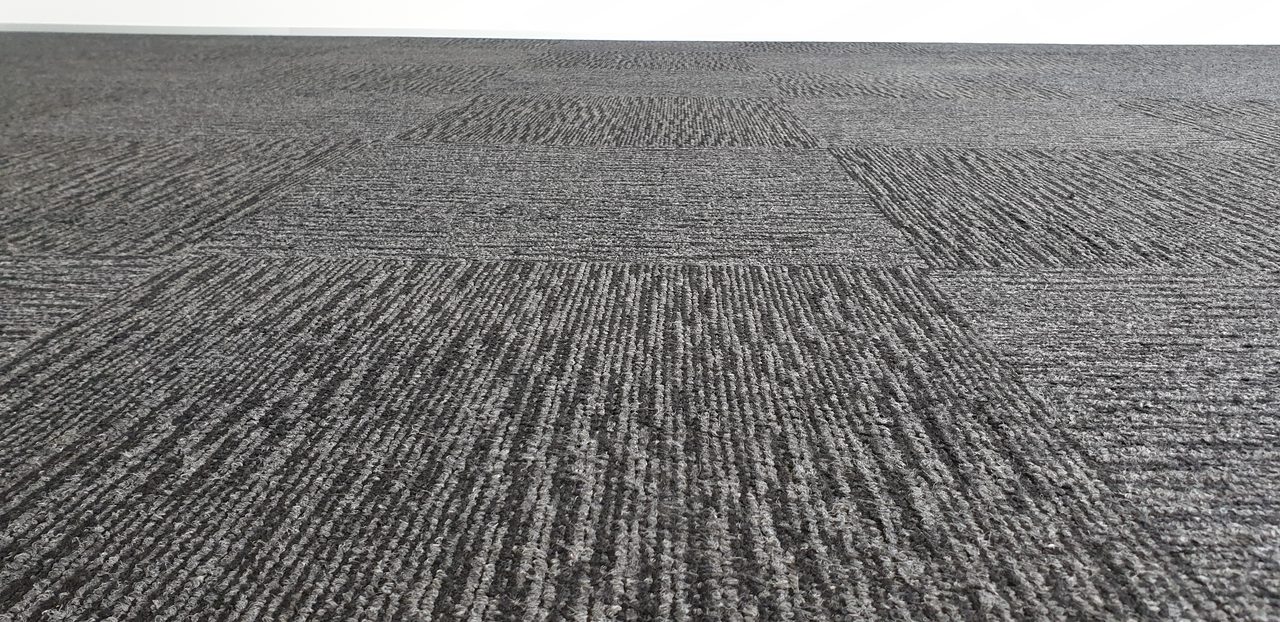
Modular carpet has a sustainability advantage that rarely makes the brochure: it fails in patches, and patches can be replaced. Wear on a commercial floor is brutally uneven. The lift lobby and the corridor pinch points take millions of footfalls a year; the tiles under desks and along walls take almost none. On a broadloom floor, the worst square metre condemns the whole sheet. On a tiled floor, it condemns forty tiles.
Forty tiles into a skip instead of four thousand is a difference of two orders of magnitude in waste, and it is available to any building that manages its tiles deliberately. That means holding attic stock from the original order, rotating tiles from hidden areas into worn ones, and treating a stained or frayed patch as a small maintenance job rather than a replacement trigger.
There is one honest caveat, and it is colour. Tiles in service fade slightly under light and cleaning, so a brand-new tile from the store room reads a shade brighter than its ten-year-old neighbours. Good tile management works around this rather than pretending it away.
It would be convenient to end a strip-out story with recycling, so it is worth setting out plainly what does and does not exist. A few large manufacturers run take-back schemes for their own carpet tiles, reprocessing bitumen-backed tiles into backing for new ones. These schemes are real, but they are conditional: generally their own product, in volume, uncontaminated, and moving through east-coast logistics.
Below that sits downcycling, where recovered carpet becomes underlay, acoustic felt or industrial padding. Downcycling is a one-way trip; it defers landfill by one product generation rather than closing a loop, though deferral still beats the skip. Energy recovery, burning carpet for industrial heat, operates overseas and barely at all here.
The reporting consequence is simple. Do not write that your old carpet will be recycled unless a named scheme has confirmed in writing that it will take your specific product from your specific site. Write a floor-life commitment instead. It is the claim you actually control, and it is the one with the larger effect anyway.
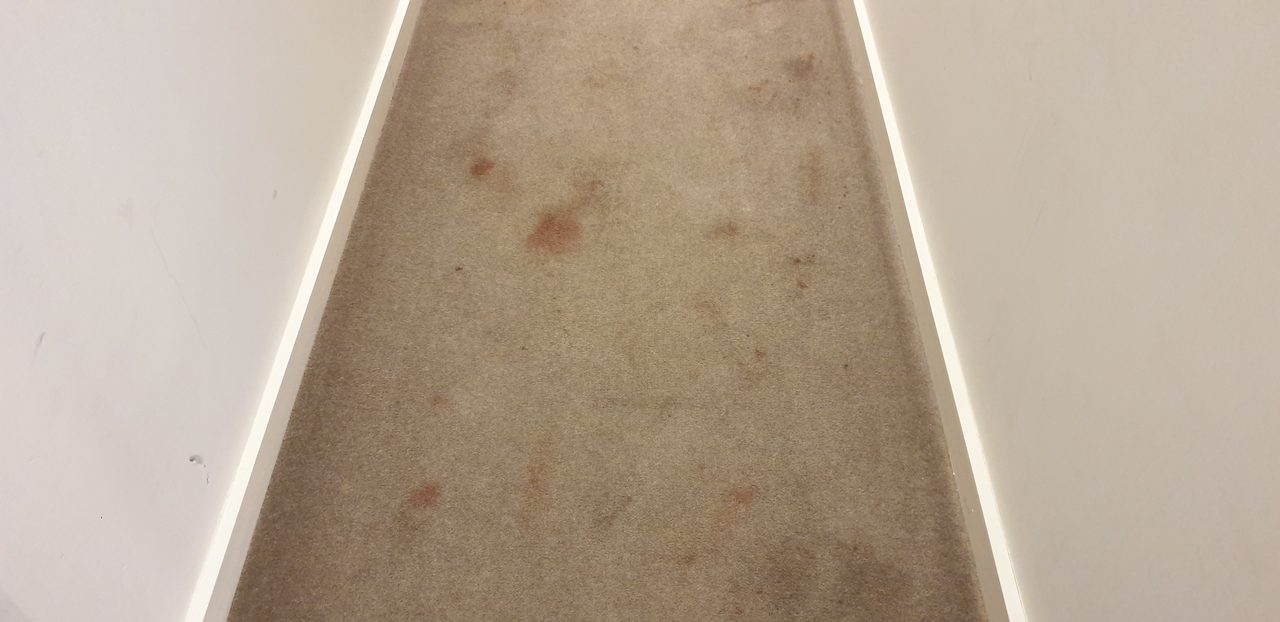
The most common environmental failure in commercial flooring is not neglect. It is the replacement of a serviceable floor for cosmetic reasons. A tenant changes, a brand refreshes, a manager looks at soiled walkways and concludes the carpet is finished. The tuft bind is sound, the backing is sound, the seams are sound. What has failed is presentation, and much of what reads as wear is in fact a film of embedded soil that has never been properly extracted.
A restorative clean frequently resets that judgement. Our agitation and steam cleaning method, with careful spotting first, often takes a floor off the replacement list. Not always; fibre genuinely worn flat by years of grit is beyond any clean, and an honest contractor will say so on inspection. We have set out the wider decision framework for restoring instead of replacing separately.
The discipline worth adopting is cheap: before any cosmetic replacement is approved, have the worst section restoratively cleaned and judge the result with your own eyes. If the floor comes back, you have deferred a capital spend and kept tonnes of composite plastic out of landfill for the price of a clean. If it does not, you have bought certainty. Either way, a replacement deferred is the most defensible sustainability saving a flooring budget can record.
ESG reporting rewards three qualities: measurability, auditability and attribution. Floor life has all three, which makes it unusual among sustainability claims about cleaning, most of which reduce to adjectives. A floor-life target is a number, on an asset register, against a date.
Record every carpeted zone: product, area in square metres, install date and stated design life. Most buildings have never done this.
Fifteen years is a defensible target for quality carpet tile in an office; adjust for traffic and sector, and note the manufacturer's design life beside it.
Attach the vacuuming and professional cleaning schedule the target assumes. A target without a maintenance line beneath it is a wish.
Walk the floor annually, photograph the traffic lanes, and record condition against the target. Twenty minutes per floor is enough.
Report average age at replacement, replacements deferred, and tonnes of flooring not sent to landfill, calculated from area and the published weight per square metre.
The tonnage line deserves emphasis because it is genuinely calculable. Every commercial carpet specification sheet publishes a weight per square metre. Multiply that by the area of any replacement you deferred and you have kilograms of composite material kept out of landfill this reporting year, attributable to a named maintenance decision. Very few sustainability claims in facilities management can be reconstructed from first principles by an auditor. This one can.
None of it stands up without the maintenance underneath. The target is only credible while a commercial carpet cleaning schedule is funded and documented, because the maintenance records are the audit trail that connects the target to the outcome. Conveniently, they are the same records your carpet warranty and your lease already expect you to hold.
There is a version of this argument that gets overstated, and it is worth naming before anyone repeats it in a sustainability report. Cleaning a carpet does not make it new, and no amount of maintenance rescues a floor that has already been walked flat. What maintenance decides is which year the replacement falls in, and moving that year out by three or four is the whole of the environmental case. It is an unglamorous claim, and it is the one that survives scrutiny.
If a floor in your building is on the replacement list because of how it looks, get an honest assessment before the skip is booked. Occasionally the most sustainable advice anyone can give is that the carpet has years left in it, and that advice is worth asking for through our contact page. The greenest square metre of carpet in Perth is the one that does not go into landfill this year.
Is the carpet dirty, damaged or done? The tests that separate the three verdicts, what restoration brings back, and when replacement is the honest answer.
Read ArticleWhat carpet cleaning chemicals actually contain, what green labels do and do not mean, and why method and rinsing matter more than the bottle.
Read ArticleDeferring carpet maintenance does not save money, it moves it. Here is the real cost stack, the arithmetic, and how to build the business case.
Read Article