
10 Questions to Ask Before Hiring a Commercial Carpet Cleaner in Perth
The questions Perth facility managers can put to any commercial carpet cleaner about certification, insurance, quotes, site walks and method.
Read ArticleAn hour-by-hour walkthrough of a commercial carpet clean in Perth: the site walk, access, the clean in sequence, drying, the final check and lock-up.
You approve a price, hand over a key or an access card, and someone arrives at your premises after everyone has gone home. With us you know exactly who that someone is. The person who prices the job is the person on the floor at night and the person who checks it afterwards. Even so, the next morning the carpet is either noticeably better or it is not, and if something went wrong you usually cannot tell what.
This article removes that uncertainty. It walks through a commercial job in the order it actually happens, from the first site walk to the follow-up call a week later, and explains what each stage is for. Some of it is craft, such as why dwell time matters. Some of it is pure logistics that only exists in commercial work, such as lift bookings, alarm codes and after-hours protocols.
This is not the conversation about how to choose a contractor, which happens before you hire. This is what to expect once the booking is made, and what a good operator volunteers without being asked.
Nearly every commercial job we price begins with a walk of the actual floor, because carpet does not describe itself accurately down a telephone. We measure the cleanable area of each room, note what is excluded and sketch a simple floor plan, so the quote, the invoice and the work all describe the same thing.
The more valuable part of the walk is reading the floor. Soil does not arrive evenly; it arrives at entries and follows people, so we look for the traffic lanes first: the run from the lift lobby to reception, the corridor spine, the path around the photocopier, the loop between desks and the kitchenette. Those lanes are what a visitor sees and what will still look tired if a job is rushed.
Then we find the problem spots and mark them: chair-castor tracking under workstations, grease at the tea point, spill rings in meeting rooms, and the dark halo where an entry mat has sat too long. A quote written without that list is a quote for an average job, not for yours.
What your carpet is made of decides the chemistry, the machine and the outcome. Solution-dyed nylon, the workhorse of most Perth office fit-outs, is tough and tolerates a robust alkaline pre-spray. Wool and wool blends, which turn up in boardrooms, churches, hotel corridors and older government buildings, need a gentler pH and controlled moisture, which is exactly what Woolsafe accreditation exists to govern.
Construction matters just as much. Loop pile hides soil but holds it deep at the base of the pile, so it needs proper agitation rather than heavier wetting. Carpet tiles can be over-wet at the seams if the operator is careless, while broadloom over underlay takes longer to dry.
| Carpet | What it needs |
|---|---|
| Solution-dyed nylon | Tolerates a robust alkaline pre-spray |
| Wool and wool blends | Gentler pH and controlled moisture |
| Loop pile | Agitation rather than heavier wetting |
| Carpet tiles | Care at the seams, which over-wet easily |
| Broadloom over underlay | Longer to dry |
The fibre is established before the pre-spray is mixed, not after. A technician who cannot tell you what your carpet is made of should not be the one deciding what goes on it.
This is also where we tell you what will not come out. Traffic-lane wear is abraded fibre, not soil, and cleaning it makes it cleaner without making it new. Sun fade along a north-facing window, bleach marks from a sanitiser spill, rubber-backed mat discolouration and permanent dye stains are all worth naming before the work, not after.
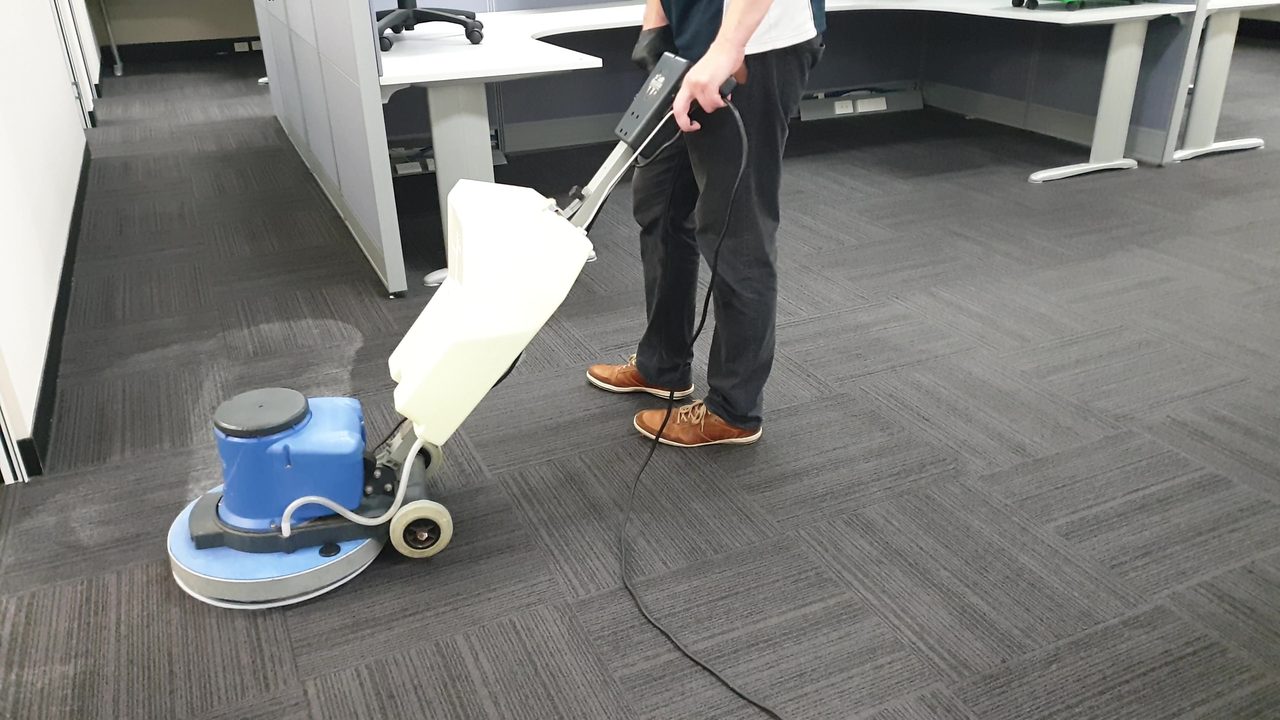
The unglamorous half of the site walk is the services check, and it is where most avoidable job-day problems are born. Truck-mounted hot water extraction generates its own heat and vacuum from the vehicle, so the questions are where the truck can legally sit for the length of the job, how far the hose has to run to reach the floor, and whether the vehicle clears the height limit on a basement car park or has to work from the street.
Water and waste come next. We need a tap to fill from and somewhere legitimate to discharge waste water, usually a cleaner's sink or a sewer point rather than a stormwater drain. In older Perth buildings the nearest tap is sometimes two floors and a locked cupboard away, which is a five-minute conversation now and a lost hour on the night if nobody asks.
Power is the other one. Scrubbing machines, portable extractors and air movers draw real current, and a tenancy floor is often fed by a few shared circuits already carrying fridges, printers and server gear. Knowing which outlets sit on separate circuits prevents the after-hours moment where a breaker trips and takes something important down with it.
Everything discovered on the site walk should end up in writing before a date is booked. The point is not paperwork for its own sake; it is that a cleaner alone in your building at eleven at night cannot ring you to ask which rooms were included.
A workable agreement is short and specific, and it covers the same ground every time. Where a site carries compliance obligations — a hospital wing, a classroom, a government tenancy — it also states what documentation will be issued afterwards.
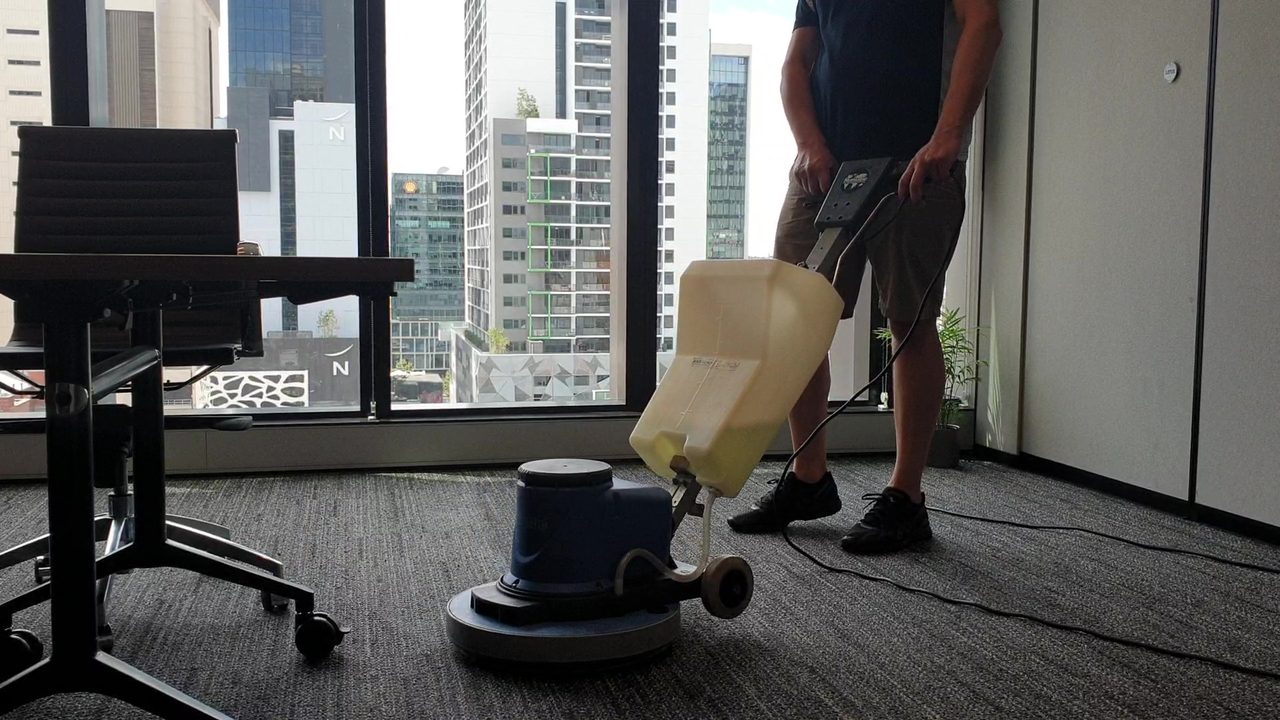
A CBD tower is a different job from a standalone office in Osborne Park, and the difference is almost entirely access. Most Perth towers require a loading dock booking with a fixed time slot, a goods lift booking to match, and a security sign-in for after-hours work. Miss the slot and the truck sits on Wellington Street with nowhere to go.
Building management will usually want documentation before the night: a certificate of currency for public liability insurance, often one for workers compensation too, sometimes a safe work method statement, occasionally a site induction. We handle that in the week beforehand, because a security guard at seven in the evening has no authority to waive it and no reason to try.
Most Perth towers work on a fixed loading dock slot.
The goods lift booking has to match the dock slot.
Certificate of currency, sometimes a safe work method statement, occasionally a site induction.
After-hours work needs a security sign-in on the night.
Usually a fire stair or service lobby, run along walls with door guards.
The hose run needs its own plan. A vacuum and solution line has to travel from the truck to the floor, usually through a fire stair or a service lobby, and it cannot hold a fire door open or become a trip hazard in a public corridor. We use door guards, route the line along walls, and agree the path in advance.
Prep is the difference between a clean floor and a cleaned floor with a mark around everything on it. The first decision is furniture strategy. Chairs, bins, small tables, floor plants and freestanding pedestals get moved. Heavy workstation banks, compactus units, servers and anything bolted or cabled get cleaned around, with the operator working to the leg and under the desk as far as a hand tool will go.
Where furniture goes back before the carpet is dry, we protect it: timber and metal legs on damp pile can leave rust or tannin marks far harder to remove than the original soil, so blocks or tabs go underneath. Hard floors and thresholds get covered or dried as we go, because the real slip risk on a job like this is not the carpet, it is the polished tile at the lift lobby.
The rest is site safety. Wet floor signage goes out at every entry, cables are lifted or taped rather than driven over, and no wet work happens near a comms cabinet or an open floor box.
If you watch one part of the job, watch this one. A large share of what is in a commercial carpet is dry particulate soil, and dry soil can simply be removed rather than dissolved. Wet it first and you turn removable grit into a wet paste that has to be flushed out with far more water and far more effort, for a worse result.
In Perth that particulate is distinctive. Coastal sites carry fine beach sand that migrates well past reception, easterly weather brings red dust from the wheatbelt, and anywhere near an active building site collects limestone dust, which is abrasive and unusually good at dulling pile. All of it works its way down to where the tuft meets the backing, which is exactly where a quick pass with a cleaner's upright will never reach.
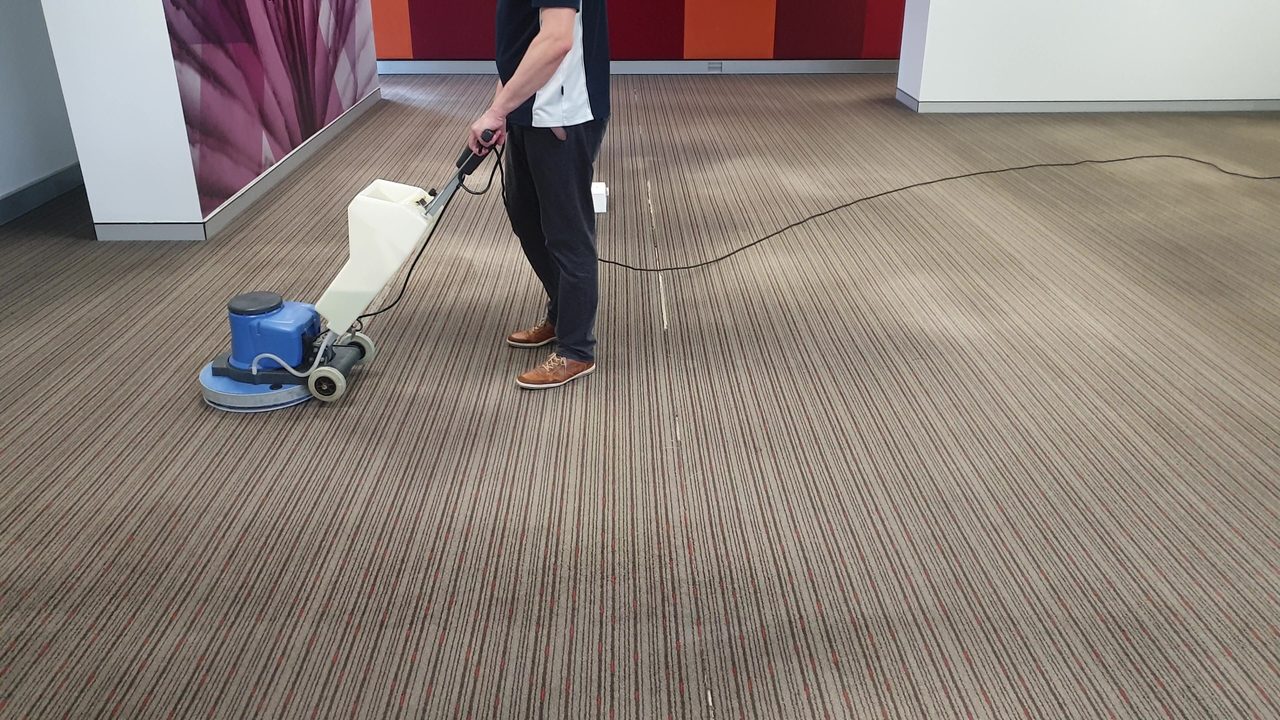
Proper pre-vacuuming means slow overlapping passes in two directions with a machine that has real airflow and an agitating brush, plus deliberate work at edges, corners and under desk returns. It is also the step that decides whether the result lasts or fades within weeks.
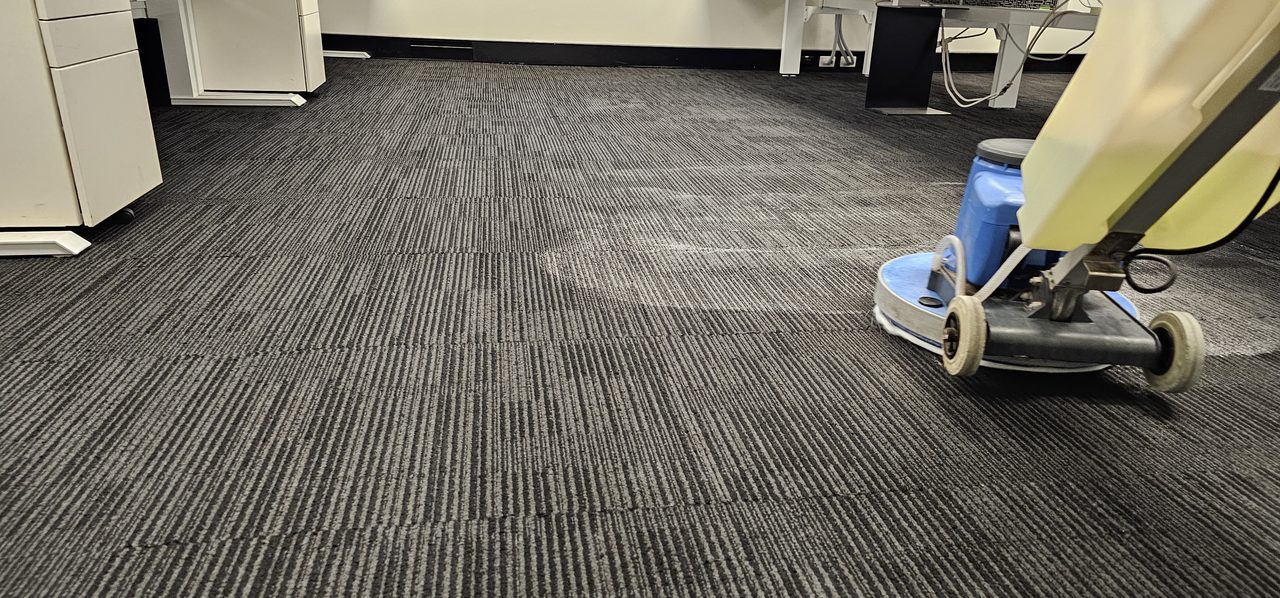
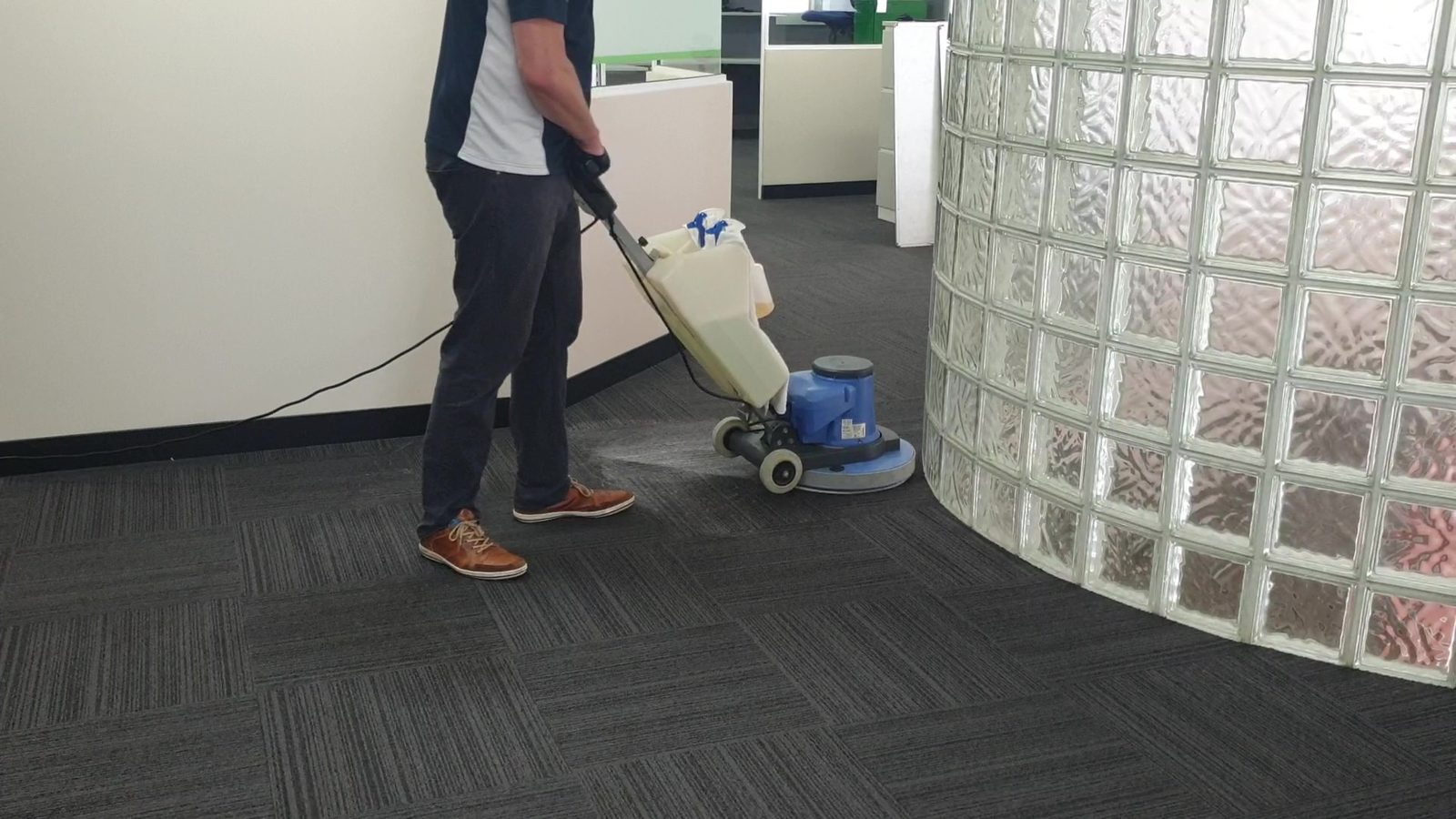
Once the dry soil is out, the chemistry goes down. A pre-spray is a surfactant solution matched to the fibre and to what is actually on the floor: a robust alkaline product for a synthetic office floor carrying body oils and food soil, a controlled low-pH product for wool.
Dwell time cannot be rushed and cannot be skipped. Detergents work by loosening the bond between soil and fibre, and that reaction needs minutes, not seconds. Extracting straight after spraying wastes the chemical, because it has had no time to work. The other half of the rule is that pre-spray must never dry on the carpet, which in a hot Perth summer means working in sections rather than spraying a whole floor at once.
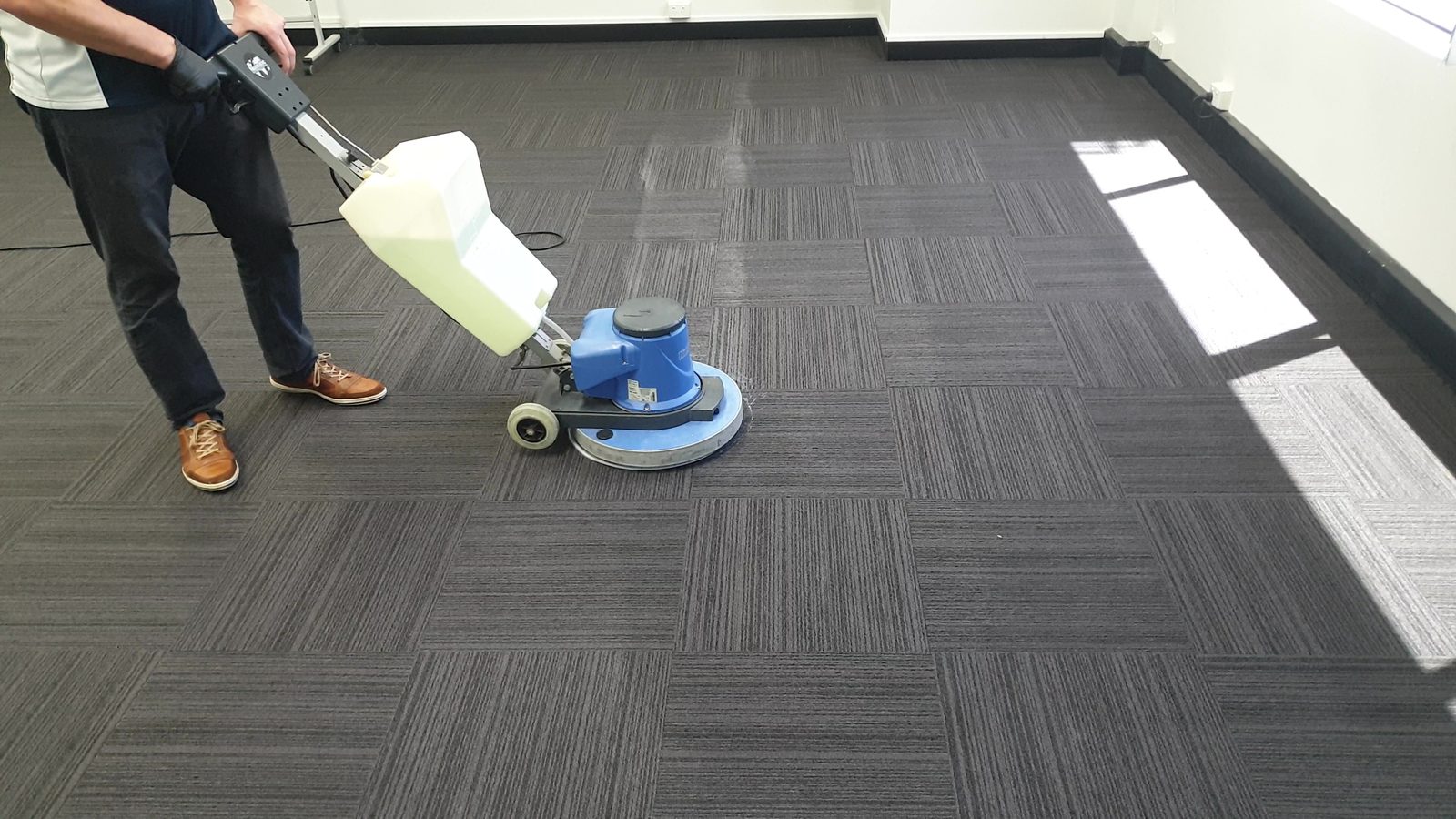
Agitation puts the solution where it needs to be. Brushing, or a cylindrical brush machine driven along the lane, pushes the chemistry to the base of the pile, breaks up the soil film on each fibre and lifts crushed pile so it can be rinsed. On heavily soiled lanes agitation contributes more than extra water ever will, and it is why a lane can come back when an owner had assumed it was worn out.
General cleaning and spot work are two different jobs and should be done as two different passes. The general clean handles the film of soil across the whole floor. Spot work handles the individual events: the coffee ring in the boardroom, the pen mark by the printer, the gum near the lift.
Each needs its own approach, because they are chemically unrelated. Water-soluble spills such as coffee, tea and most food come out with the right cleaner and patience. Oil-based marks need a solvent. Dye stains, the difficult category, may need a reducing or oxidising treatment, always tested first in a hidden area because the wrong product on the wrong fibre removes the carpet's colour along with the stain.
Timing matters too. We work the spots after the pre-spray is down, so the fibre is already relaxed, and we re-check every marked spot after extraction rather than assuming it went. Some do not go, and saying so plainly is part of the job. A ballpoint mark that has sat in nylon for two years, or a spill scrubbed repeatedly with supermarket product until the fibre is damaged, is a limit rather than a failure of effort.
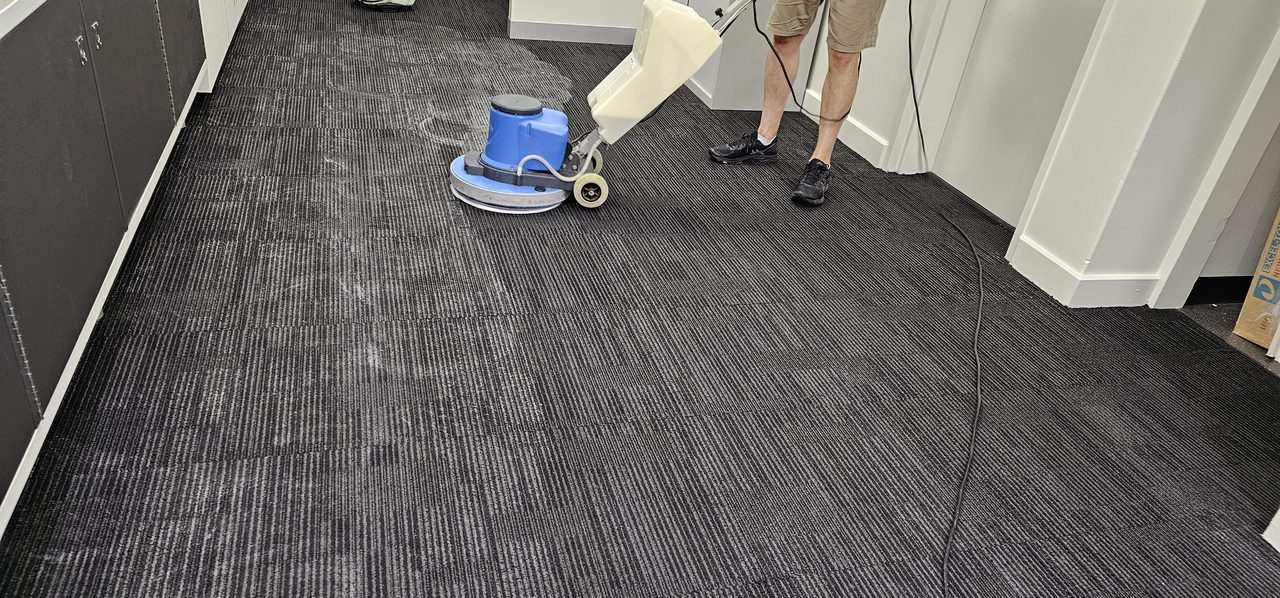
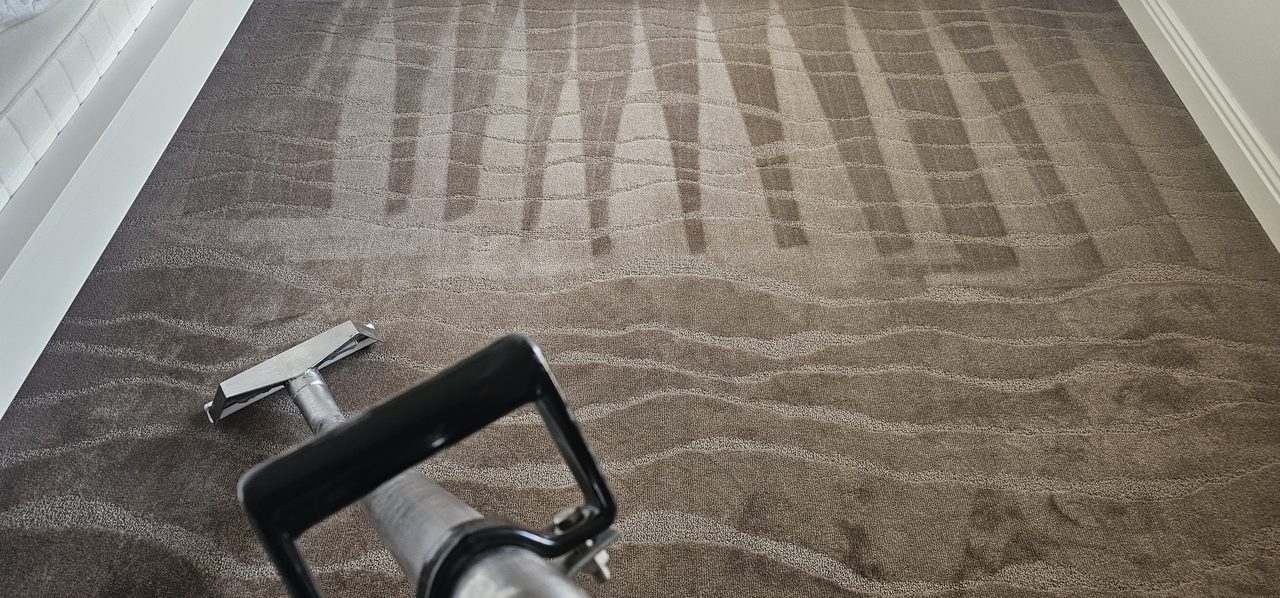
Extraction is where the loosened soil actually leaves the building. Hot water under pressure is injected into the pile and immediately recovered with the suspended soil, so technique determines both cleanliness and drying. Passes overlap so no strip is missed, and each wet pass is followed by dry passes with the solution off, because those recovery strokes pull the moisture back out. Those dry passes are what keep carpet from staying soaked overnight, so we never cut them short.
Heat and a proper rinse do the rest. Truck-mounted equipment holds temperature better than portable gear and carries stronger vacuum, and a rinse that returns the fibre to a neutral pH leaves no detergent residue behind to attract soil. Residue is the real cause of carpet that looks grey again a fortnight later.
Then comes the detail work that separates a professional job from a quick pass down the middle. Edges along skirting boards, corners, stair nosings, under desk returns and around workstation legs are all worked with a hand tool. We finish with dry strokes laid parallel in one direction, so the pile dries evenly and no wand marks are left on the floor.
Drying is a race between the water that went in and the air that can carry it away, and good extraction wins most of it before drying even starts. After that the levers are air movement, temperature and how much moisture the air can still absorb. Air movers placed to sweep along the floor rather than blast at one spot make a real difference in corridors and interior rooms with no natural ventilation.
Building services help if they are set correctly. Running the HVAC overnight rather than letting it shut down at six is often the cheapest drying decision a facility manager has, because conditioned air is dry air in constant motion. The method also sets the drying time. After encapsulation you can walk on the floor within an hour or two, while carpet that has been steam cleaned takes 4 to 8 hours to dry. We recommend the method at the site walk by how soiled the carpet is.
Winter in Perth needs a plan. Cold wet weeks push indoor humidity up, air holds less moisture, and the instinct to throw open the windows on a rainy July night makes things worse. For winter work we lean harder on dry passes, bring more airflow and keep doors and windows shut. Where a tenancy needs the floor back by Monday, tell us at the site walk and we time the start so every area has its drying hours.
The closing walk-through is ours, done with the lights on before the equipment leaves the floor. We check the traffic lanes under angled light, the edges and corners, and every spot that was treated, and anything that needs another pass gets it while we're still on site.
Most commercial cleans happen when nobody from your side is in the building, so the honest conversation about what will not come out happens at the site walk, before the work. If a lane is abraded, if a spot is permanent dye, or if the backing shows browning from old over-wetting, you hear it then, with the reason attached.
Then the small things. Bins go back where they were, chairs return to their desks, signage stays out until the space is safe, and the building is locked and the alarm set the way you asked. When your team is back the next morning, these are the checks worth making.
Two things commonly worry managers afterwards, and both have straightforward explanations. The first is the belief that cleaning makes carpet resoil faster. What causes that is detergent residue left by an inadequate rinse; a properly rinsed floor does not behave that way. The second is wicking: a spot cleaned successfully reappearing a day later because contamination deep in the backing travelled up the fibre as it dried. It is normal, it is fixable, and a call gets it treated rather than left.
Give the carpet a full day to dry before the first vacuum, then vacuum normally. That pass lifts the last of the loosened dry soil and sets the pile up. From there the ordinary rules apply: keep entry matting clean, deal with spills while they are fresh, and put the vacuum through the traffic lanes on a shorter cycle than the quiet parts of the floor.
Our part of the job ends with our own final check and the lock-up. If a mark returns or anything else isn't right, our 14-day guarantee covers it, so just call us. Then book the next clean around your budget cycle, school holidays or a quiet trading period, rather than waiting until the carpet forces the decision.
A last word on what to do with all of this. Nobody expects you to supervise a clean; what you should be able to do is tell afterwards whether you got one. Everything above is really a list of things that leave a trace — a chair back on its own mark, a lane that matches the carpet under the cabinet, a floor that is dry at the hour you said it had to be. Check those in the morning and you will know more about the job than most of the people who were there for it.
The questions Perth facility managers can put to any commercial carpet cleaner about certification, insurance, quotes, site walks and method.
Read ArticleSteam cleaning versus encapsulation for Perth commercial carpets: what each one does at fibre level, real dry times, costs over a year, and how to choose.
Read ArticleHow to set commercial carpet cleaning frequency by zone, traffic and sector, and build a Perth maintenance schedule that protects the carpet.
Read Article