
How Clean Carpets Improve Workplace Health and Air Quality
Carpet works as a filter for dust, allergens and fine soil. Here is how regular vacuuming and deep cleaning keep that filter working in Perth workplaces.
Read ArticleWhat your office chairs absorb, how fabric, vinyl and mesh each clean, why we test the dye first and how often office furniture in Perth needs cleaning.
Most facility managers have a plan for the carpet. Far fewer have one for the chairs sitting on it. Task chairs, reception lounges, partition panels and breakout sofas are used every working day for years and almost never professionally cleaned, because nobody thinks of them until a stain or a smell forces the issue.
Part of the reason is that furniture soils evenly. Carpet shows its wear in obvious places: a dark walkway from the lift, a grey arc in front of the printer. A chair darkens all over at the same rate, so there is never a morning where the change is sharp enough to prompt a call.
Yet soft furnishings collect the same soil as carpet, plus a few things carpet does not, and they sit far closer to people's skin and clothes. Cleaning them is a hygiene and asset-protection question, not just an appearance one, and it deserves a place in the maintenance schedule.
A chair sat in for eight hours a day absorbs a surprising amount. It collects dead skin cells, body oils and sweat, all of which soak into the fabric and then the foam beneath it. Add hand cream, sunscreen, hair product, spilled coffee and the crumbs of a thousand desk lunches, and the fabric becomes a reservoir of organic soil a vacuum cleaner cannot reach.
That soil does two things. It discolours the fabric, and it becomes food for dust mites and bacteria. Dust mites thrive in the warm, protein-rich environment a well-used chair provides, and their waste is a common trigger for allergy and asthma symptoms. In a Perth office sealed and air-conditioned through a long hot summer, that environment is available all year. The mix itself is remarkably consistent from building to building.
Walk a floor of task chairs and look only at the armrests, headrests and front edge of the seat, and you have an accurate picture of the whole building. Those three areas fail first because they take direct, repeated skin contact under pressure, and skin deposits oil continuously.
Oil is the problem, not dust. Dry soil sits on the fibre and vacuums away. Oil wets the fibre, wicks into it, then acts like glue for everything airborne that lands afterwards. A soiled armrest is not merely dirty; it is a tacky surface that darkens faster than the rest of the chair because it is capturing new soil rather than shedding it.
A chair rarely gets replaced because the whole thing is worn out — it gets replaced because three small contact areas were never cleaned.
Headrests take the same treatment from hair products, which are often waxy or silicone-based and even more stubborn than skin oil, and frequently show a distinct halo where every user's head has rested. The seat front takes the backs of thighs and any transfer from denim or dyed clothing.
The practical consequence is that a chair rarely needs replacing because the whole thing is worn. It gets replaced because three small contact areas were never cleaned.
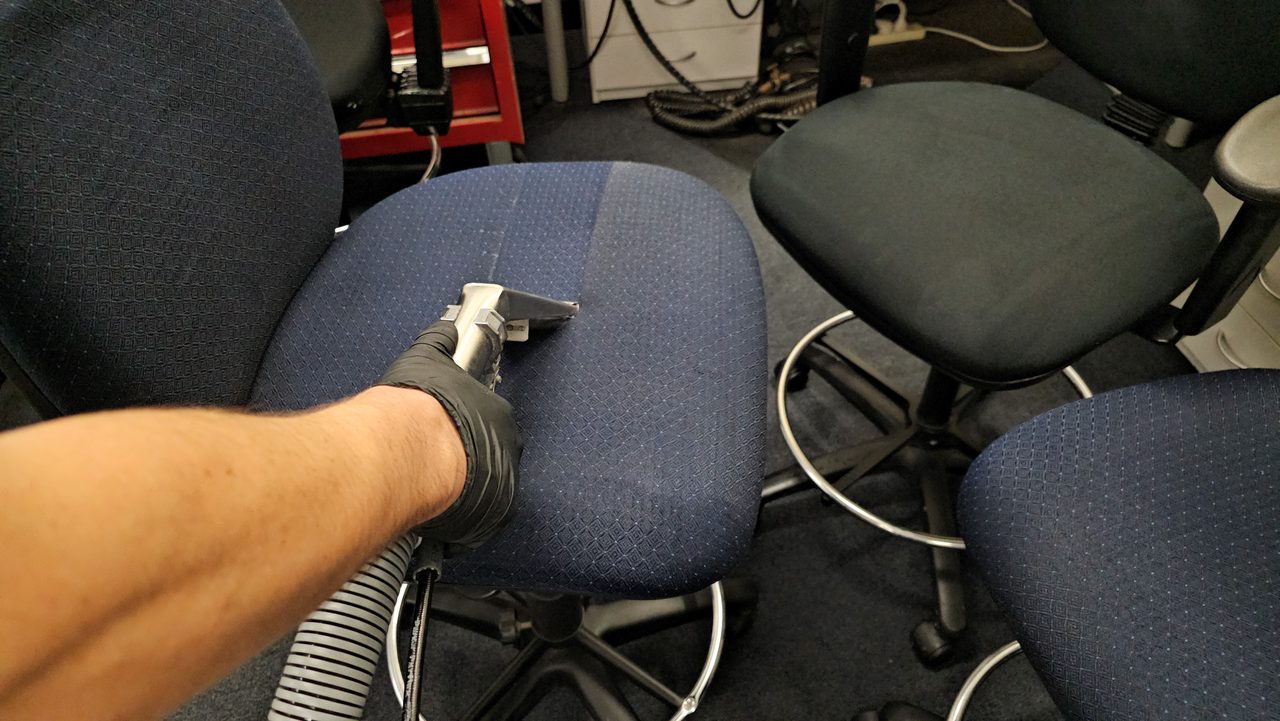
Upholstery is far more varied than carpet. A single floor might hold polyester mesh task chairs, a wool-blend reception lounge, vinyl tub chairs and cotton-mix acoustic panels, and each responds differently to water, heat and chemistry. Treating them all the same is how fabric shrinks, dyes run and finishes are stripped.
Working out what you actually have is the first job on any upholstery quote, and it takes longer than people expect, because the same chair model is often supplied in several coverings. In broad terms, they behave like this.
Many upholstery fabrics carry a cleaning code on a tag under the seat or inside a cushion cover: W for water-based cleaning, S for solvent only, WS or SW for either, and X for vacuum only with no wet cleaning at all. Where the tag exists and is legible it tells you immediately whether extraction is even on the table.
| Code | What it means | Wet cleaning? |
|---|---|---|
| W | Water-based cleaning | Yes |
| S | Solvent only | No |
| WS or SW | Either method | Yes |
| X | Vacuum only | No wet cleaning at all |
Four letters, and a good half of the chairs in any office no longer carry any of them.
The trouble is that office furniture is bought in bulk, reupholstered, moved between sites and stripped of its tags within a few years. Contract seating often arrives with no code at all, and where one exists it describes the covering as manufactured, not after three years of a supermarket spray.
So the code informs the plan; it does not replace the test. On an unlabelled item the fibre is identified on the spot from its weave, its hand and its behaviour with a small amount of solution. This is where accreditation earns its keep: IICRC certified and Woolsafe accredited technicians match the method to the fibre, which is the difference between a chair that comes up fresh and one damaged by the clean meant to save it.
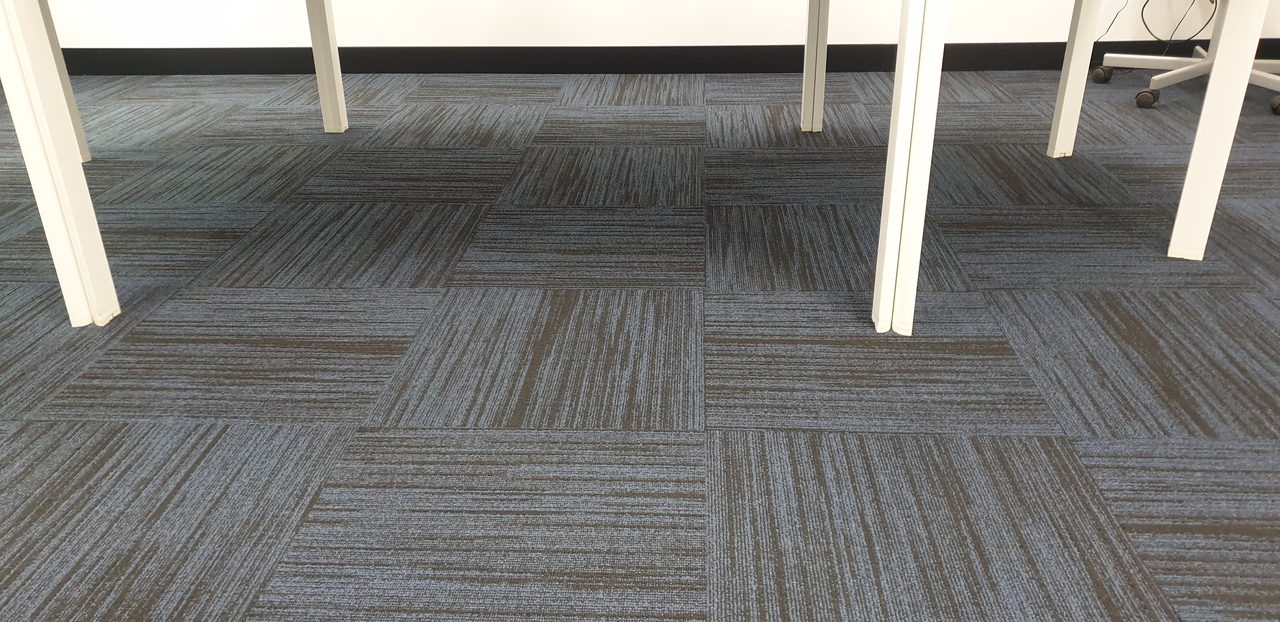
Professional upholstery cleaning always begins with a colourfastness test somewhere inconspicuous: the underside of a seat, a rear skirt, the back of a cushion. The intended solution is applied and blotted with a white towel. If colour transfers, the dyes are not stable and either the method changes or the item is declined.
Bleeding dyes matter most on dark, saturated colours and on anything with contrast piping or two-tone panels, because a red or navy that runs will migrate into the adjacent light panel and will not come back. Reception seating in strong brand colours is the case to be careful with.
Shrinkage is the other risk, and it belongs to natural fibres, particularly cotton, linen and some viscose blends. They swell when wet and contract as they dry, and on a tightly fitted cover that contraction pulls the fabric off the frame or splits a seam. Too much moisture and heat together cause it.
Both risks are managed the same way: identify the fibre, test first, control the moisture, and use a method the fabric can tolerate rather than the quickest one. We tell you before we start if an item is better left alone.
For most hard-wearing office upholstery, hot water extraction is the workhorse method, the same principle used on carpet but with tools, pressure and moisture suited to fabric. A pre-spray is agitated with a soft brush to break the bond between oil and fibre, then given a few minutes of dwell time so the chemistry does the work rather than the scrubbing.
Extraction uses a small hand tool that injects and vacuums in the same pass. The tool is narrow, the spray pressure is reduced, and short strokes are overlapped with the vacuum running, so the fabric never carries more water than can be pulled straight back out.
A pre-spray is worked through the fabric with a soft brush to break the bond between oil and fibre.
A few minutes, so the chemistry does the work rather than the scrubbing.
A narrow hand tool injects and vacuums in the same pass, at reduced spray pressure.
Strokes overlap so the fabric never carries more water than can be pulled straight back out.
Because the dirty solution is extracted rather than left to dry in the fabric, the result is genuinely cleaner rather than freshened, and there is far less residue to attract new soil. A chair cleaned with a shampoo that is never rinsed out will resoil within weeks and look worse than before it was touched.
For delicate fabrics that cannot take the moisture, low-moisture and dry-solvent methods are used instead, along with encapsulation chemistry that crystallises around the soil so it vacuums away once dry. Which applies is decided by the fibre, not by preference.
On upholstery, drying is not a footnote to the job; it is the job. Fabric sits over foam, and foam is a sponge with no airflow through it. Put more water into a seat cushion than the tool can pull back out and it will still be damp three days later: a musty chair, a watermark ring and a real chance of odour in the padding.
This is why controlled moisture matters more than cleaning power. Done properly, upholstery dries in 3 to 8 hours. Where it lands in that range comes down to the fabric, the cleaning method used and the weather inside the building. Air movers pointed across a row of chairs rather than at them cut that substantially.
Perth adds a seasonal twist. Through a hot dry summer, upholstery dries quickly and the main concern is avoiding watermarks by working evenly across a whole panel rather than spot-cleaning the middle of it. Through a wet winter the air is damp, buildings are shut up, and a chair that dries in three hours in February can take eight in July. In winter the ventilation plan is not optional.
So upholstery is best booked alongside a carpet clean, in the evening or over a weekend, so chairs are dry before anyone sits on them. Spacing furniture out and keeping it off freshly cleaned carpet helps it dry evenly.
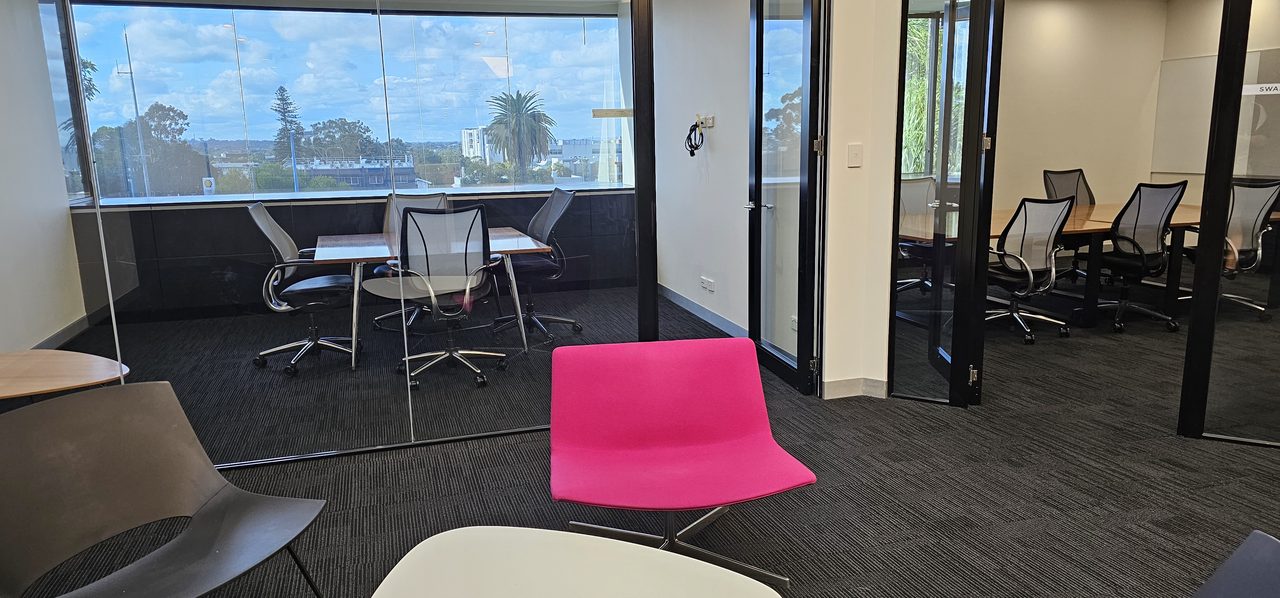
Fabric partition panels and acoustic screens have a different problem from chairs. Standing vertically, they act like filters for airborne dust and, where there is a kitchen on the floor, for cooking smells and airborne oil. They grey gradually and hold odour without anyone noticing, because nobody sits on them and nobody looks at them directly.
The tell is contrast. Lift a monitor arm or unclip a screen-mounted shelf, look at the strip of fabric that has been shielded behind it, and compare it with the panel around it. In an office that has been occupied for a few years, that hidden strip is usually a noticeably different shade, and it is the same fabric that has simply not been breathed on.
Panels are typically a stretched fabric over an acoustic core, and that core must not get wet, which makes them a low-moisture job almost every time. A few practical points before you book them.
Reception is the one piece of soft furnishing every visitor sees and most of them sit on. It is also the item most likely to be an expensive designer piece in a light fabric, chosen for how it photographs rather than how it survives. It does the same job as a shop window, so it tends to need a professional clean sooner than anything else on the floor.
Breakout and cafe furniture is the opposite case. Nobody chose it for appearance and everybody eats on it. The soil is greasy rather than dusty, so it needs extraction rather than surface work. Bench seating with a fixed base is worth checking underneath, where crumbs collect against the wall.
| Seating | The problem | What it needs |
|---|---|---|
| Reception | Constant public use, often a light designer fabric | Cleaned more often than anything else |
| Breakout and cafe | Greasy soil rather than dusty, because everybody eats on it | Extraction, not surface work |
| Boardroom | Used a few hours a week, but every mark is seen by the wrong people | Annually, and never left off the schedule |
Reception does the job of a shop window; the boardroom is the quiet one that gets forgotten.
Boardroom chairs are the quiet problem. They look immaculate because they are used a few hours a week, but any mark on one is seen by exactly the people you would least like to see it. They rarely need frequent cleaning, but should never be left off the schedule.
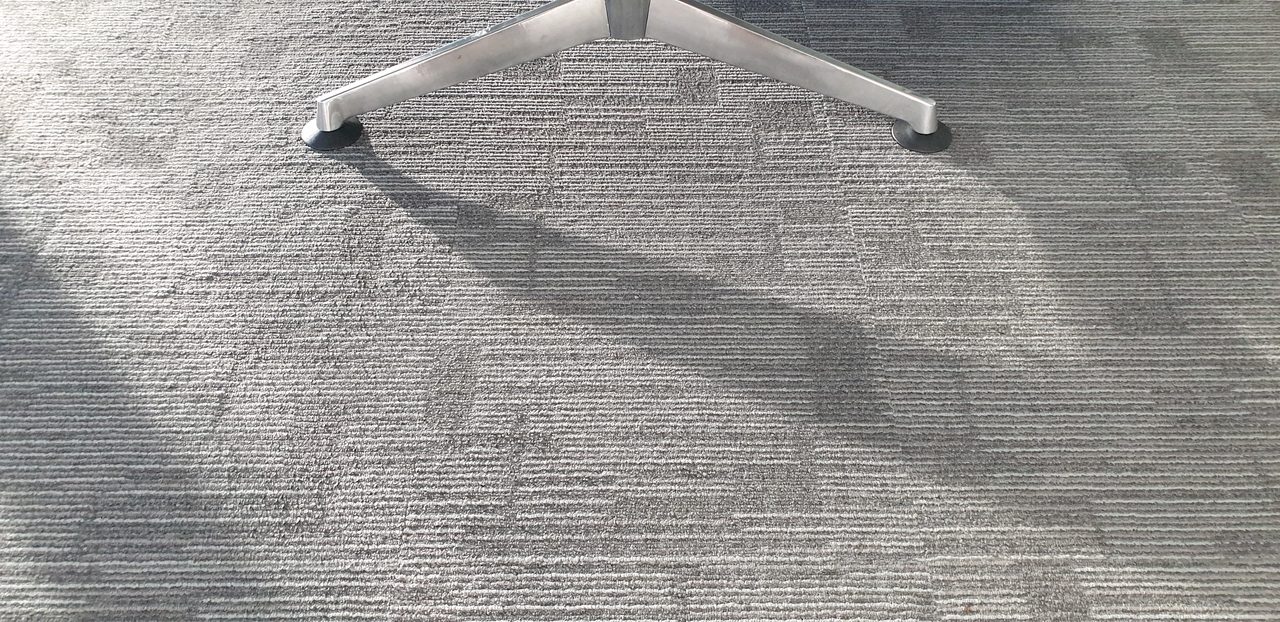
Changing ways of working have raised how much hygiene matters for shared furniture. Hot-desking means a single chair may be used by many people across a week, and breakout and reception seating is touched by staff and visitors alike. A chair that once carried one person's soil now carries everybody's.
Regular professional cleaning removes the oils, allergens and bacteria that build up in that shared use, which supports indoor air quality and signals to staff and visitors that the workplace is properly cared for. In sectors where hygiene is scrutinised, fresh furniture is part of the standard, not an extra.
There is a comfort dimension too. Stale, allergen-laden furniture feeds the stuffy air that leaves staff drowsy, particularly anyone prone to hay fever or asthma.
It is worth being clear about what cleaning is and is not. Extraction removes soil, oils and allergens, and it removes the food source bacteria and mites live on. Your staff get a real hygiene benefit from that. Sanitising is a separate claim we never make for extraction.
Not every chair can be brought back, and a professional should say so before taking your money rather than afterwards. Cleaning lifts soil. It cannot put back fibre that has been rubbed away, replace dye bleached out of the weave, or rebuild collapsed foam.
The honest test is whether the problem is sitting on the fabric or has happened to it. Soil, oil, food and odour are the first kind and they respond. Wear, damage and dye loss are the second kind and they do not. These are where cleaning will disappoint you.
As with carpet, frequency depends on use, but soft furnishings are so often ignored that even a modest schedule is a large improvement. The aim is to clean before the oil in the contact areas has oxidised and set, because past that point you are not cleaning, you are trying to reverse something permanent.
The simplest approach is to book the upholstery with your carpet clean rather than on its own. If you have the floors cleaned twice a year, we recommend doing the chairs at one of those visits and the reception seating at both. Use the following as a guide.
The financial argument is usually what finally gets upholstery onto the schedule. A floor of task chairs is a serious capital item, and reupholstering a lounge is not cheap either once labour and downtime are counted. Cleaning on a sensible cycle costs a fraction of replacing and pushes the replacement date years further out.
The trap is that the decision is rarely framed that way. Nobody proposes replacing a floor of chairs; they just look tired, somebody adds them to next year's fit-out budget, and the lot goes to the tip while the frames, mechanisms and foam still have years left. Had the arms and headrests been cleaned regularly, most would have kept their appearance.
Between professional cleans, vacuuming with an upholstery tool and attending to spills promptly slows the build-up. Blot rather than rub, and try plain water first, because most permanent upholstery marks in offices are made by the person who tried to fix them.
Because upholstery and carpet share methods and equipment, it is usually cheapest to clean them together in one after-hours visit, so the whole floor is back in service the next working day. That also disposes of the usual scheduling objection, since furniture is moved once rather than twice and there is a single access arrangement to organise with building management.
The argument here is not that furniture deserves more attention than the floor it sits on. It is that soft furnishings currently get almost none, so the distance between nothing at all and a modest annual routine is where most of the value sits. Walk your own floor and look at the armrests, headrests and seat fronts rather than the carpet, and you will know within a minute whether the chairs have ever been cleaned. If the answer is no, that is the sensible place to start, and Commercial Carpet Cleaning Perth can be reached on 0460 815 038 or at commercialcarpetcleaningperth@gmail.com.
Carpet works as a filter for dust, allergens and fine soil. Here is how regular vacuuming and deep cleaning keep that filter working in Perth workplaces.
Read ArticleA smell in your carpet is a source problem. Here is how to find what is causing it, treat it below the surface, and know when the underlay has to go.
Read ArticleAn hour-by-hour walkthrough of a commercial carpet clean in Perth: the site walk, access, the clean in sequence, drying, the final check and lock-up.
Read Article