Fabric Partitions and Acoustic Panels: The Vertical Surfaces Nobody Cleans
What fabric partitions and acoustic panels collect at sneeze height, why nobody notices, and how they are cleaned without ruining the core behind them.
Upholstery12 min read
The surfaces standing at sneeze height
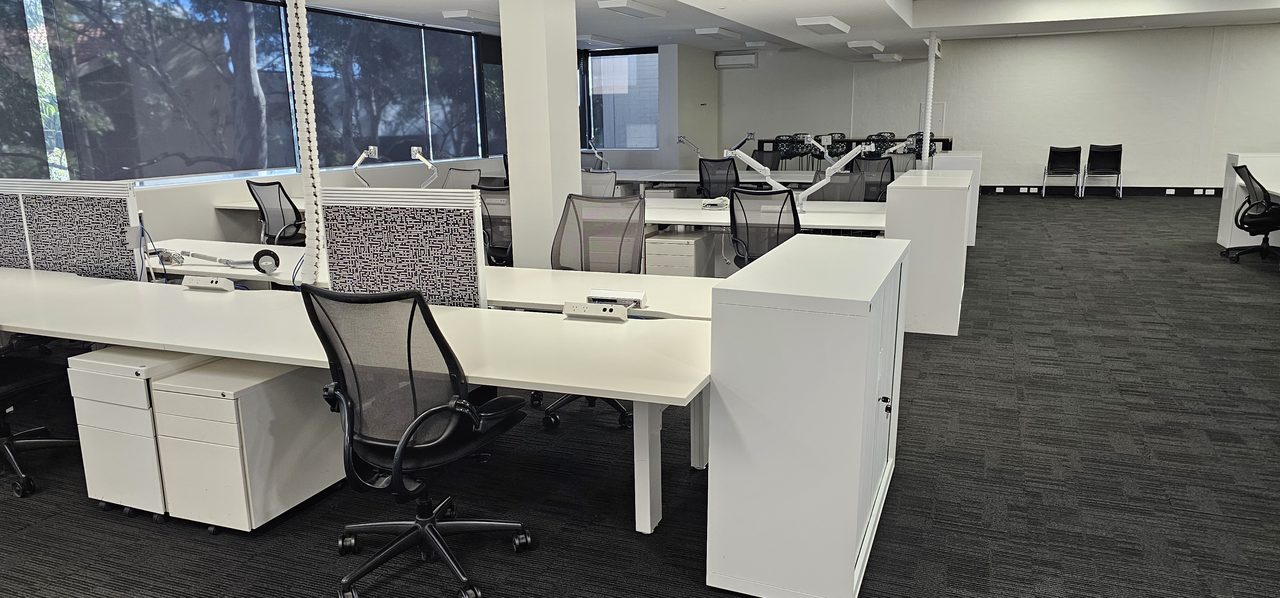
Walk any recent fit-out in the Perth CBD and count the fabric that is not on the floor. A screen stands between every pair of facing desks. Acoustic panels climb the meeting room walls, felt baffles hang from the ceiling, the phone booths are wrapped in fabric and the banquette in the breakout area has a padded back a metre tall. In many modern offices the vertical fabric outmeasures the upholstered seating, sometimes by a wide margin.
Now ask when any of it was last cleaned. The carpet has a cleaning schedule. The desks are wiped nightly. The chairs at least get noticed, because people sit on them and complain about them. The fabric standing between the desks belongs to nobody's checklist — not the daily cleaner's, not the carpet contract's, not the furniture budget's — and in most buildings it has collected every year of the tenancy without a single visit.
The short version
Modern fit-outs carry more fabric on screens, walls and ceilings than on chairs, and almost none of it is ever cleaned.
Vertical fabric soils evenly, so it never triggers the call a stained chair does.
Most of a panel's load is dry and comes out with proper vacuum extraction; wet methods need strict moisture limits.
Saturating an acoustic panel can ruin it: backing boards swell, adhesives release and the face sags.
Book panels alongside the carpet visit, where the access and equipment are already paid for.
This article is about those vertical surfaces: what they collect, why nobody sees it happening, and how they are cleaned without destroying the acoustic core behind the fabric. Seated upholstery — task chairs, lounges, the cushions people actually sit on — is a different job with different risks, and we cover it separately in our guide to office chair cleaning. Here we deal with everything that stands up.
An inventory of the fabric you walk past
Start with a list, because the quantity is the point. A single bank of six workstations carries perhaps ten square metres of screen fabric once both faces are counted, and both faces do collect soil. Multiply that across a floor, add the wall panels and the pods, and a mid-sized office is holding several hundred square metres of fabric at desk height — often more area than its breakout carpet.
The inventory has also grown. A decade of open-plan noise complaints has driven acoustic treatment into every fit-out brief, and polyester felt panelling became cheap enough along the way to cover whole walls rather than feature strips. An office fitted out in the last ten years typically carries two or three times the vertical fabric of the one it replaced. The usual suspects are worth naming, because half of them do not register as fabric at all.
Workstation screens and desk dividers: fabric at exactly the height that hands, sneezes and coffee reach, on both faces.
Pin boards and tackable wall panels: fabric over a pinnable core, shielded in crisp rectangles by whatever has been pinned to them.
Acoustic wall panels: large, often pale, chosen in a showroom for colour and acoustic rating rather than cleanability.
Ceiling baffles and rafts: out of reach and out of mind, collecting whatever the air conditioning keeps moving.
Fabric-wrapped meeting pods and phone booths: gripped at the same door edge by every person who has ever entered one.
Banquette and booth backs: lean surfaces that take collar contact and hair product at head height.
Free-standing acoustic screens: moved by hand whenever the floor is rearranged, and marked exactly where they are held.
Why soil on panels goes unnoticed
Carpet betrays itself. Traffic concentrates along walkways, so a dirty floor develops dark lanes anyone can see against the cleaner field beside them. A vertical panel has no traffic lanes. Air moves across its whole face at much the same rate, so it soils with almost perfect evenness, greying a fraction of a shade at a time. The human eye is excellent at spotting contrast and hopeless at noticing slow, uniform change.
The reference eventually arrives, and it is always a shock. Unpin a notice that has hung on a tackable panel for a few years, unclip a screen-mounted shelf, or slide a whiteboard along its rail, and the rectangle behind it is the colour the whole panel used to be. Facility managers who do this in a five-year-old office tend to go quiet for a moment.
Nobody remembers the colour a panel used to be, so nobody notices the colour it has become.
The second tell is the touch band. Look along a run of screens at the height of a seated person's shoulder and hand — roughly 1.1 to 1.4 metres — and you will often find a continuous darker band where sleeves, chair backs and fingers have made contact for years. From straight on it is invisible. From a shallow angle, with a window behind you, it is unmistakable.
What builds up in a fabric panel
A fabric panel is, functionally, a filter standing in an airstream. The air conditioning keeps the floor's air moving past it all day, and a felted or looped face is precisely the sort of surface engineers choose when they want to capture particles. It collects most of what carpet collects, minus the grit tracked in on shoes, plus everything that happens at desk height rather than shoe height.
The mix varies by neighbourhood within the floor. Panels near the printers carry toner. Panels near the kitchen carry airborne cooking oil, which greys fabric and holds odour. Panels near the lift lobby catch what the doors push in, including the fine red dust an easterly delivers across Perth in summer. And every screen between two facing desks carries the record of every cold and flu season the office has worked through.
Airborne dust and clothing lint, settling continuously on any textured vertical face the air moves past.
Dried droplet residue from sneezes and coughs: the screen between facing desks exists partly to intercept them, and it does.
Coffee mist and food splash: the aerosol from a stirred flat white travels further than anyone thinks, and the desk edge takes the rest.
Skin oils and hand cream at every gripped edge, which darken slowly and then bond new dust to the fabric.
Toner and paper dust near print stations, fine enough to lodge deep in a felted face.
Cooking aerosols near kitchens and cafes, an airborne oil film that ordinary dusting does not shift.
The hygiene case for the fabric between desks
Height is the hygiene argument. Carpet soil sits at shoe level, a metre and a half from anyone's face. Screen soil sits at breathing level, and that is not an accident — a workstation divider stands where it does precisely to interrupt sound and sightlines between two seated people, which also puts it squarely in the path of whatever those people exhale, sneeze or spill.
We have made the healthy-workplace case for carpet elsewhere: soft surfaces act as a sink for dust and allergens, which is genuinely useful for air quality, but only while the sink is emptied on a schedule. The same logic applies a metre higher. A screen that has filtered the air between two desks for five years is a full sink at face height, and disturbing it — bumping it, rearranging the floor, pinning and unpinning — releases a little of what it holds.
It is worth being precise about claims here. Cleaning removes soil, oils and the organic residue that microbes and dust mites feed on, which is a real hygiene benefit. It is not disinfection. We keep the two claims separate. Where a workplace genuinely needs more than removal — medical suites, childcare, a contamination event — that is a separate conversation about sanitising soft surfaces, with its own chemistry and its own limits.
Dry soil extraction does most of the work
The encouraging news is that most of what a panel carries is dry, and dry soil leaves under vacuum and agitation alone. Industry teaching on upholstery has long held that the bulk of the soil in any fabric is loose particulate best removed dry, before any chemistry is introduced, and panels are the best-case example: no foot traffic grinding soil in, no spills soaking through, just years of gentle settlement.
Dry soil extraction, done properly
01
Vacuum top to bottom
Slow, overlapping strokes with an upholstery tool, working downward so dislodged soil falls onto fabric not yet cleaned.
02
Brush the face
A soft brush lifts what texture and static are holding, without abrading the fibre or the felt.
03
Vacuum again
A second pass collects what the brushing released; on a felted panel this pass often removes more than the first.
04
Read what is left
Marks that survive dry work are oil-bound, such as hand shadows and kitchen film. Those areas alone need chemistry.
On panels away from hands, kitchens and printers, thorough dry extraction alone restores most of the lost shade, and it is safe on every fabric and every core, which is why it is the annual default. Wet methods then become a targeted decision for the touch bands and the greasy zones, rather than a blanket treatment applied to hundreds of square metres that mostly did not need it.
Why acoustic panels need low moisture
Everything wet in panel cleaning is governed by what stands behind the fabric. A typical screen or wall panel is fabric stretched or glued over an acoustic core: compressed polyester batt, glass wool behind a scrim, or a timber-fibre board. None of it is designed to be wet, and water that passes the face goes somewhere no tool can retrieve it from.
The failure modes are worth spelling out, because they are mostly permanent. A timber-fibre backing swells and stays swollen. Adhesives release, and the face fabric bubbles or sags off the board in a way no amount of drying will re-stick. Wet glass wool holds a distinctive musty odour for weeks. And moisture in a vertical panel migrates downward as it dries, leaving a tide mark that is often more visible than the soil was. An over-wet chair dries badly; an over-wet panel is frequently a write-off.
The methods that respect the ceiling are low-moisture ones. Encapsulation chemistry is misted lightly onto the face, agitated with a soft hand pad, and vacuumed away once dry — the same crisp-drying polymer principle used on carpet, at a fraction of the wetting. Delicate faces get dry-compound sponging instead. Through-coloured polyester felt panels, where the fabric is the panel, tolerate slightly more moisture but hold water in their thickness, so the same discipline applies.
Hand marks, pilling and the pin-hole zones
Three complaints come up on almost every panel job, and only one of them is actually dirt. Hand-mark shadows cluster wherever fingers grip: the door edge of every pod, the ends of screen runs where people steer past, the panel beside the light switch. These are skin oil, and they respond to low-moisture chemistry — fully if they are recent, partially if they have had years to oxidise into the fibre.
The other two are damage wearing a disguise, and it is better to know before the clean than to be disappointed after it.
Fresh hand shadows at grip points release with chemistry; marks that are years old have oxidised and may only soften, not vanish.
Pilling — the small bobbles where chair backs and sleeves rub a screen — is fibre damage, not soil. A fabric shaver removes it; cleaning does not.
Pin boards develop shielded rectangles where notices protected the fabric. Cleaning narrows the contrast between rectangle and field, but the two histories never quite match again.
Pin holes themselves relax a little under brushing in looser weaves, and remain visible indefinitely in tight ones.
Burnished patches where a desk edge or chair arm has polished the fibre flat are an appearance change no cleaning reverses.
Dye stability, polyester and the wool-blend exception
No wet work starts without a dye test, and on panels there is a particular reason for it. Fit-out fabrics come in saturated brand colours — teals, ochres, corporate navy — and screens are frequently two-tone, with a coloured face inside a pale frame or a contrasting rear panel. On a vertical surface a running dye does not sit where it bled; it migrates downward with the moisture and dries as a streak.
The test itself is small and quick. The intended solution goes onto a hidden corner — the bottom edge behind a cabinet, the rear face of an end screen — and is blotted with a white towel. Colour on the towel means the plan changes: drier chemistry, less agitation, or a recommendation to leave the item alone. Most of the time the towel comes up clean, and the reason is what modern panels are made of.
Two fabrics, two temperaments
Polyester panel fabric
Wool-blend panel fabric
Where you find it
Most screens and acoustic panels made in the last decade
Premium fit-outs, heritage offices, older screen systems
Dye behaviour
Usually solution-dyed: the colour is in the fibre and stays there
More often surface-dyed; the towel test is taken seriously
Moisture tolerance
Good, within the limits the core allows
Lower; over-wetting risks browning as the fibre reacts
Chemistry
Standard low-moisture encapsulation products
Woolsafe-approved products only, with gentler agitation
The fabric decides the chemistry; the core decides the moisture. Both are identified before anything is applied.
Polyester dominates because it earns its place: solution-dyed polyester is colourfast, hard-wearing and tolerant of encapsulation chemistry, which is why the outlook for most panel cleaning is good. Wool blends reward the extra care with an appearance polyester cannot quite match, and punish shortcuts with browning and dye movement. Zoran, our owner, holds WoolSafe Approved Fibre Care Specialist status, so we identify the fibre before any panel gets wet.
How often to clean fabric panels
Panels do not need the cycle carpet needs. Nothing walks on them, nothing is spilled directly into them, and their soil arrives at the gentle pace of airborne settlement. For most offices our advice is a dry soil extraction of every panel once a year, with a low-moisture clean of the touch bands and the kitchen-side panels wherever marks show. You decide what to book. We point out which panels need more when we visit.
The economics are the persuasive part. The access arrangement, the after-hours window and the equipment are already on site for the carpet visit, so panels ride along for added hours rather than a second call-out — the same reasoning that makes chairs and upholstery cleaning cheapest to book with the floors. Booking the panels with your carpet clean also means they are done every time the floors are.
Standard screens and wall panels: dry extraction once a year, plus a low-moisture clean of the touch zones when hand marks show.
Panels within a few metres of kitchens, cafes and printers: cleaned more often than once a year, because oil film and toner bond new soil quickly.
Pod and booth door edges: attention at every visit, since one gripped edge soils faster than ten square metres of wall.
Ceiling baffles and rafts: inspect them from the floor each year and clean them once dust shows, since hands never reach them.
Any panel that takes a splash: promptly, before the mark wicks downward and sets.
Specifying a cleanable panel at the next fit-out
The cheapest panel cleaning is specified, not scheduled. Fabric for screens and acoustic panels is usually chosen in a showroom on acoustic rating, colour rendering and price per metre, with cleanability nowhere on the scoresheet — which is how offices end up with pale boucle at grip height and a wool loop around the kitchen servery.
If a fit-out or refresh is anywhere on your horizon, a short list of questions to the supplier will save years of quiet greying. Get the answers in writing; panel warranties are precisely the sort of document that turns out to have opinions about professional cleaning.
Questions for the panel supplier
Is the face fabric solution-dyed polyester, and is there a cleaning code that permits water-based methods?
Can the face fabric be replaced without replacing the whole panel, and at what cost?
Does the warranty say anything about professional cleaning, and does anything void it?
Are through-coloured felt panels available for the surfaces hands will actually touch?
Can spare fabric or a spare panel from the same dye batch be held for future repairs?
What does the manufacturer's own care guidance specify, in writing?
Colour placement is the other free decision. Pale fabric at grip height is a commitment to visible hand shadows within a couple of years; mid-tones and heathered weaves at the touch band hide years of contact. Save the pale statement panels for above shoulder height, where nothing but air ever touches them, and let the fabric that meets hands be fabric that can afford to.
Getting the vertical metres onto the schedule
Panels will never force the issue. Carpet floods, chairs stain, tiles crack — panels just stand there, a fraction greyer each quarter, until a relocation or a burst of noticeboard housekeeping produces the rectangle that tells the truth. By then the office has been breathing past a full filter for years, and the touch bands have oxidised past an easy fix.
The audit costs five minutes and needs no equipment. Unpin one long-serving notice and look at what was behind it. Walk a screen run from one end, keeping your eye down near panel height so the light skims the fabric rather than hitting it square. Press a white cloth against the panel beside the kitchen and see what transfers onto it. Fail two of those three and the vertical fabric is due, and has probably been due for a couple of years.
If you already book regular carpet cleaning, the fix is administrative rather than dramatic: add panels to your next visit, where the access, the equipment and the after-hours window have already been paid for once. The thing worth asking for when you do is an honest sort: which panels genuinely need chemistry, which only need a proper vacuum with the right head, and which shielded rectangles are going to stay exactly as they are whatever anybody does, as a permanent monument to the office noticeboard.
How do I tell whether our panels actually need cleaning?
You can tell with three quick checks that take about five minutes and need nothing more than a white cloth:
Behind a notice: take down one that has been up a year or longer and see whether the fabric under it is lighter than the panel around it
Along a screen run: stand at one end, with a window at your back, and look for a darker band at shoulder height
Beside the kitchen: press the cloth on a panel, then check the cloth for a grey film and the fabric for a stale smell
If any of the three shows a difference, the panels are overdue, not just due. We're happy to look them over when we come to quote on your carpet.
02 /
Can you steam clean fabric partitions the same way as carpet?
No, fabric partitions need a far drier clean than carpet, because water that gets past the fabric can't be dried out of the panel behind it. Most screens and wall panels are fabric over an acoustic core of polyester batt, glass wool or timber-fibre board. The volume of water used in hot water extraction would swell the board, release the glue and leave the fabric sagging.
So we start dry. A slow vacuum and a soft brush take out most of the soil. Only the hand marks and kitchen film then get a fine mist of encapsulation solution, which we work in by hand with a soft pad and vacuum off when it's dry. The most delicate faces get a dry sponge instead, a block of vulcanised rubber that lifts soil from the fabric without any moisture, and wool blends get WoolSafe-approved products. That way the fabric is cleaned and the core behind it stays dry.
03 /
Will cleaning fix the pin holes and pilling on our pin boards?
Cleaning won't fix pilling or pin holes, because both are damage to the fabric, not soil, and we'd rather you know that before we start. Pilling, the small bobbles that chair backs and sleeves raise on a screen, comes off with a fabric shaver, not with any cleaning product. Pin holes close up a little when we brush a loose weave, and they stay visible in a tight one.
The pale rectangles where notices hung are a different case. Once the fabric around them is clean, the difference narrows, but the two rarely match exactly, because the covered fabric has had years less dust and light on it. When we look at your boards, we'll show you which marks are soil and which are damage.
04 /
Can acoustic ceiling baffles be cleaned as well?
Yes. Acoustic ceiling baffles and rafts are usually the simplest panels to clean, because nobody touches them and almost all their soil is airborne dust. We vacuum them with a soft brush head from a ladder or platform, and they rarely need any wet cleaning.
Most of the cost is in reaching them, so we agree the access with you before the day. Baffles need cleaning less often than the screens below them: look at them from the floor once a year, and book a clean once you can see them greying.
05 /
How much does adding panels to a carpet visit cost?
The cost of adding panels depends on how much fabric there is and how many panels need more than a vacuum, and it's lower than booking them as a job of their own. The carpet visit already covers the trip to your site and the set-up, so the panels add only the work done on them.
We count both faces of every screen when we measure, because both collect soil. You get the price in writing with the free on-site quote, and we'll tell you then which panels only need vacuuming. Our pricing guide explains how we work out a price, if you'd like to read it before we visit. To arrange the quote, call Zoran on 0460 815 038.