
Wool, Nylon and Olefin: Why Fibre Changes the Whole Clean
Wool, nylon, olefin and polyester each need a different pH, temperature and agitation. How we identify your fibre on site, and why guessing ruins carpet.
Read ArticleA practical guide to office carpet stains for Perth facility managers, with first aid for every spill, the right fix for each stain and when to call us.
Office carpet takes a different kind of punishment to the carpet in a home. It absorbs concentrated foot traffic along the same lanes every day, sits under wheeled chairs, and cops spills near kitchenettes, printers and meeting rooms. Nobody owns the mess in a shared space, so a spill is often walked past by three people before anyone deals with it, and the stain is ground in before it is treated.
Perth adds its own complications. Coastal sand and the fine red dust that blows in from the east are abrasive, and construction work pushes limestone dust through half the CBD. When that grit is already in the pile, a coffee ring becomes a coffee-and-grit ring that behaves more like wet grit than a drink.
The single biggest factor in whether a stain comes out is time. A fresh spill sits on the surface and lifts easily; the same spill left overnight bonds to the fibre and oxidises, especially with tannin drinks like coffee and tea. So give reception and cleaning staff permission and a basic kit to act immediately, rather than logging the spill and waiting for the next scheduled clean.
Most permanent office stains are not caused by the spill at all. They are caused by what someone did in the first sixty seconds. A spill is liquid sitting in a pile of fibre; a stain is that liquid bonded to the fibre chemically, physically or optically. Almost everything that turns the first into the second is a human decision.
Three mistakes account for most of the damage. Someone scrubs hard with a paper towel, which frays the yarn tips so the patch reflects light differently forever, even after the colour comes out. Someone fetches hot water from the kitchen tap, which denatures protein and drives tannin into the dye sites. Someone reaches for whatever spray is under the sink, and a bleaching product strips colour or leaves a residue that pulls in soil for months.
Put in plain terms for staff, the goal in the first minute is not to clean the carpet. It is to remove as much of the spill as possible without doing anything that cannot be undone. That single idea sets the order of operations for everything that follows.
The order is always the same, whatever landed on the floor. Lift solids off with a blunt edge, blot the liquid out dry, then introduce cool water sparingly, then a weak detergent solution only if a shadow is still there, then rinse-blot with clean water, then dry the area with airflow. Each step is reversible, and you stop at whichever one finishes the job.
A blunt edge, scooping inwards so nothing spreads into clean pile.
A clean white cloth, pressing firmly and lifting straight up, before any water at all.
Cool, never warm, and only enough to dilute what is left.
Onto the cloth rather than poured onto the carpet.
Clean water to lift the detergent out, then get the area dry quickly.
Patience beats force. Ten gentle blots with a fresh section of white cloth lift far more than one hard scrub, and each blot tells you whether you are still making progress. When the cloth stops picking up colour, stop as well.
Not everything that looks like a stain is one. A soil stain is material sitting on or between the fibres, and the right chemistry with proper rinsing will remove it. A dye stain is different: the colourant has bonded to the dye sites in the fibre itself, exactly as the manufacturer's own dye did. Coffee, tea, red cordial, food colouring and mustard all fall in this category, and nylon carpet is particularly receptive to them.
Dye stains are not hopeless, but they are a different job. They need a reducing or oxidising agent applied with heat and time, which risks removing the carpet's own colour if it goes wrong. That is professional work, not first aid.
| What it is | What is happening | What it takes |
|---|---|---|
| Soil stain | Material sitting on or between the fibres | The right chemistry, rinsed properly |
| Dye stain | Colour bonded to the fibre's own dye sites | A reducing or oxidising agent — professional work |
| Colour loss | The colour destroyed, nothing left to lift out | Re-dyeing, or a patch from an off-cut |
A soil stain and a dye stain look identical for the first hour. The difference only shows in what happens after the first correct attempt to remove one.
Colour loss is the third case and the one people misread most often. Benzoyl peroxide acne cream, some hand sanitisers, certain cleaning sprays and plant fertiliser can bleach a patch pale. There is nothing there to remove; the colour has been destroyed. The remedies are re-dyeing or patching in carpet from an off-cut.
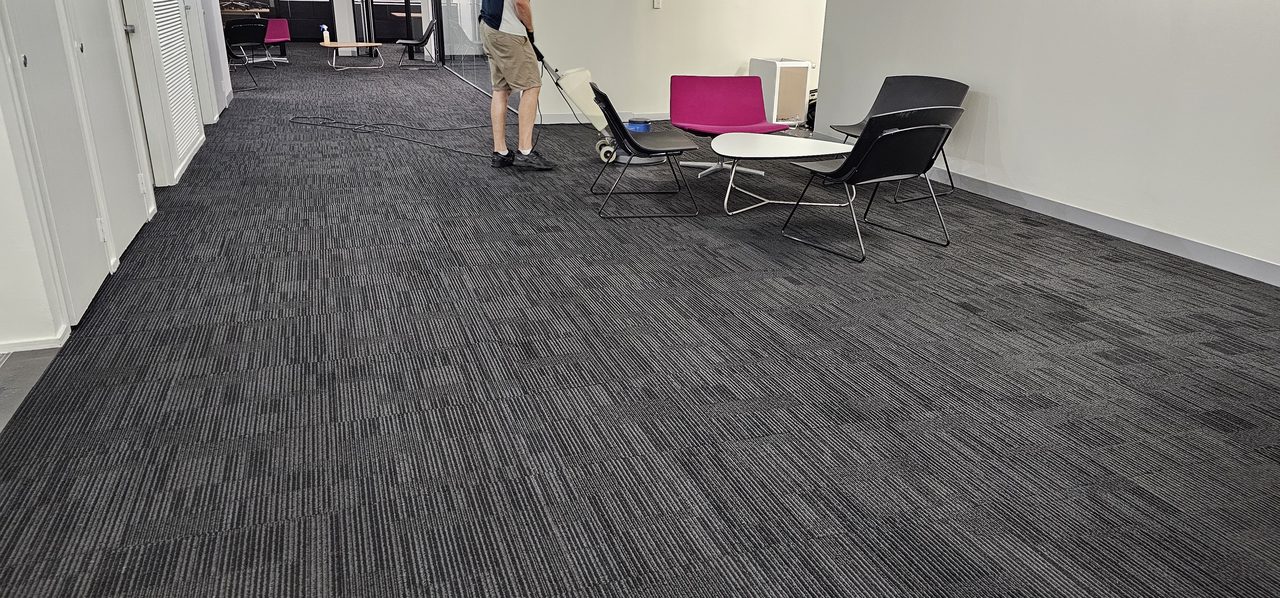
These are the most common office stains and among the most stubborn, because coffee and tea carry tannins that stain like a dye, along with milk, sugar and heat. Blot up as much liquid as possible with dry towelling first, pressing firmly and lifting straight up rather than dragging. Then apply cool water sparingly and keep blotting with a fresh section of cloth.
If a shadow remains, a mild solution of dishwashing liquid in cool water usually shifts the rest. Rinse by blotting with clean water afterwards, because leftover detergent attracts dirt and the spot reappears within days. Sugar in soft drinks does the same thing, which is why an untreated cola spill becomes a dark tacky patch that collects every bit of sand walked in from the car park.
A dried, oxidised coffee ring that has had a week of foot traffic over it is a different proposition. The tannin has had time to bond, and it usually needs professional spotting with the right agent and extraction.
Protein spills are where the temperature rule really matters. Milk, cream, yoghurt, egg, meat juices and blood all coagulate with heat, exactly as they do in a frying pan. Warm water cooks the protein into the fibre and locks in both the mark and the smell, so use cold water from start to finish.
For spilled milk, blot hard and often, then flush lightly with cold water and blot again. Milk that is not fully removed will sour within a day or two, and in a warm Perth office that smell arrives faster than most people expect.
Blood should be treated with cold water and a clean white cloth, changing to a fresh area constantly. Never use hot water or an ammonia-based glass cleaner as a shortcut. If a first aid incident has left more than a small mark, have it professionally sanitised and extracted.
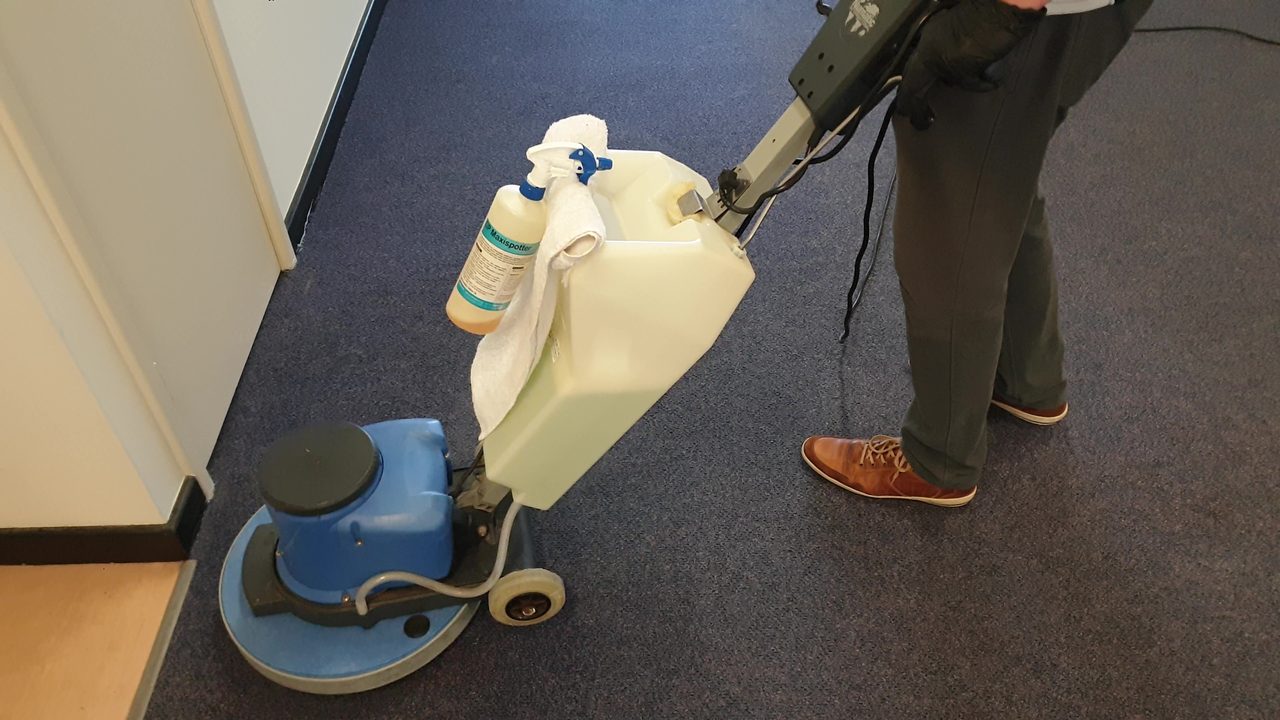
Function nights, staff farewells and client events are where red wine meets office carpet, usually late in the evening when nobody is thinking about the carpet. Red wine is a tannin and a dye at once, so speed matters more here than almost anywhere else. Blot immediately with dry towelling, working inwards, and keep going longer than feels necessary.
Diluting with a little cool water and blotting again is the safe move. Tipping white wine or soda water on the spot does no harm but very little good; it is the blotting, not the fizz, that does the work. Salt absorbs some liquid, but it leaves a gritty residue and can drive colour deeper if left overnight.
What you should not do is apply heat or a strong household cleaner. Both can set the dye and make the professional job significantly harder. Contain the area, keep chairs and feet off it, and have it looked at the next working morning.
Kitchen and breakout areas produce the widest mix of stains: sauces, dairy, oily takeaway, salad dressing and the grease walked out on shoe soles. Solid food should be lifted with the edge of a spoon or a blunt knife before any liquid is added, scooping inwards so nothing spreads into clean pile.
Greasy marks do not respond to water alone, because oil and water repel one another. A small amount of dishwashing liquid, which is formulated to cut grease, worked in gently with a cloth and then blotted out with clean water is the right first step. Take the solution to the cloth rather than the carpet, so you are not soaking the backing.
Oil is also why kitchenette doorways go dark faster than anywhere else on the floor. A thin film of cooking oil on the pile is sticky and captures grit permanently, so the mark that eventually appears is not one spill but many small ones, and it needs hot water extraction rather than spotting.
Ink from a leaking pen or a stray marker near the printer looks alarming but is often recoverable if you resist the urge to scrub. Dab, do not wipe, and keep turning the cloth to unused fabric so you are lifting ink rather than smearing it in a widening circle. Ballpoint ink is solvent based, so an alcohol-based product on a cloth can work, but test it first.
Permanent marker is usually just that. It is worth a careful attempt while it is fresh, but it is a dye stain and it may need a professional or, in a small area, a patch.
Toner is a different animal entirely. It is a fine plastic powder designed to fuse under heat, so nothing wet goes anywhere near it. Vacuum the loose powder gently, without pressing the head down, and do not brush it. Water applied to spilled toner turns a recoverable dusting into a bonded plastic mark.
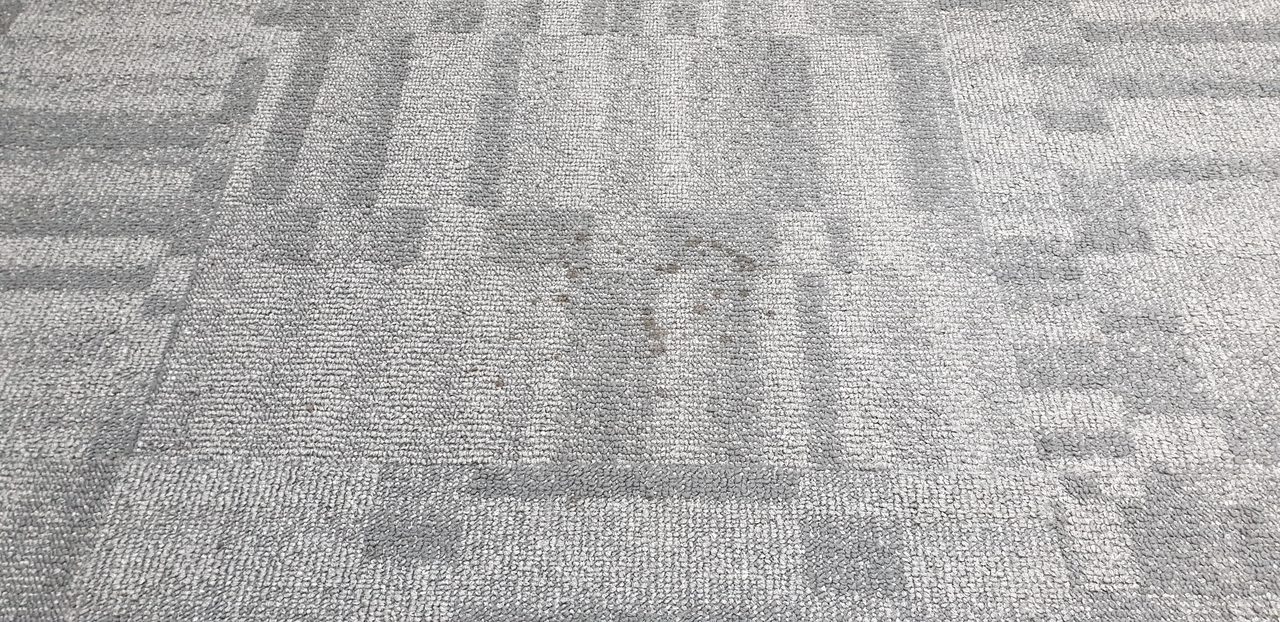
These three behave the same way. They are not liquids that soaked in, they are solids sitting on the fibre, and the answer is to make them brittle or let them harden rather than to wet them. Water and detergent are the wrong instinct with all of them.
For chewing gum, freeze it. An ice cube in a plastic bag held on the gum for a few minutes makes it brittle enough to shatter, and the pieces can be picked or gently scraped out with a blunt edge. Blu-tack responds to the same treatment, and the oily shadow it leaves can then be treated as a light grease mark. Correction fluid must dry fully before you touch it, because picking at it wet spreads a white film through the pile.
None of these should be attacked with a sharp blade. Cutting the yarn leaves a bald spot more visible than the mark you were trying to remove, and it cannot be reversed.
Office plants cause more carpet damage than most managers realise. A pot that seeps, or one watered generously on a Friday afternoon, leaves a slow, repeated wetting in the same spot. The water carries fertiliser salts and soil tannins with it and dries into a brown ring that sits in the backing rather than the pile.
The fix is to solve the pot before you clean the carpet. Put a waterproof saucer under every planter, lift the pot onto a stand so air can move under it, and shift it a few centimetres on cleaning day.
Rust has the same root cause: metal in contact with damp carpet. Filing cabinet feet, older chair legs, a bin base or scaffolding left over from a fitout will all mark the pile orange. Rust is a chemical stain and general-purpose cleaners will not touch it. It needs a rust-specific treatment rinsed thoroughly, and rust that has been in the fibre for months is often permanent.
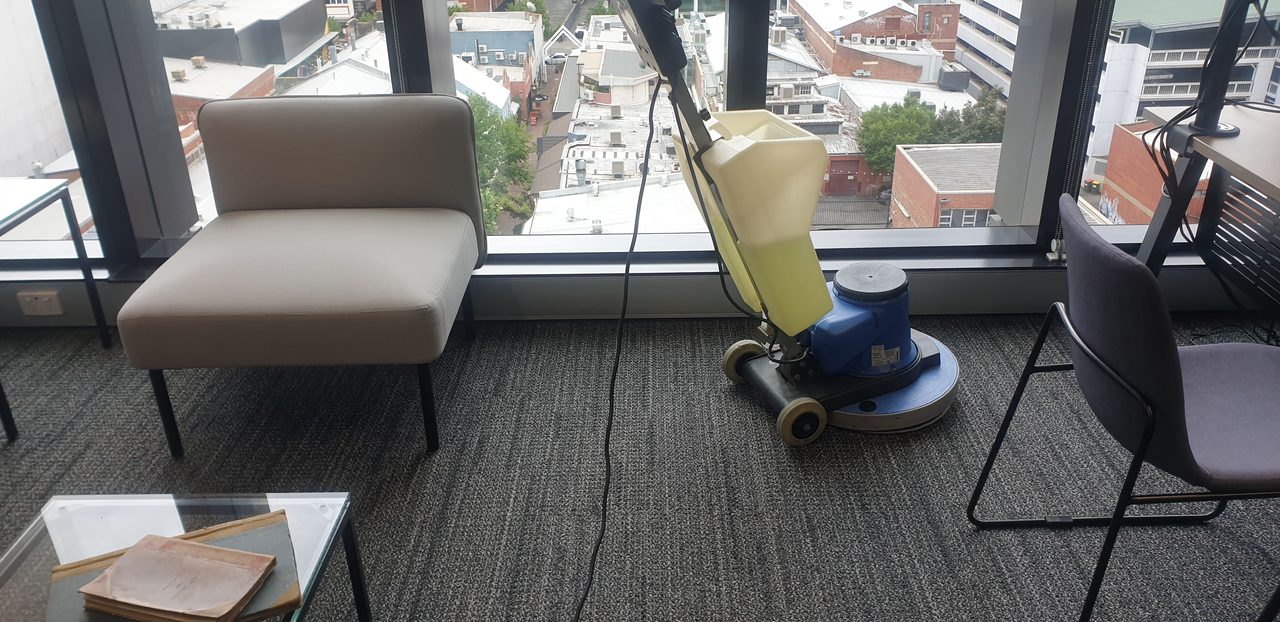
The same spill is not the same problem in every building, and the sensible response depends on what kind of floor you are running. In a professional office in West Perth the carpet is usually a mid-tone loop or a carpet tile, the spills are drinks and food carried from the kitchenette, and the real constraint is visibility. A mark in the reception lane is seen by every client who walks in, so speed there is about appearance as much as about the fibre.
The office side of a workshop or trade counter faces a different enemy. In the front office of a tyre business in Perth, for instance, the soil arriving on boots is grease, oil and fine workshop grime, none of which responds to water and none of which arrives as a single identifiable spill. Those floors are not a spotting problem at all. They need degreasing and hot water extraction on a schedule, because the mark that finally shows is the accumulation of months rather than the accident of one afternoon.
| Type of floor | What lands on it | Where the money belongs |
|---|---|---|
| Professional office | Drinks and food carried from the kitchenette | A spill kit and a fast response |
| Workshop or trade counter | Grease, oil and workshop grime off boots | Matting, degreasing and scheduled extraction |
| Public foyer | Food and drink in short concentrated bursts | A routine between sessions, deeper clean after hours |
| Weekly-use foyer | The same, on a weekly rather than nightly rhythm | The long quiet stretch gives the work room |
Most floors are clearly one or the other, and the ones in trouble are usually the ones being managed as though they were the other kind.
Public foyers sit at the other end again. A cinema foyer takes concentrated food and drink spills in short bursts and then has to look presentable for the next session, so the routine has to fit into the gaps between sessions with a deeper clean scheduled after hours. A hall or function room used once a week has the same shape of problem on a weekly rhythm, with a long quiet stretch between uses that makes drying time easy to find.
It is worth deciding which of these your floor is, because it tells you where the money belongs. A drinks-and-visitors floor is won with a spill kit and a fast response; a grease-and-grit floor is won with matting and a periodic extraction schedule, and no amount of spotting will save it.
One of the most common calls we get is from someone who removed a stain, went home pleased with themselves, and found it back in the morning. That is wicking, and it is less a failure of the cleaning than a failure of the drying.
When a spill goes right through to the backing, cleaning the surface only deals with what is on top. As the carpet dries, moisture travels upward through the fibre by capillary action and carries the remaining soil back to the tips, where the air is. The mark reappears in almost the same shape. Over-wetting during the attempted clean makes it worse, because more water means more travel.
The way to reduce it is to use as little liquid as possible, blot rather than pour, and dry the area quickly with airflow. Perth's dry summer air helps; a winter week of humidity and closed-up offices does not. If a mark keeps returning, the problem is deeper than the pile and it needs proper extraction.
A spill kit is not a big investment, and it works only if it is where the spills happen. One at reception, one by the kitchenette and one near the printer beats a well-stocked box in a locked cupboard on another floor.
The routine matters as much as the contents. Decide in advance who acts, what they are allowed to do, and when they escalate. In most offices the right rule is that anyone may blot with water, one or two nominated people may use the detergent solution, and anything older than a day goes straight to a phone call.
Add a simple log. A sheet where staff note the date, the location and what was spilled takes ten seconds. When the same three spots appear repeatedly, you have found where a bin should move or where a mat belongs.
Knowing when to stop is as valuable as knowing what to do. If a stain has been down for more than a day, covers a large area, sits in a high-visibility lane near reception or the lift lobby, or has already been treated with something that did not work, further DIY attempts usually make it harder for a technician to correct. Every extra product applied is another variable someone has to work around.
The reason a professional result differs is mostly rinsing and control. Truck-mounted hot water extraction flushes out the stain and the residue that would otherwise pull it back to the surface, which is exactly what a wicking spot needs. Encapsulation cleans lightly soiled carpet with very little water. Spotting agents are matched to the stain rather than used as one bottle for everything. On wool the margin narrows sharply, and there a bad product choice costs more than the stain ever did.
Most office carpet is replaced years before it needs to be, not because it wore out but because nobody dealt with the spills while they were still spills.
Take an honest look at the marks on your floor and sort them into three piles. The ones from this week are a training problem, solved by a kit and a rule about who is allowed to act. The ones in the traffic lanes are a scheduling problem, solved by extraction at sensible intervals. The handful that are dyed or bleached are neither, and the useful decision there is to stop spending time on them and plan a patch or a re-dye.
That sorting is the whole discipline. Most office carpet is replaced years before it needs to be, not because it wore out but because nobody dealt with the spills while they were still spills. Do it once a year, in the same week each time, and the list of permanent marks stops growing. That list is the true measure of a spotting routine.
Wool, nylon, olefin and polyester each need a different pH, temperature and agitation. How we identify your fibre on site, and why guessing ruins carpet.
Read ArticleA smell in your carpet is a source problem. Here is how to find what is causing it, treat it below the surface, and know when the underlay has to go.
Read ArticleMost Perth buildings run their entrance matting too short and pay for it in worn traffic lanes. How the three-zone system works and how to audit yours.
Read Article