
Hotels and Venues: Cleaning Carpet Around a Booking Calendar
How Perth hotels, function centres, clubs and churches schedule carpet cleaning around a full events diary, in the gap between one event and the next.
Read ArticleHow Perth retailers keep carpet presentable without closing: the night-fill window, dry-by-opening rules, centre coordination and cleaning before peaks.
In retail, the carpet is inspected by hundreds of strangers a day, every trading hour, by people deciding whether to hand you money. An office carpet is seen by the same fifty people until they stop seeing it. A shop floor is seen fresh, every few minutes, by someone forming a first impression, and the floor is the largest surface in the store and the one part of the fit-out every customer touches.
Retailers understand presentation better than any other sector. Money goes into lighting, joinery, window displays and visual merchandising, all of it arranged to say something deliberate about the brand. A soiled walkway from the door to the counter says something too. Customers notice it within seconds and judge the shop by it.
That is why retail carpet care is a different problem from office carpet care. The driver is appearance retention rather than hygiene, the audience is the public rather than staff, and the shop can almost never close to be cleaned. Everything in this guide follows from those three facts. If what you want is the work scoped for your own tenancy rather than explained, that sits on our retail carpet cleaning page instead.
A shopping centre concourse is polished hard floor: porcelain, terrazzo or stone, scrubbed nightly by the centre's contractors. Hard floor does not hold soil; it carries it. Grit, food-court residue and moisture sit on the surface until a shoe picks them up, and the first absorbent surface that shoe meets is usually the carpet inside your lease line. The first three metres of your floor work as an unpaid doormat for the entire centre.
The physics is simple. Carpet is a filter, and a good one: fibre strips soil off footwear within a few paces, which is exactly why the soiling in a tenancy concentrates in a band at the entry and a lane to the counter. Street-front shops take the same load with less processing. Sand off the footpath, red dust when the easterly has been blowing, and winter rain walked straight in off the street all arrive at your door with no concourse to slow them down.
Where your lease and the centre's fit-out rules allow it, entrance matting inside your own doorway intercepts a large share of this before it reaches the carpet; that subject deserves, and has, its own article. What matters here is recognising what actually arrives:
Soil in a shop does not spread evenly, and the places it concentrates are not the places a quote priced by the square metre pays attention to. A fashion tenancy of two hundred square metres can carry ninety per cent of its visible wear in perhaps twenty of them, and those twenty decide how the whole shop reads.
Fitting rooms are the extreme case. They are the smallest carpeted spaces in the store and take the most punishing use per square metre: shoes off and on, bare feet, dropped hangers and pins, make-up and fake tan transferring from skin and clothing, all inside a two-metre box with a queue outside it. The carpet in a busy fitting room can need attention at three or four times the frequency of the sales floor around it, and it is judged at closer range than any other floor in the building, by a customer standing on it in socks.
The counter is the other fixed point. Staff stand and pivot in the same half-circle for the whole trading day, which crushes and soils a crescent of carpet behind the counter, while customers waiting to pay wear a patch in front of it. Queue barriers and promotional tables then invent traffic lanes the carpet layout never planned for, and every re-merchandising moves them somewhere new.
Shop carpet rarely fails by being visibly dirty. It fails through a gradual, even dulling along the traffic lanes that no single day causes and no vacuum reverses. The mechanism is abrasion. Fine grit down near the backing works at the fibre surface under every footstep, and once a filament has been scuffed it stops returning light cleanly, so the lane reads darker and flatter than the carpet beside it whatever the actual soil level.
Staff do not see it happen, for the same reason nobody notices a child growing. Customers see it at once, because a fortnightly visitor compares the floor to a memory rather than to yesterday. A customer will not mention that the floor has gone grey; they simply recalibrate what they expect the shop to be worth.
A customer will not mention that the floor has gone grey; they simply recalibrate what they expect the shop to be worth.
The broader signs a carpet needs professional attention apply in retail as anywhere else, but the trigger point sits earlier. An office can carry a slightly tired lane for a quarter without consequence. A shop is charging a margin that its presentation has to justify, and the floor is part of that argument whether anybody meant it to be or not.
Retail has no dark days. What it has is the night-fill window: the hours between the doors locking and the doors opening, already shared with shelf-stackers, merchandisers, stocktake crews and, in a centre, the concourse scrubbers and the security patrol. In a Perth suburban centre that window might run from 5.30pm to 8.30am on an ordinary weeknight, and it shrinks to almost nothing in the late-trading weeks before Christmas.
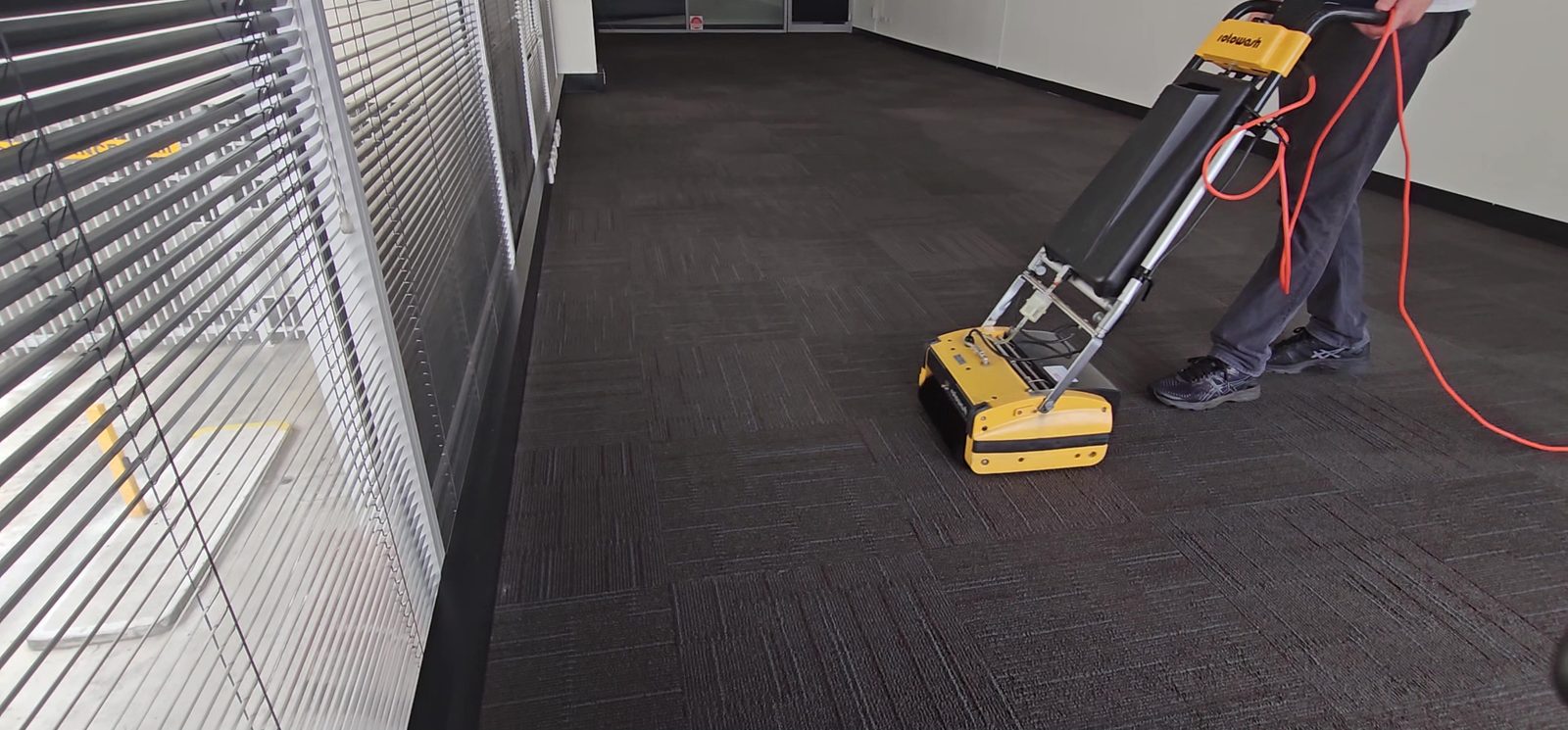
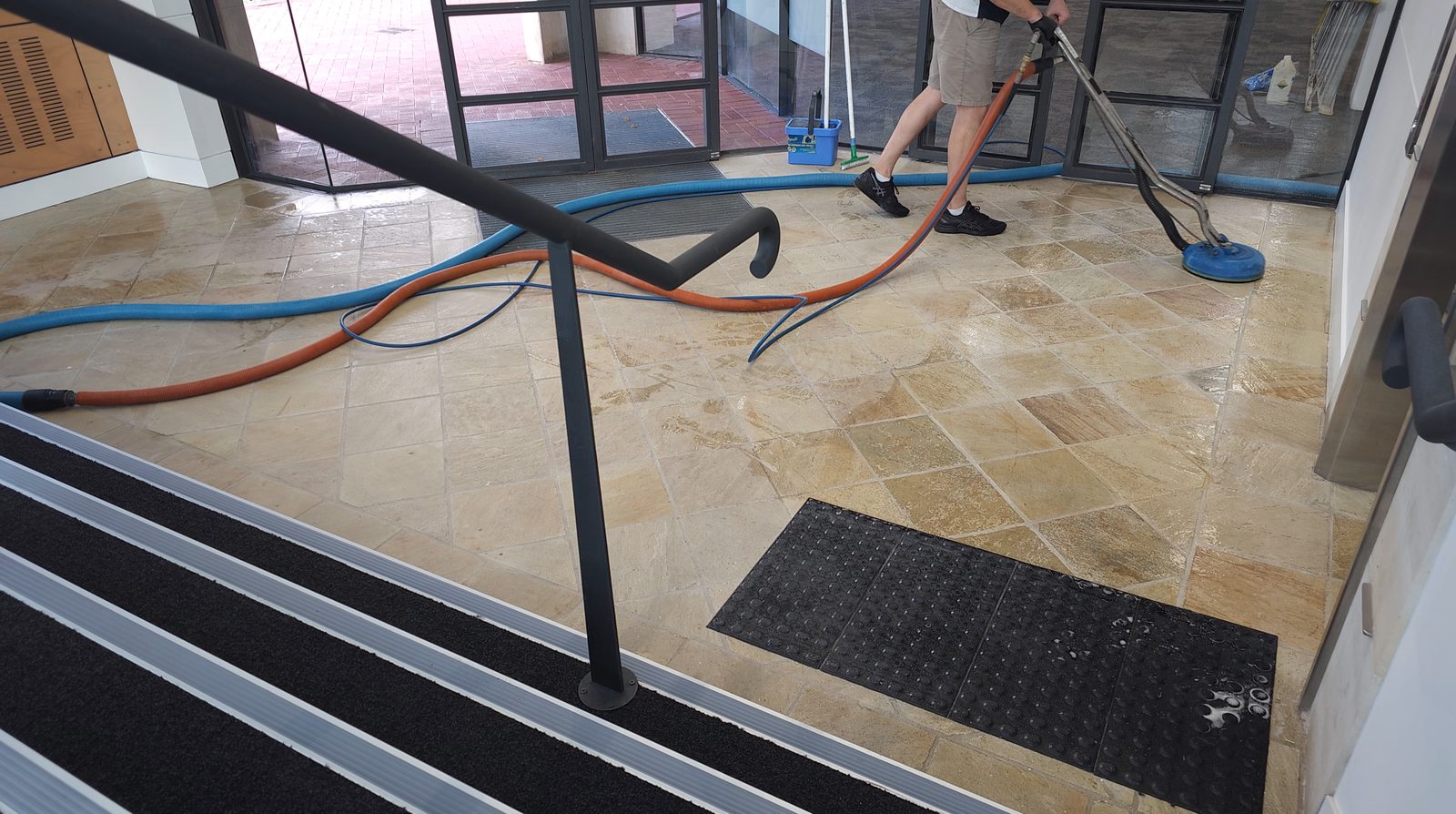
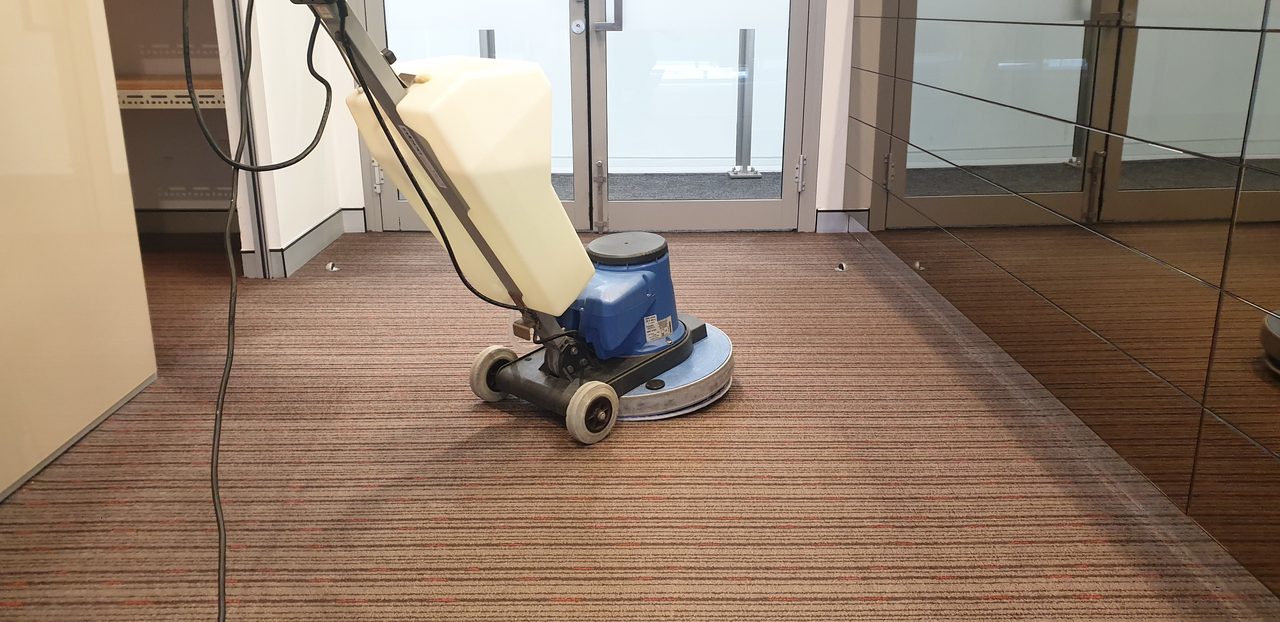
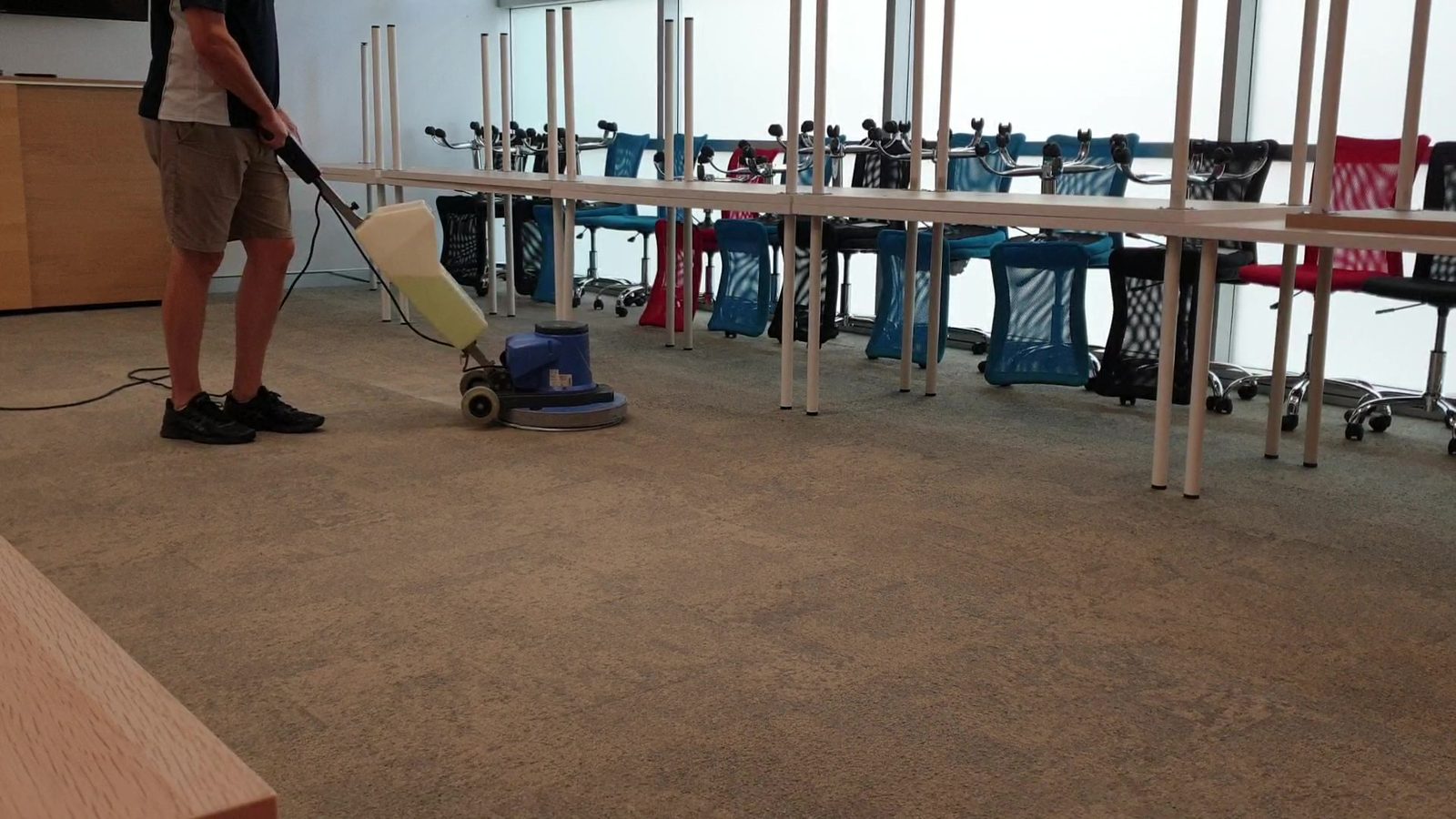
The soil sets the method, which we recommend at the site visit. Encapsulation suits lightly soiled carpet and uses very little water. The detergent bonds to the soil near the pile tips. The vacuum then removes it, so nothing is left in the fibre. The floor is walkable in an hour or two. The machine is quiet enough to run while a night-fill crew works two aisles over. Heavier soil and a spread of different stains call for hot water extraction, the deeper clean. With its 4 to 8 hours of drying, extraction is booked into the longest window the week offers, typically the night after early closing, when a 5pm finish buys sixteen hours before the next morning's open.
A before-trade clean in a tenancy runs to a rhythm that respects everyone else working in the building:
Arrive after close at the agreed time, sign in with centre security or use the tenancy keys, and confirm the night-fill schedule has not moved.
Racks and displays on castors slide aside; fixed joinery and loaded shelving stay put, and the plan works around them.
Thorough vacuuming first, then pre-treatment on the entry band, queue lanes and counter crescent where the soil concentrates.
Encapsulation or hot water extraction, whichever the site visit recommended, always working back towards the door.
Displays return to their marks, and the floor is checked dry before the keys go back or security signs the crew out.
The one outcome worse than a grey carpet is a customer on the ground. Damp carpet itself rarely causes a slip; the danger lives at the transitions, where a shoe that has picked up moisture from damp pile steps onto polished tile at the lease line and finds no grip. A shopping centre concourse is exactly that surface, which is why cleaning that leaves carpet damp into trading hours is not a service but an exposure.
The legal position is worth stating plainly, with the caveat that your lease, your public liability policy and the centre's rules are the documents that actually govern you, and they are worth reading. As a general rule an occupier owes a duty of care to people entering the premises, incident reports in managed centres name the tenancy involved, and a wet-floor sign in the middle of a fashion floor at ten in the morning is both an admission and an eyesore. Insurers ask what systems were in place, and 'the carpet was still wet from last night's clean' is not an answer anyone enjoys giving.
The protection is to make dry-by-opening a term of the job rather than a hope. That means working the start time back from the opening hour, understanding how quickly commercial carpet dries under real conditions rather than brochure conditions, running air movement whenever extraction is used, and having the honesty to postpone a deep clean when the window is too short. A four-hour winter window is too short for a full extraction, so we tell you before the job is booked.
In a managed centre, two cleaning regimes meet at your shopfront. Centre management's contractors clean the concourse, the food court and the amenities on the centre's schedule and the centre's budget. Everything inside the lease line — your carpet, your fitting rooms, your back-of-house — is yours to maintain, usually under a lease clause requiring you to keep it to a stated standard. The concourse being spotless does not make your entry band anyone's problem but yours.
The practical consequence is coordination. After-hours work in a centre runs through centre management: contractor inductions, certificates of currency lodged before anyone sets foot inside, loading dock bookings for the truck-mount, security sign-in and escort protocols, and agreed hours so a vacuum head is not running beside a tenancy where a fit-out crew is working. We lodge the paperwork before the night, so no part of a short window is lost at the security desk.
The two regimes also interact underfoot. The concourse scrubbers finish shortly before opening, and their water recovery is never perfect, so the first hundred customers walk a faint film of scrubber water and dissolved soil straight onto your entry carpet. It is one more reason the entry band usually needs cleaning more often than anything else inside the lease line, whatever standard the centre keeps its own floor to.
Outside the centres, retail carpet lives a different life. A boutique on a Leederville or Fremantle strip, or a tenancy in the Perth CBD malls, has no concourse buffer and no centre contractor cleaning the approach. The footpath is the council's, the weather is nobody's, and whatever the day brings walks straight in: winter rain off Hay Street, coastal sand, jacaranda litter in November, red dust when the easterly has carried it across the metro area.
Access, on the other hand, is simpler. There is no dock to book and no induction to sit through; the owner's keys and an alarm code replace the security desk. The window is whatever the retailer says it is, which makes street-front shops some of the most flexible before-trade work in Perth, so a strip retailer can book a mid-week clean at an hour a centre tenancy cannot.
| Centre tenancy | Street-front shop | |
|---|---|---|
| Soil source | Concourse grit, food-court oils, trolley wheels | Footpath sand, rain and dust straight off the street |
| Who controls the approach | Centre management and its contractors | Nobody; the weather and the council |
| Access for cleaning | Induction, dock booking, security sign-in | The owner's keys and an alarm code |
| Best window | The longest night after early closing | Any time the retailer chooses |
Two retail worlds, one requirement: dry and presentable by the first customer.
The method mix barely changes between the two worlds. Encapsulation for lightly soiled carpet, hot water extraction for heavier soil and many stains, with the entry band and the counter checked first. What changes is the logistics, and in retail, logistics is most of the job.
The retail year has two summits, and the carpet should meet both of them at its best. Christmas trade concentrates a remarkable share of the year's footfall into six weeks, and those are precisely the weeks when presentation is doing the most selling. A clean in early November means the floor meets the rush freshly cleaned. If the entry band starts to tire, it can be cleaned again in the shortened late-trading windows.
Cleaning in January instead is repair rather than preparation. The floor greets peak trade already tired, degrades through the busiest weeks under the heaviest traffic of the year, and by Boxing Day carries ground-in soil that has been walked over for a month and become measurably harder to remove. The same logic applies to the EOFY sales in June, which arrive together with the winter rain: a refresh in May puts the best face on the sale, and the wet-weather soil is dealt with in the July lull that follows.
The quiet weeks are the other half of the calendar. Late January and February after the sales wind down, and the mid-winter trough, are when the longest windows and the easiest bookings exist, and they are the natural home for the heavy extraction work. How many of these cleans you book is your choice. At the site visit we recommend the ones your floor needs. Book a November night early, because every retailer in the metro area wants the same fortnight.
Spills in a shop happen in front of an audience, during trade, and the response has to work around customers. The retail repertoire is distinctive: chewing gum walked in off the concourse, make-up and fake tan around fitting rooms and beauty counters, sunscreen in summer, and food-court coffee that turns out not to have been lidded after all. Each is manageable when treated correctly and stubborn when improvised on.
The first two minutes belong to whoever is standing there, and in a shop that person is usually serving somebody. So the retail version of the drill is deliberately short: get the liquid up with clean white paper before it travels, park a stand or a dump bin over the spot so three hundred more shoes do not walk through it, and write down where it is. That last step sounds trivial and is not, because a mark that is obvious under trading lights at two in the afternoon is genuinely hard to find at seven the next morning under half the lighting. What has to be forbidden outright is somebody fetching a spray from the cleaning aisle three bays over, since the residue those leave behind collects soil and comes back as a grey shadow inside a fortnight.
Gum deserves its own rule. The professional method is to freeze it or treat it with a solvent and lift it in pieces; scraping at it warm smears it deeper into the pile. For everything else, a standing arrangement beats a string of emergencies: staff log marks as they happen, and the technician clears the week's list in one before-trade visit while the marks are still young and easy.
Most retail cleaning arrangements fail on vagueness: a quote by the square metre, a frequency picked from habit, and nothing in writing about the two things that actually matter, which are the window and the dry-by time. A specification that works is short and concrete, and it reads like a trading document rather than a cleaning one.
It names the zones and gives them separate frequencies — the entry band, queue lanes and fitting rooms on a short cycle, the wider sales floor on a longer one, back-of-house on a longer one still. It states the window for routine work and the long windows kept for nights when hot water extraction is recommended. It sets dry-by-opening as a condition rather than an aspiration, and it includes the spot-response arrangement so mid-trade marks have a standing answer instead of a fresh negotiation.
It also names the practical requirements a centre will enforce anyway, and they are worth knowing before you go looking for a contractor: current public liability cover lodged with centre management, a completed induction for that particular centre, a dock booking if a truck-mounted machine is coming, and, for after-hours access to a tenancy full of stock, evidence that whoever holds the keys has been screened. None of it is optional and none of it can be arranged on the night. Our commercial carpet cleaning service is built around exactly this kind of specification.
One last observation, from a good many shop floors at five in the morning. The retailers whose carpet still reads well in year six are rarely the ones spending most on cleaning. They are the ones who worked out early which two or three metres of their floor actually do the selling, then defended those metres with proper matting, a tight interval and a spill rule the staff genuinely follow. The rest of the shop then looks after itself on a fraction of the attention.
How Perth hotels, function centres, clubs and churches schedule carpet cleaning around a full events diary, in the gap between one event and the next.
Read ArticleHow encapsulation polymers trap soil, why the vacuum finishes the job, what each machine does, and where low-moisture cleaning fits a Perth office.
Read ArticleMost Perth buildings run their entrance matting too short and pay for it in worn traffic lanes. How the three-zone system works and how to audit yours.
Read Article