
Wool, Nylon and Olefin: Why Fibre Changes the Whole Clean
Wool, nylon, olefin and polyester each need a different pH, temperature and agitation. How we identify your fibre on site, and why guessing ruins carpet.
Read ArticleA straight answer on carpet protection treatments, what the chemistry does on the fibre, what it never does and the Perth floors where it is worth having.
Whether a carpet protection treatment is worth paying for is a fair question. It usually comes up when new carpet is being chosen or after a spill has set into pale carpet. Plenty of facility managers are sceptical of it. That instinct deserves a better response than a sales pitch, because protection treatments are neither a scam nor a miracle. They are a modest piece of surface chemistry with one specific job.
This article is the measured version. Protectors do work, in the narrow sense that they change how liquids and dry soil behave on the fibre, and that change is worth real money on some floors. They are also oversold often enough that scepticism is entirely fair. The difference between a good buy and a wasted line on the invoice comes down almost entirely to which floor you are standing on, and that is what the rest of this piece works through.
A carpet protection treatment is a surface finish, most commonly based on a fluoropolymer, applied as a fine spray after cleaning and left to dry around each fibre. A fluoropolymer is a molecule from the same broad chemical family as non-stick cookware coatings, engineered to produce surfaces that other substances do not want to cling to. On carpet it forms a film so thin it cannot be seen or felt; a treated floor looks and behaves like carpet, not like a laminated surface.
What the treatment changes is the surface energy of the fibre, which is a measure of how eagerly a surface grabs whatever touches it. High-energy surfaces pull liquids flat and let soil key in; low-energy surfaces shrug both off. A protector drops the fibre's surface energy low enough that water, coffee and most oils would rather hold their own shape than spread into the pile, and dry soil rests against the fibre without bonding to it firmly.
How much difference that makes depends on the fibre underneath. Nylon is moderately absorbent and takes food and drink dyes readily, so it has the most to gain. Olefin barely absorbs water at all but attracts oil, and wool absorbs nearly everything and is expensive to get wrong. The full story of how fibre changes the clean is a subject of its own; for this article it is enough to know that a protector adds the most where the fibre is naturally the most vulnerable.
Every liquid holds itself together with surface tension, the same property that lets a water droplet sit proud on a freshly waxed car bonnet. Whether a spill soaks into carpet is a contest between that tension and the pull of the fibre. Untreated fibre wins easily: it draws the liquid flat, wicks it down the tuft and delivers it to the backing within seconds. Treated fibre loses the contest, so the spill beads and sits in the upper pile instead.
The practical value of that beading is measured in minutes. A coffee knocked over in a boardroom at ten in the morning will, on protected carpet, stay substantially on the surface long enough for someone to fetch paper towel and blot it. Most of the liquid comes away before it reaches the dye sites in the fibre, and what looked like a permanent event finishes as a damp patch. The blotting technique that turns it into a nil event is in our guide to common office stains.
The quieter benefit is what happens to dry soil, which is most of what a commercial carpet actually collects. Grit, dust and lint rest against a low-energy fibre without gripping it, so a higher fraction leaves with each pass of the vacuum instead of grinding down into the pile. Industry testing has long shown that treated carpet releases dry soil more readily, and over a year that improvement in vacuum yield does more for appearance than the occasional rescued coffee.
It is worth being blunt about the limits, because the disappointments people report almost always trace back to a promise the chemistry never made. A protector does not make carpet stainproof. Strong dyes, hot liquids and anything genuinely corrosive will beat it. Bleach does not stain carpet at all; it strips the colour out, and no surface film prevents that. Turmeric, cordial and red wine, given enough time, will find their way to the fibre regardless of what was sprayed on it.
Nor is a protector a repair. It cannot fix marks that are already in the carpet, and it cannot stop a spill that reached the backing before treatment from travelling back up the fibre as the carpet dries, which is the mechanism behind why stains come back after an apparently successful clean. And it is emphatically not a substitute for cleaning: treated carpet soils at very nearly the same rate, it simply releases that soil more willingly when the cleaning happens.
New commercial carpet almost always arrives protected, and the factory version is the best treatment the carpet will ever wear. It is applied at the mill as part of finishing, distributed with industrial evenness and cured with heat, which bonds it to the fibre far more durably than anything applied on site can manage. For the first stretch of a carpet's life, paying to add more protection achieves very little.
On nylon, the factory actually applies two different things, and the distinction matters when you are deciding what reapplication buys. The first is a stain resist, an acid-dye blocker that fills the empty dye sites in the fibre so food and drink colourants cannot occupy them. The second is the fluoropolymer soil and water repellent on the outside of the fibre. Reapplication restores only the second. The dye blocker lasts longer but degrades with hot water and harsh alkaline chemistry, and no aftermarket spray fully rebuilds it.
| Factory treatment | Reapplied treatment | |
|---|---|---|
| Applied | At the mill, during finishing | On site, after a professional clean |
| Cured | Heat-set for maximum bond | Air-dried in the pile |
| What it includes | Dye blocker plus surface repellent (on nylon) | Surface repellent only |
| How long it lasts | Years, depending on traffic | As a rule of thumb, roughly a year in working lanes |
Reapplication tops up the surface repellent; it does not rebuild everything the mill put on.
None of this makes reapplication pointless; it makes it a top-up rather than a restoration. The sensible pattern is to leave a new floor alone while the factory treatment is doing its work, then begin reapplying once spills start behaving differently, which on a busy floor is typically somewhere in the second or third year.
Because the treatment lives on the outside of the fibre, everything that touches the fibre wears it away. Shoe soles flex the pile and scrub the tips, chair castors grind the same few square metres all day, and the grit a building tracks in, in Perth a blend of coastal sand and the red dust that arrives on a summer easterly, works between the tufts like a fine abrasive. No surface film survives that indefinitely.
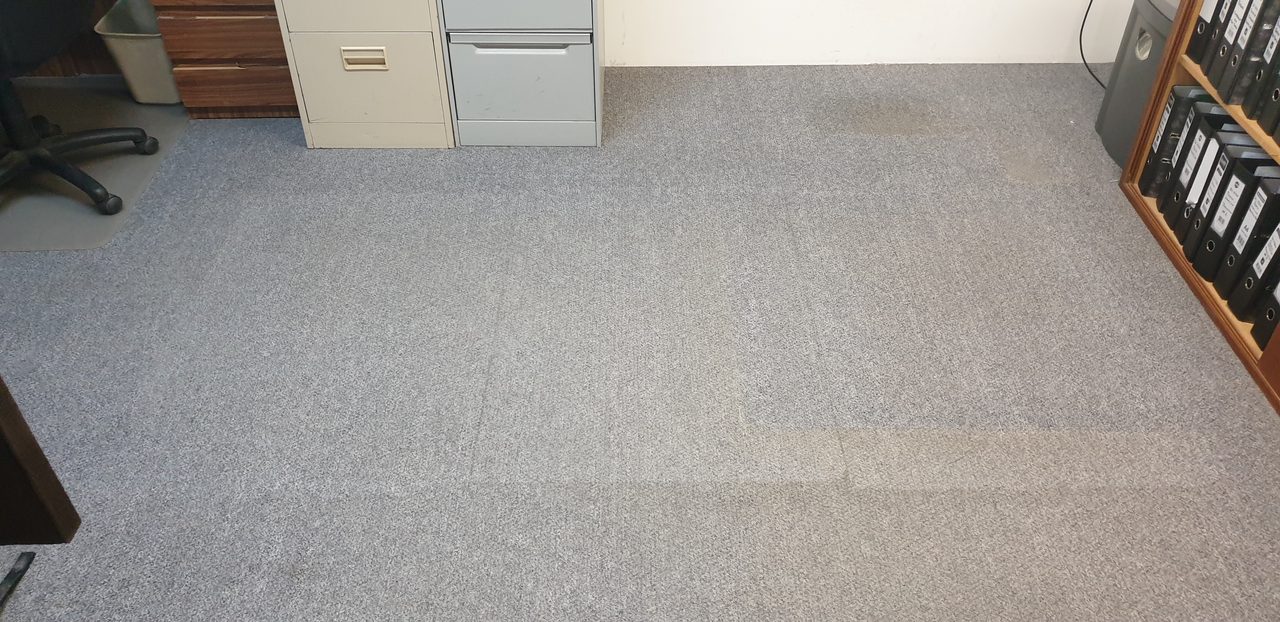
The consequence is awkward: protection fails first precisely where the risk is highest. The entrance lanes, the corridor pinch points and the run between the lift and the kitchen lose their treatment within months, while the carpet under the visitor chairs keeps its factory finish for a decade. Testing the quiet corner of a floor and concluding that the protector is fine is therefore a classic mistake.
Protection wears off first exactly where you need it most, which is the whole argument for reapplying it by zone rather than by floor.
Cleaning chemistry wears it too. Aggressively alkaline presprays and high-pH degreasers strip fluoropolymer along with the soil, which is one reason a careful commercial cleaner works at moderate pH on protected and wool carpet. On wool we use WoolSafe-approved products and finish with a low-pH rinse, which looks after the fibre and its dyes.
Where the treatment earns its money is any floor where liquids and light colours meet. Dining areas and staff cafés are the obvious case: coffee, wine and food service produce spill events daily, and every one intercepted at the beading stage is a stain that never enters the ledger. Function rooms and hotel dining floors, where accidents happen on someone else's schedule and are reported late, sit in the same category.
Boardrooms make the list for a different reason. Catering meets pale carpet in the one room the business shows to outsiders, and the cost of a visible coffee stain there is reputational rather than financial. Light-coloured carpet anywhere amplifies the case, since a mark that would vanish into a dark heather grey reads as neglect on cream. Wool deserves the treatment almost regardless of colour, because the fibre is absorbent, the carpet is expensive and remediation on wool is delicate work. On wool the product has to be one approved for the fibre, because the wrong protector there is a more expensive mistake than no protector at all.
The pattern across all of these is high visibility and moderate traffic. A protector gives its longest service where feet are not scouring it off daily but a single stain would be noticed by everyone who walks in.
The clearest case against is carpet approaching the end of its life. If replacement is budgeted within a year or two, or a lease is winding down towards its make-good, money spent protecting the pile is money spent polishing an asset already scheduled for the skip. Spend it on keeping the floor presentable instead.
Dark, heavily patterned contract carpet in solution-dyed synthetic fibre is the second poor candidate. That carpet was engineered to hide and resist marks: the colour runs through the fibre rather than sitting in dye sites, and the pattern camouflages most of what lands on it. A protector still changes the surface chemistry, but you are paying to insure against a risk the carpet was already built to absorb.
The third is any heavily scoured traffic lane, and the logic is simply the wear problem again. A treatment abraded off in six or eight weeks cannot return its cost, and the same money buys more appearance as additional entrance matting or an increase in vacuuming frequency. Finally, never pay to protect a visibly soiled carpet. Applied over dirt, the treatment bonds to the dirt and holds it in the pile. Cleaning comes first, always.
Application quality decides more of the outcome than brand names do, and the first rule is absolute: the carpet must be freshly and properly cleaned. A protector bonds to whatever surface it lands on. On clean fibre, that is the fibre; on soil or detergent residue, the treatment attaches to the contamination and leaves with it at the next clean. This is why a protection treatment only ever belongs on carpet that has just been cleaned.
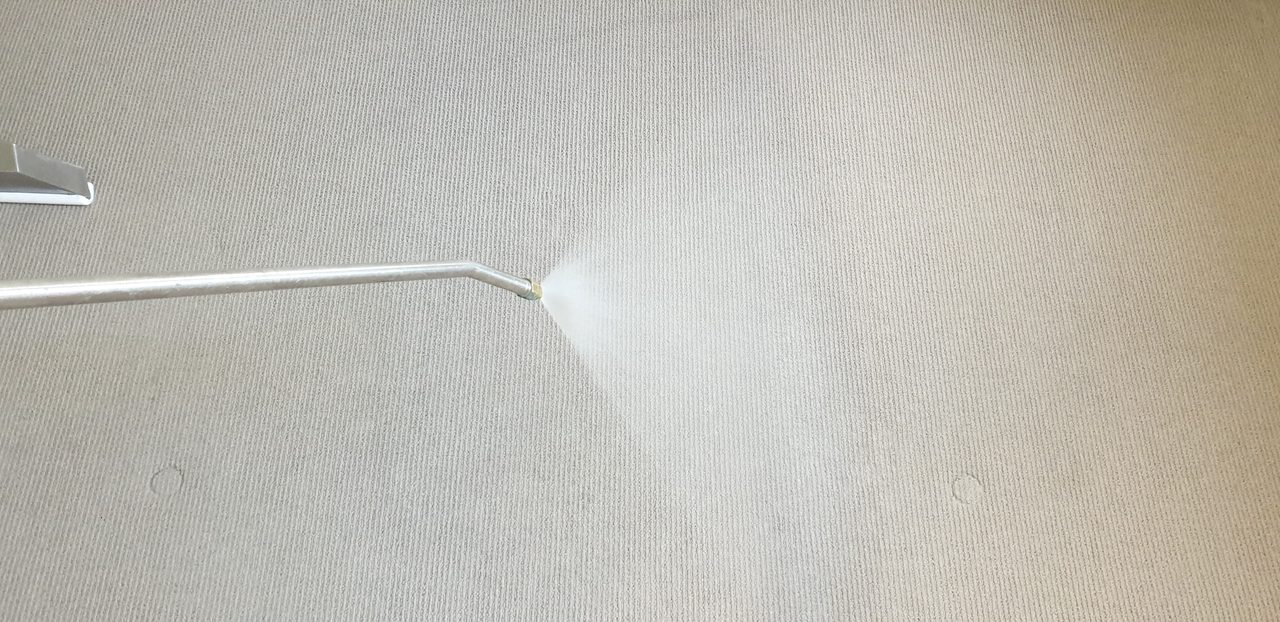
Coverage is the second decider. The product has a labelled application rate per square metre, and both directions of error cost you: too little leaves dry gaps that later stain in streaks, too much wastes product and can leave the pile feeling harsh underfoot. A good application uses even, overlapping passes from a calibrated sprayer, with a second set of passes at right angles to the first so the treatment reaches the sides of each tuft and not just the tips.
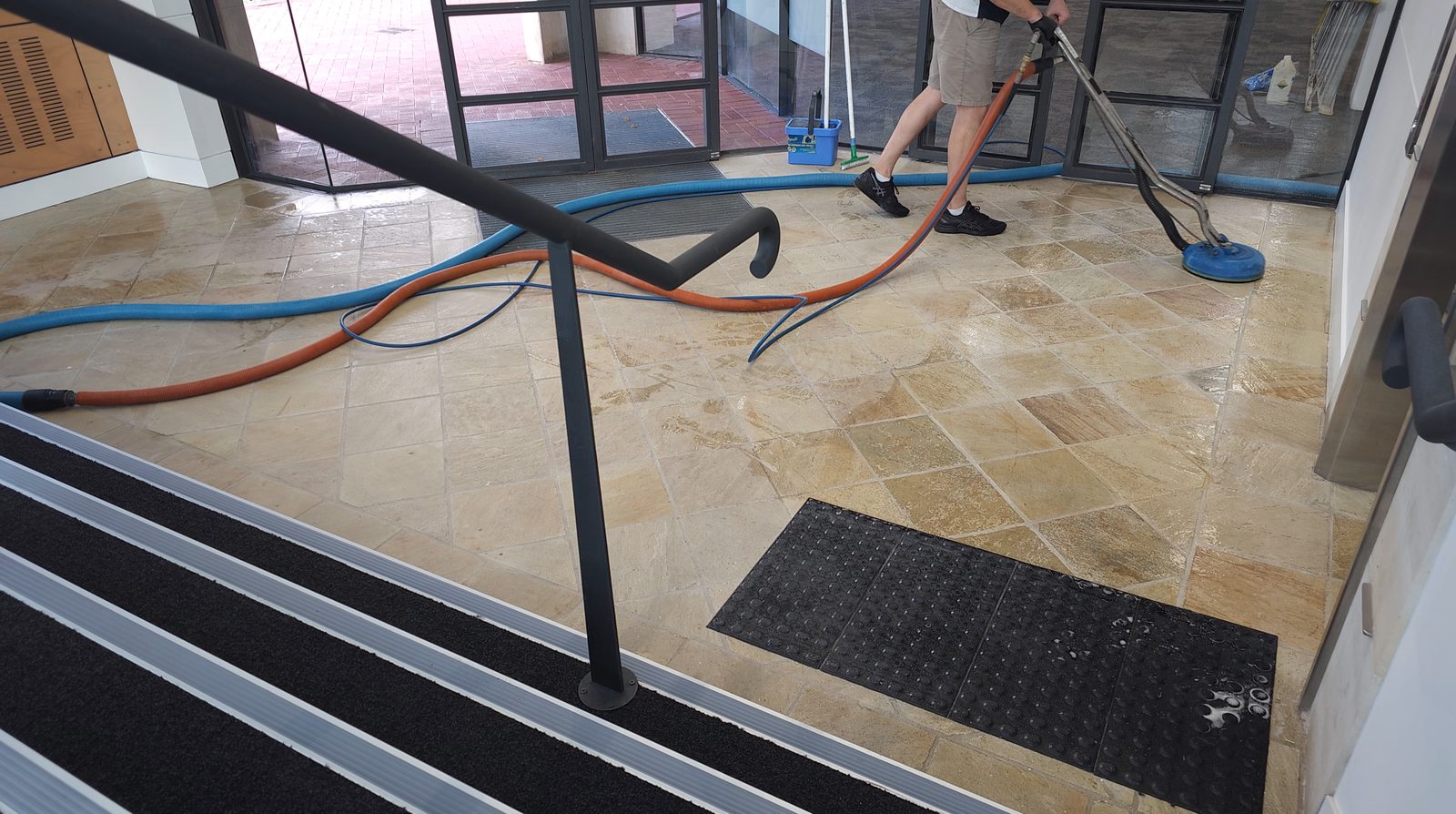
Hot water extraction removes soil and detergent residue so the treatment can bond to bare fibre.
Even, overlapping spray passes from a calibrated sprayer, not a guess from a pump bottle.
Passes crossed at right angles carry the product down the sides of the tuft, not just the tips.
Foot traffic before the treatment cures grinds it off before it has done a day's work.
From here the treatment increases the vacuum's yield; it never replaces it.
Drying is the last detail. The treatment cures as it dries and should not carry traffic until it has, which in a Perth February with the air conditioning running is quick work, and in a closed building on a wet June evening is not. An application done after hours, with the floor left undisturbed overnight, suits most workplaces.
The test for a live protector could not be simpler. Put a few drops of tap water on the carpet in a traffic lane and watch for a minute. On a working treatment the drops bead and sit; on a dead one they darken the fibre and disappear within seconds. Repeat the test in a corner under furniture and you will usually see the difference between the protection the lane has lost and the protection the quiet zone still holds.
Behaviour between tests tells the same story. When spills that used to blot out cleanly begin leaving faint marks and the traffic areas soil noticeably faster between cleans, the treatment has gone from the places it was bought for. The corners can still bead while the walkways have lost it.
As a rule of thumb, protection is worth reapplying roughly once a year on dining rooms and busy client-facing floors and less often in quieter areas. The zones in the money-wasted list above never justify it. If a mark has already beaten the treatment, reapplication is not the fix; our stain removal service deals with what is already in the fibre.
A protection treatment pays back only in certain areas, so the sensible way to buy it is for those areas and not the whole floor. Treating the boardroom, the dining area and a light-coloured reception while leaving the storage corridors alone keeps the cost in line with the benefit. The clean itself comes first in the budget. Our pricing guide explains how we price it.
It also belongs in the right place in the queue. Entrance matting, disciplined vacuuming and a sensible cleaning schedule all return more per dollar, because they control how much soil enters the building and how long it stays. A protector is a multiplier on those habits rather than a replacement for them: it makes the vacuum yield more, the spills forgive more and the cleans last longer, and it does none of that on a floor where the basics are missing.
For any floor the deciding questions are the same. What is the fibre, how pale is the colour, how heavy is the traffic, how often do spills happen and how long does the carpet have left? Get in touch and we will look at your carpet on a free site visit, recommend the clean it needs and give you a written quote, GST inclusive.
Wool, nylon, olefin and polyester each need a different pH, temperature and agitation. How we identify your fibre on site, and why guessing ruins carpet.
Read ArticleA practical guide to office carpet stains for Perth facility managers, with first aid for every spill, the right fix for each stain and when to call us.
Read ArticleMost Perth buildings run their entrance matting too short and pay for it in worn traffic lanes. How the three-zone system works and how to audit yours.
Read Article